
If your insurance stopped covering your GLP-1, you’re probably wondering what you’re supposed to do next.
Maybe you’re losing weight. Maybe your appetite finally feels manageable. Maybe your blood sugar or other health markers are improving.
Then you try to refill your prescription and get the message nobody wants to see:
Your insurance isn’t covering it anymore.
Now what?
Before you panic—or start searching online for the cheapest GLP-1 you can find—there’s something important to understand:
“Not covered” doesn’t always mean “you’re out of options.”
Sometimes the medication was removed from your plan. Sometimes the rules changed. Sometimes a prior authorization expired. Sometimes your insurer wants additional documentation. And sometimes the answer really is that your plan no longer covers the drug for your situation.
Those are very different problems.
And they require very different next steps.
Article at a Glance
- If your insurance stopped covering your GLP-1, find out the exact reason before deciding what to do next.
- Ask whether you’re dealing with a formulary change, prior authorization problem, step-therapy requirement, benefit exclusion, or another coverage rule.
- Get the denial or coverage decision in writing and keep notes from every phone call.
- Depending on the reason for the denial and your plan, you may have the right to appeal and potentially request an independent external review.
- Don’t assume compounded semaglutide or tirzepatide is simply a “generic GLP-1.” Compounded drugs are not FDA-approved, and the rules surrounding GLP-1 compounding changed substantially after the shortages ended.
- If you have Medicare Part D, don’t rely on old information. A new Medicare GLP-1 Bridge began July 1, 2026, for certain eligible beneficiaries.
Quick Answer: What Should You Do If Insurance Stops Covering Your GLP-1?
Start by finding out exactly why coverage stopped.
Call the number on your insurance card and ask for the specific coverage rule or denial reason. Then ask what would have to happen for the decision to change.
If it’s a prior authorization or medical-necessity issue, your doctor may be able to provide additional documentation or help with an appeal. If the medication is excluded from your plan altogether, an appeal may be more difficult and you may need to discuss covered alternatives or legitimate self-pay options.
Whatever you do, don’t change your dose, switch medications, or stop treatment based solely on something you read online. Talk with the clinician prescribing your medication.
Your Insurance Dropped Your GLP-1. Do This First.
Here’s the mistake I’d try hardest to avoid:
Don’t immediately start shopping for another medication.
First, figure out what happened.
Your insurer is required to explain why it denied a claim or ended coverage in situations covered by federal appeal protections, and the denial information should tell you how to challenge the decision.
Call member services and have your insurance card, prescription information, and denial letter or Explanation of Benefits in front of you.
Then start asking questions.
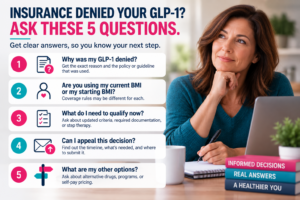
Five Questions I’d Ask the Insurance Company
- Why exactly is this medication no longer being covered for me?
- Is the drug excluded from my plan, or does it require prior authorization, step therapy, or different documentation?
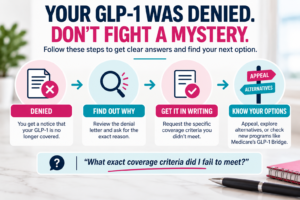
- What exact coverage criteria did I fail to meet, and what documentation would change this decision?
- What GLP-1 or weight-management medications are preferred or covered under my current plan?
- Can I appeal this decision, and where are the instructions and deadline for doing that?
And if you’ve already lost substantial weight while taking the medication, I’d add one more:
“Are you evaluating my eligibility based on my BMI today, or my BMI when I started treatment?”
Don’t assume that question will change the answer. Different plans have different rules.
But it’s absolutely worth asking.
We’ll come back to why.
Why Did My GLP-1 Coverage Suddenly Change?
There isn’t one universal reason.
Your situation might involve a formulary change, an employer changing benefits, a prior authorization expiring, new clinical criteria, step therapy, a different preferred drug, or a plan that excludes medications used for weight management.
That’s why two people taking the same medication can get completely different answers from their insurance companies.
One might need a new prior authorization.
Another might need to switch to a preferred medication.
A third might discover that weight-management medications simply aren’t included in their plan.
Don’t fight a mystery. Find out what you’re actually fighting first.
Truth or Hype?
“If Insurance Denied My GLP-1, There’s Nothing I Can Do.”
HYPE.
A denial isn’t necessarily the end of the process.
HealthCare.gov explains that consumers covered by applicable protections can request an internal appeal, meaning the insurer reviews its decision again. Certain denials can then go to an external review, where an independent third party—not the insurance company—reviews the decision.
That doesn’t mean every GLP-1 denial will be overturned.
And it doesn’t mean an appeal can force a plan to cover a benefit the plan doesn’t actually provide.
But there’s a big difference between:
“My plan excludes this benefit.”
and
“My insurer says I didn’t meet the medical criteria for this covered benefit.”
That’s exactly why you want the reason in writing.
How Does a GLP-1 Insurance Appeal Work?
For health plans subject to the federal appeals rules described by HealthCare.gov, you generally have 180 days from receiving the denial notice to file an internal appeal. You can include additional information for the insurer to consider, including information from your doctor.
Your exact process depends on your plan, so follow the instructions in your denial notice.
But here’s the basic idea:
Get the denial. Read the reason. Gather the evidence. File the appeal. Keep copies of everything.
HealthCare.gov specifically recommends keeping your denial documents, appeal materials, information from your doctor, and notes from phone conversations—including dates, names and what was discussed.
That paper trail may become important later.
How Your Doctor May Be Able to Help
This is where your doctor’s office can matter.
If the insurer says you didn’t meet its coverage criteria, ask what documentation it’s looking for.
Depending on your situation, relevant records might include your diagnosis, weight or BMI history, previous treatments, laboratory results, other health conditions, or documentation showing how you’ve responded to treatment.
But don’t tell your doctor what diagnosis to use just to get the medication covered.
The medical record should tell the truth.
The goal isn’t to find a clever code that gets around the insurance company.
The goal is to make sure the insurer has the complete and accurate information it needs to evaluate your case.
That’s a very different thing.
What If the First Appeal Is Denied?
Read the denial again.
If your situation qualifies, you may be able to request an external review.
HealthCare.gov says an external review is conducted by an independent third party. For applicable cases, the request generally must be filed within four months after receiving the insurer’s final denial, and the insurer must accept the external reviewer’s decision.
There are also expedited procedures for qualifying urgent medical situations.
The important point isn’t that you should automatically appeal everything until somebody gives in.
It’s this:
Understand the reason for the denial before deciding whether an appeal makes sense.
What If They Say You No Longer Qualify Because You Lost Weight?
Now we get to one of the strangest situations patients can encounter.
Imagine starting treatment with obesity, responding well, losing substantial weight—and then wondering whether your new, lower BMI could be used against you when coverage is reviewed.
This is where that earlier question matters:
“Are you using my current BMI, or my BMI when treatment began?”
We can’t tell you that every commercial insurer must use your starting BMI. Coverage criteria vary.
But there is now an important real-world example showing why the question is worth asking.
Medicare’s New 2026 Rule Is Especially Interesting
CMS launched the Medicare GLP-1 Bridge on July 1, 2026. It gives eligible Medicare Part D beneficiaries access to certain GLP-1 medications for weight management for a $50 monthly copay, subject to specific eligibility requirements.
The demonstration currently runs through December 31, 2027.
And CMS specifically addresses the starting-BMI issue.
For the Bridge’s clinical criteria, CMS says eligible beneficiaries must meet the applicable BMI requirement at the time they initiated GLP-1 therapy.
CMS even gives an example: someone who began GLP-1 therapy with a BMI of 37 and later had a BMI of 34 can have the prescribing provider attest that the person met the BMI requirement when treatment began.
That’s a pretty important distinction.
It does not mean your private insurer follows the same rule.
But if somebody tells you that your successful weight loss automatically means you no longer qualify, I wouldn’t be afraid to ask:
“What does my actual plan say?”
Make them show you the rule.
Does Medicare Cover GLP-1 Drugs for Weight Loss in 2026?
This is where a lot of older articles are already outdated.
Beginning July 1, 2026, CMS’s Medicare GLP-1 Bridge began providing certain eligible Part D beneficiaries access to specific GLP-1 medications for weight management.
The program has detailed clinical and plan requirements, so having Medicare does not automatically mean you qualify.
CMS currently lists Foundayo, Wegovy injection and tablets, and Zepbound KwikPen as eligible Bridge products for weight management.
CMS also says some GLP-1 uses—including certain approved indications for Type 2 diabetes and other conditions—can already be eligible for regular Part D coverage and therefore are handled differently from the Bridge.
So if someone tells you simply:
“Medicare doesn’t cover GLP-1s for weight loss.”
That answer is no longer complete in 2026.
What If Your Appeal Doesn’t Work?
Now we get practical.
Talk with your prescriber about what alternatives actually make sense for you.
That could mean a different medication your insurance covers, another FDA-approved weight-management treatment, or paying cash for the medication you already use if there’s a legitimate self-pay option you can afford.
The important thing is not to turn a coverage problem into a medical experiment.
A cheaper drug isn’t automatically an equivalent drug.
Semaglutide, tirzepatide and older weight-management medications don’t all work the same way, aren’t appropriate for everyone, and shouldn’t be swapped around just because one happens to cost less.
Are There Generic GLP-1 Drugs?
Here’s one place where the language gets sloppy online.
You’ll see compounded semaglutide described as “generic Ozempic” or “generic Wegovy.”
That’s not an accurate way to think about it.
A compounded medication is not simply the generic version of an FDA-approved drug.
FDA says compounded drugs are not FDA-approved, meaning the agency does not review them for safety, effectiveness and quality before marketing the way it does approved medications.
And the GLP-1 compounding situation changed substantially after the shortages ended.
FDA determined the tirzepatide injection shortage was resolved in December 2024 and the semaglutide injection shortage was resolved in February 2025.
In April 2026, FDA again clarified restrictions on compounding drugs that are essentially copies of commercially available approved products.
That doesn’t mean compounding can never legally occur.
It means the old shortage-era assumption—
“I can just get compounded semaglutide or tirzepatide instead”
—is far too simplistic in 2026.
This is exactly the kind of fine print worth understanding before paying anybody.
We explain those differences in more detail in our guide to compounded vs. brand-name GLP-1 medications.
Truth or Hype?
“Compounded Semaglutide Is Just Generic Wegovy.”
HYPE.
They shouldn’t be treated as interchangeable terms.
FDA-approved generics go through an FDA approval process.
Compounded drugs do not.
And FDA’s current rules restrict when compounders can make products that are essentially copies of commercially available FDA-approved drugs.
That doesn’t automatically make every compounded medication bad.
It means you deserve to know what you’re actually buying.
Can You Pay Cash for a GLP-1 Instead?
Sometimes.
And this is one area where it’s worth checking the manufacturer’s current program before assuming the retail sticker price is your only option.
For example, Lilly currently offers self-pay pricing for Zepbound KwikPen. As of September 2026, its published pricing starts at $299 per month for the 2.5 mg starting dose, with different prices and program terms at higher doses.
That doesn’t mean Zepbound will be the right—or cheapest—option for you.
And these programs can have eligibility requirements, refill requirements and changing terms.
Which leads us straight back to one of our favorite subjects:
Read the fine print.
Don’t compare a telehealth company’s advertised monthly price with a manufacturer’s cash price until you know what each number actually includes.
Medication?
Membership?
Doctor visits?
Dose increases?
Shipping?
Lab work?
Refills?
Cancellation rules?
A $299 headline and a $299 total cost aren’t necessarily the same thing.
If you’re comparing what these medications actually cost, see our complete GLP-1 medication cost guide for 2026.
What About Prescription Discount Cards?
They’re another price worth checking, particularly when you’re paying cash.
But compare the actual pharmacy price available to you rather than assuming one discount service is always cheapest.
Prices can vary by medication, dose, pharmacy and program.
And remember: a discount card is not insurance.
If you’re appealing an insurance denial at the same time, keep those two paths separate in your head:
One is trying to restore coverage.
The other is trying to reduce what you pay if you’re using cash.
Should You Use a Telehealth GLP-1 Provider Instead?
Possibly.
But don’t choose one simply because the first number on the page looks cheap.
This is precisely why we built our GLP-1 provider comparisons.
Look at the total cost, which medication you’re actually receiving, whether pricing changes with dose, whether there’s a membership fee, how cancellation works, what medical follow-up is included, and who is actually dispensing the medication.
A telehealth company can be convenient.
It can also have fine print.
Our job isn’t to tell you that telehealth is good or bad. Our job is to help you see what you’re agreeing to before you agree to it.
Don’t Let an Insurance Problem Turn Into an Online Shopping Problem
This part matters.
If your prescription suddenly costs hundreds of dollars more than it did last month, desperation makes cheap offers look awfully attractive.
That’s when you need to become more careful, not less.
Don’t buy something claiming to be semaglutide or tirzepatide just because a website says it’s the same medication for a fraction of the price.
Know what product you’re getting.
Know who’s prescribing it.
Know who’s dispensing it.
Know whether it’s FDA-approved or compounded.
And understand why the price is different.
Cheap isn’t automatically a scam. Expensive isn’t automatically better.
But unexplained is a problem.
What About Your Progress While You’re Fighting the Insurance Company?
This isn’t just a money issue.
If you’ve been taking a GLP-1 long enough to lose substantial weight, you may understandably worry about what happens if treatment is interrupted.
We’ve covered this separately because the research deserves more than a paragraph: stopping GLP-1 treatment can be followed by significant weight regain for many people.
That doesn’t mean everyone will regain everything.
And it doesn’t mean you should stretch doses, change your schedule, or invent your own taper to make the medication last longer.
Call your prescriber before you run out.
Tell them coverage has changed and ask what they recommend while the insurance issue is being resolved.
If you’ve reached your goal weight, that’s also not automatically a reason to stop. Maintenance is a treatment question—not simply a number on the scale.
What We’d Check Before Giving Up on GLP-1 Coverage
Before accepting that you’re simply stuck paying full price forever, I’d want answers to these questions:
- What is the exact written reason coverage stopped?
- Is the medication excluded entirely, or is there a prior authorization, step-therapy or preferred-drug requirement?
- What exact criteria does the plan say you failed?
- What documentation could change the decision?
- If you’ve lost weight, is eligibility based on your current BMI or starting BMI?
- Is another GLP-1 or weight-management medication covered?
- Is there an internal appeal available?
- Could the decision qualify for external review?
- Does the manufacturer offer a legitimate self-pay or savings program?
- If you’re considering telehealth or compounded medication, do you understand exactly what you’re buying and what the total monthly cost will be?
You don’t need to memorize that list.
Take it with you when you call.
The Bottom Line
If your insurance stopped covering your GLP-1, don’t let the first “no” be the only information you get.
Find out why.
Get it in writing.
Ask what rule you failed to meet.
Ask what documentation could change the decision.
Ask whether your doctor can submit additional information.
Ask whether there’s an appeal.
And if insurance truly isn’t going to cover the medication, then compare legitimate alternatives based on the real total cost and what you’re actually receiving—not the biggest number in an advertisement.
Sometimes the answer really will be no.
But you deserve more than:
“Your prescription isn’t covered anymore. Good luck.”
You deserve to understand the decision before deciding what to do next.
That’s the difference between accepting the fine print and actually reading it.
Frequently Asked Questions
Can my doctor appeal an insurance denial for a GLP-1?
Depending on your health plan and the reason for the denial, you or an authorized representative such as your doctor may be able to appeal. For plans subject to federal appeal protections, HealthCare.gov says an internal appeal can include additional information from your physician. If the insurer still denies an eligible claim, external review may also be available.
Are compounded GLP-1 medications the same as generic GLP-1 drugs?
No. Don’t use those terms interchangeably. Compounded drugs are not FDA-approved, and FDA has restrictions on compounding products that are essentially copies of commercially available approved drugs. The legal landscape also changed after FDA declared the semaglutide and tirzepatide injection shortages resolved.
Does Medicare cover GLP-1 medications for weight loss in 2026?
For some people, yes. The Medicare GLP-1 Bridge launched July 1, 2026, and provides certain eligible Medicare Part D beneficiaries access to specified GLP-1 medications for weight management for a $50 monthly copay. Eligibility requirements apply, and the program currently runs through December 31, 2027.