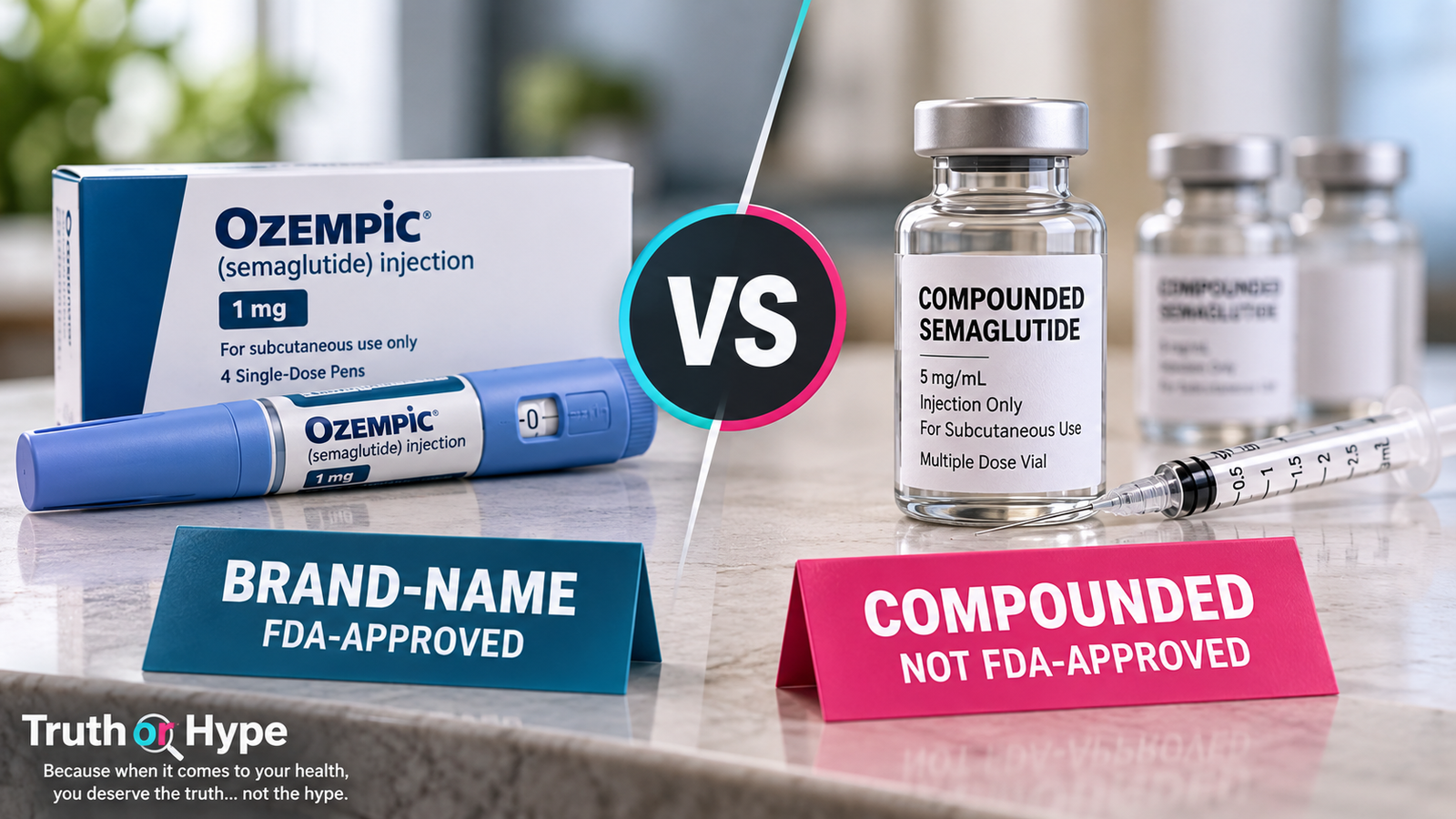
Comparing compounded vs brand-name GLP-1 medications isn’t just about price. The bigger differences involve FDA approval, manufacturing standards, clinical evidence, dosing, oversight and exactly what medication you’re receiving.
That doesn’t mean every compounded GLP-1 is unsafe. Compounded medications can serve legitimate medical needs. But a compounded GLP-1 is not the same thing as an FDA-approved brand-name drug or an FDA-approved generic, even when advertisements make them sound nearly identical.
If you’re considering one, here’s what we think you should know before deciding.
Article at a Glance
- Brand-name GLP-1 medications are FDA-approved. Compounded versions are not.
- FDA-approved drugs undergo premarket review for safety, effectiveness and manufacturing quality; compounded drugs do not.
- 503A pharmacies and 503B outsourcing facilities operate under different regulatory frameworks.
- FDA says semaglutide salt forms such as semaglutide sodium and semaglutide acetate are different active ingredients from the semaglutide used in approved drugs.
- Compounded versions may cost less, but price shouldn’t be the only comparison.
- In March 2026, the FDA warned 30 telehealth companies about false or misleading marketing of compounded GLP-1 products.
Last checked: September 2026
Quick Answer: Compounded vs Brand-Name GLP-1 — What’s the Difference?
The simplest difference is this:
Brand-name GLP-1 medications have been reviewed and approved by the FDA for specific uses. Compounded GLP-1 medications have not.
FDA-approved medications are produced according to standardized manufacturing requirements and have supporting clinical evidence reviewed as part of the approval process.
Compounded medications are prepared under a different regulatory system to meet certain patient or supply needs. Depending on where they’re made, different manufacturing and oversight requirements apply.
That distinction matters because FDA says compounded drugs do not undergo its premarket review for safety, effectiveness or quality.
Compounded vs. Brand-Name GLP-1 at a Glance
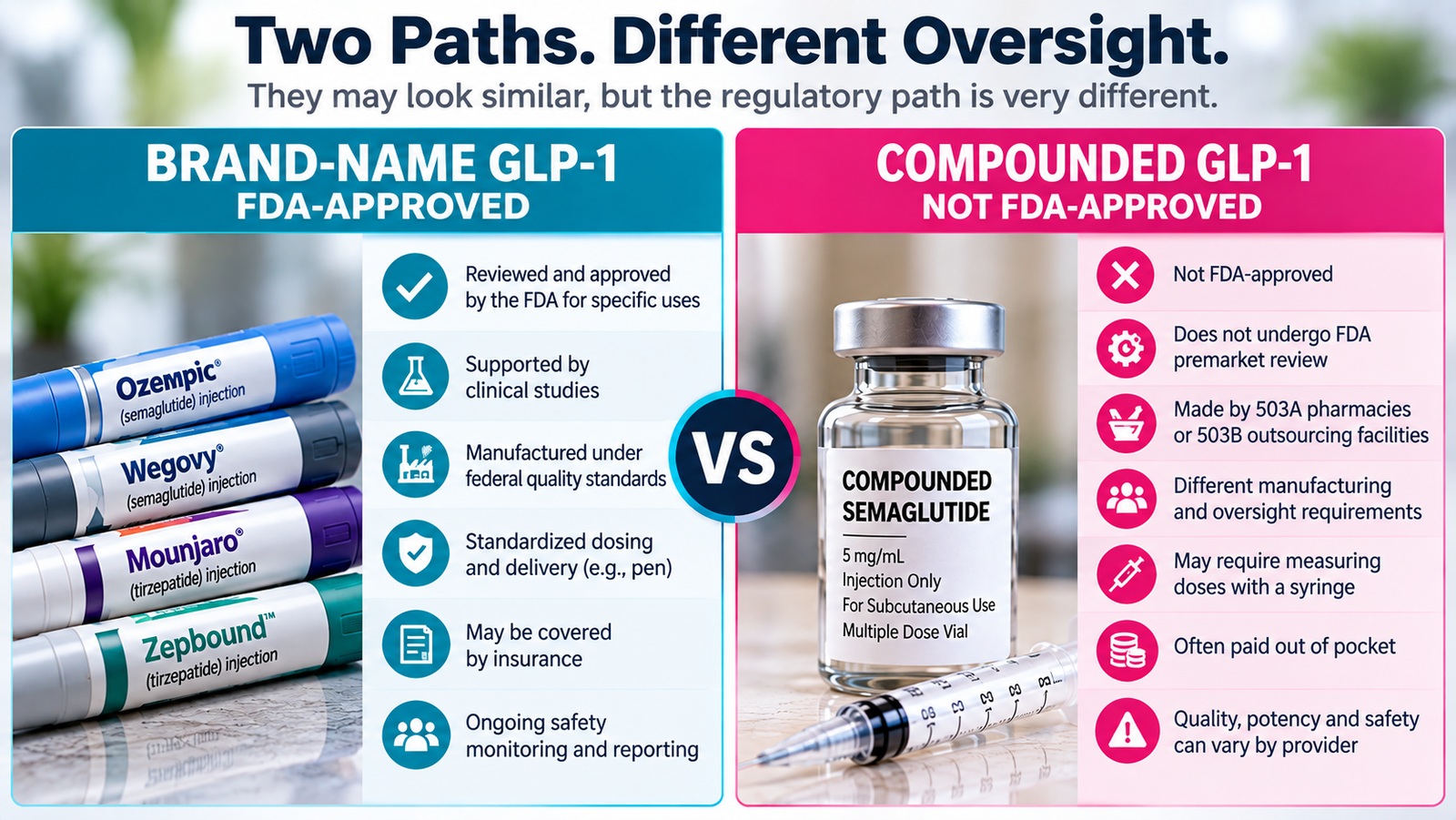
| Brand-Name GLP-1 | Compounded GLP-1 | |
|---|---|---|
| FDA approved? | Yes | No |
| FDA premarket review? | Yes | No |
| Clinical evidence | Approval supported by clinical studies | Compounded product itself isn’t FDA-approved |
| Manufacturing | FDA-regulated manufacturing standards | Requirements depend partly on compounding pathway |
| Typical delivery | Manufacturer-designed pen or other approved delivery form | May include multi-dose vials requiring measurement |
| Insurance | May be covered depending on drug, indication and plan | Often paid out of pocket |
| Cost | Can be expensive without coverage, although self-pay programs may reduce cost | Often advertised at lower cash prices |
| Same as an FDA-approved generic? | N/A | No |
Why FDA Approval Matters
It’s easy to treat “FDA-approved” as another label on a box.
It’s more important than that.
Before an FDA-approved drug reaches the market, the agency reviews evidence concerning its safety and effectiveness for the proposed use. Manufacturing is also subject to federal quality requirements intended to ensure the drug is consistently produced.
That doesn’t mean FDA-approved medications are risk-free. GLP-1 medications have side effects, contraindications and risks that should be discussed with a healthcare professional.
It means there is a standardized product with an FDA-reviewed body of evidence behind it.
Compounded drugs don’t go through that same approval process.
The FDA states that compounded drugs are not FDA-approved and therefore aren’t reviewed by the agency for safety, effectiveness or quality before they’re marketed.
That’s the first thing we’d want someone to understand before comparing the two.
Why Do Compounded GLP-1s Exist?
Compounding itself isn’t some shady corner of medicine.
It can serve an important purpose.
A patient may sometimes need a medication customized because an FDA-approved product doesn’t meet a particular medical need. Compounding has also played a role when approved drugs are in shortage.
The huge demand for semaglutide and tirzepatide created another situation.
When FDA-approved GLP-1 drugs went into shortage, federal rules allowed more compounding activity under certain conditions. That helped create the large compounded GLP-1 market consumers see advertised online today.
But the shortage situation changed.
The FDA eventually determined the tirzepatide and semaglutide injection shortages were resolved, which substantially changed the circumstances under which copies of those commercially available drugs could be compounded.
Today, the legal framework is considerably more complicated than simply saying:
“A licensed pharmacy can make a cheaper copy.”
Sections 503A and 503B of federal law contain specific requirements and restrictions, including rules involving drugs that are essentially copies of commercially available or FDA-approved products.
That’s one reason we’re cautious when a website presents compounded GLP-1s as though they’re simply inexpensive generic versions of the brand-name drugs.
They aren’t.
503A vs. 503B: What’s the Difference?
You’ll probably encounter these two terms if you start researching compounded medications.
They’re worth understanding without turning this into law school.
503A Pharmacies
Section 503A generally covers traditional pharmacy compounding based on valid prescriptions for identified individual patients.
State boards of pharmacy generally have primary responsibility for day-to-day oversight of state-licensed pharmacies that aren’t registered with the FDA as outsourcing facilities.
Drugs compounded under qualifying 503A conditions are exempt from certain federal requirements, including FDA premarket approval and current good manufacturing practice requirements.
503B Outsourcing Facilities
503B outsourcing facilities voluntarily register with the FDA and operate under a different framework.
They are subject to current good manufacturing practice requirements, FDA risk-based inspections, adverse-event reporting requirements and other conditions.
That’s meaningful additional federal oversight.
But here’s an important detail that gets lost in marketing:
FDA registration does not mean the facility or its compounded drugs are FDA-approved.
The FDA specifically says registration doesn’t establish that a facility complies with CGMP requirements or that its compounded products are safe.
So we’d never treat the words “FDA-registered facility” as equivalent to “FDA-approved medication.”
They mean very different things.
Truth or Hype: Compounded Semaglutide Is Basically Generic Ozempic
HYPE.
This is one of the biggest misconceptions in the GLP-1 market.
A compounded drug is not an FDA-approved generic drug.
In fact, the FDA made this point unusually clear in 2026.
On March 3, the agency announced warning letters to 30 telehealth companies over false or misleading marketing involving compounded GLP-1 products.
Among the problems FDA identified were claims implying compounded products were the same as FDA-approved drugs and marketing that could obscure where the compounded medication actually came from.
The FDA stated that compounded drugs aren’t FDA-approved and aren’t the same as generic drugs, which are FDA-approved.
That’s exactly the kind of distinction we think consumers deserve to see before they buy.
Does a Compounded GLP-1 Work as Well as the Brand-Name Version?
This question deserves a more careful answer than yes or no.
FDA-approved semaglutide and tirzepatide products have clinical evidence supporting their approved uses.
A compounded preparation isn’t itself an FDA-approved product and hasn’t undergone the FDA approval process establishing that particular compounded product’s safety, effectiveness and quality.
So we wouldn’t tell someone:
“It’s the same active ingredient, so the results will be the same.”
There are more variables involved than the name of an ingredient.
Formulation, concentration, sterility, storage, stability and dosing can matter.
There’s another issue that makes blanket comparisons especially difficult: not every compounded product is necessarily identical to another compounded product.
That’s why we think the right question isn’t:
“Do compounded GLP-1s work?”
It’s:
“What exactly is in the product I’m being prescribed, who made it, under what standards, and what evidence supports the claims being made about it?”
That’s a much better consumer question.
What About Semaglutide Sodium and Semaglutide Acetate?
This deserves its own section because the names sound deceptively similar.
The FDA says it is aware that some semaglutide products sold by compounders may use salt forms including semaglutide sodium and semaglutide acetate.
Those are different active ingredients from the semaglutide used in FDA-approved drugs.
FDA says it doesn’t have information showing that these salt forms have the same chemical and pharmacologic properties as the active ingredient used in approved semaglutide products, and the agency says it isn’t aware of a lawful basis for their use in compounding.
So if someone tells you:
“It’s all semaglutide.”
We’d ask one more question:
Which semaglutide?
That’s not nitpicking. It’s exactly the kind of detail consumers should know.
Dosing Errors Are Another Difference Worth Understanding
FDA has also raised concerns about dosing errors involving compounded injectable semaglutide.
One reason is fairly easy to understand.
An FDA-approved product may come in a manufacturer-designed delivery system with established dosing instructions.
Some compounded products come in multi-dose vials. That can require a patient to measure a dose using a syringe.
Now you may be dealing with milligrams, milliliters, concentrations and “units.”
That’s a lot more opportunity for confusion.
FDA advises healthcare providers to be vigilant when prescribing compounded semaglutide or tirzepatide and determining doses and titration schedules. It also encourages patients to ask their healthcare provider or compounder how to correctly measure and administer the intended dose.
The FDA also reports receiving adverse-event reports associated with compounded semaglutide and tirzepatide. As of May 31, 2026, it had received 990 reports associated with compounded semaglutide and more than 730 involving compounded tirzepatide.
Importantly, an adverse-event report doesn’t prove the compounded drug caused the event. FDA itself notes that other factors may be involved, and reporting for some state-licensed pharmacies isn’t mandatory, so the data have limitations.
That’s the kind of context we want to preserve rather than throwing scary numbers at readers.
The Cost Difference Is Real
Here’s where the compounded market becomes understandable.
Price matters.
A lot.
Brand-name GLP-1 treatment can be expensive, particularly when insurance doesn’t cover the medication.
Compounded alternatives have often been advertised at considerably lower cash prices.
For someone staring at hundreds of dollars of difference every month, that’s not a trivial consideration.
But advertised price isn’t always total price.
A telehealth offer may involve a membership fee, consultation charges, laboratory costs, shipping, different pricing at higher doses or minimum commitments.
We’ve already broken down those issues in our guide to why a $99 GLP-1 price may not be what you actually pay.
And if you’re comparing the broader cost of treatment, see our 2026 GLP-1 medication cost guide, where we track brand pricing, self-pay programs, insurance and other costs.
Our rule here is simple:
Compare the total cost of getting treated—not the number in the advertisement.
Cheaper Doesn’t Automatically Mean Worse — or Better
This is another place where we don’t like absolutes.
A lower price doesn’t prove a medication is unsafe.
A higher price doesn’t prove it’s the right treatment for you.
And “compounded” by itself doesn’t tell you everything you need to know about how or why a particular drug was prepared.
That’s why our decision wouldn’t start with:
Which one is cheapest?
It would start with:
What am I actually getting?
Then we’d compare cost.
That’s a very different buying process.
What We’d Check Before Choosing a Compounded GLP-1
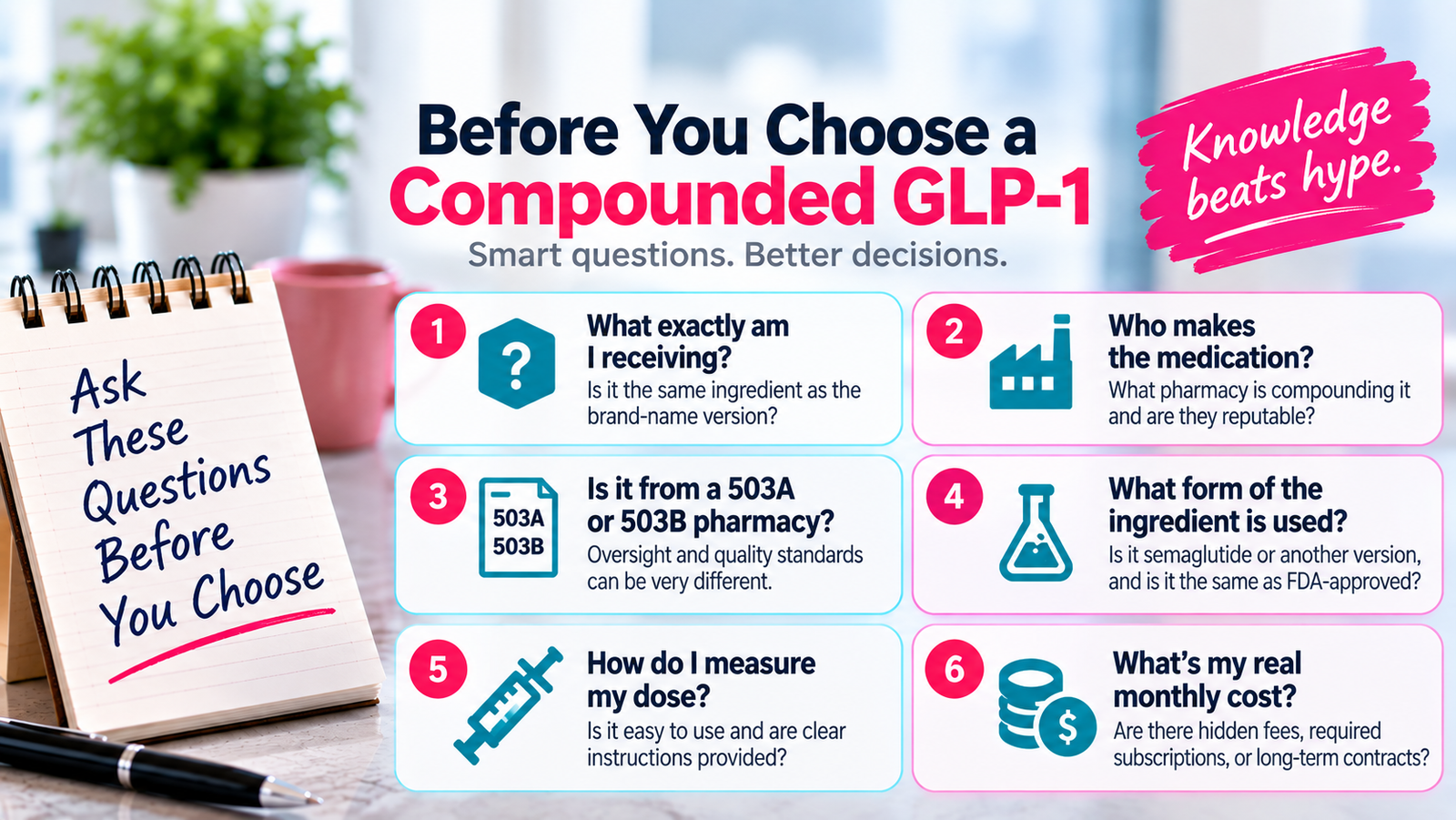
If a telehealth company or clinician offered us a compounded GLP-1, these are the questions we’d want answered before paying:
- What exactly is the medication?
- Why is a compounded product being recommended instead of an available FDA-approved option?
- Which pharmacy or outsourcing facility actually makes it?
- Is that facility operating under 503A or 503B?
- Can I independently verify the facility and its license or registration?
- What form of the active ingredient is being used?
- What concentration will I receive?
- How will I measure my dose?
- Who do I contact if I have a dosing question or side effect?
- What is my total monthly cost after membership fees, labs, shipping and dose changes?
- What happens if the pharmacy or formulation changes?
- Can I cancel without a long-term commitment?
A legitimate provider should be able to answer basic questions about what they’re prescribing and where it comes from.
If the answers stay vague, that’s information too.
Red Flags We’d Pay Attention To
We’re especially cautious when a website makes compounded GLP-1 treatment sound almost indistinguishable from buying Ozempic, Wegovy, Mounjaro or Zepbound.
We’d look more closely if we saw:
- Claims such as “generic Ozempic” for a compounded product.
- Language suggesting the compounded medication itself is FDA-approved.
- No clear identification of the pharmacy actually filling the prescription.
- No meaningful medical evaluation.
- Confusing or vague dosing instructions.
- Unclear total pricing.
- No easy way to contact a clinician about side effects or dosing.
- Claims that make compounded treatment sound risk-free or guaranteed.
Some of these marketing concerns aren’t theoretical. FDA’s 2026 enforcement action specifically targeted misleading claims about sameness with approved GLP-1 products and the source of compounded drugs.
What If Cost Is the Reason You’re Considering Compounded Medication?
Before assuming compounded medication is your only affordable option, we’d compare the alternatives.
Check whether your insurance covers an FDA-approved GLP-1 for your medical indication.
Find out whether prior authorization is required.
Check current manufacturer self-pay and savings programs.
And compare the real monthly price, not just list price.
The market has changed considerably, and the sticker price of a brand-name GLP-1 isn’t necessarily what every patient pays.
Our Best GLP-1 Providers of 2026 comparison also shows how different telehealth companies approach medication access, insurance assistance, pricing and ongoing care.
Sometimes the cheapest-looking provider isn’t cheapest after everything is included.
And sometimes the more expensive-looking option becomes competitive once insurance or a manufacturer program enters the picture.
Do the math before making the medical decision based on an advertisement.
The Bottom Line
The biggest difference between compounded vs brand-name GLP-1 medications isn’t simply the price.
It’s the level of evidence, standardization and regulatory review behind the product you’re receiving.
FDA-approved brand-name medications have gone through the agency’s approval process and are manufactured under federal requirements applicable to approved drugs.
Compounded medications haven’t gone through FDA premarket approval. They can serve legitimate medical needs, but the rules governing them are different, and the FDA has raised specific concerns about misleading marketing, dosing errors and semaglutide salt forms.
That doesn’t mean our answer is:
“Never use a compounded GLP-1.”
Our answer is:
Know exactly what you’re choosing.
Ask who made it. Ask what’s in it. Ask why it’s being prescribed. Ask what oversight applies. Ask what the total price will be.
Then make the decision with a qualified healthcare professional who knows your medical history.
We don’t care which company you choose. We care that you know what you’re choosing.
Frequently Asked Questions
Are compounded GLP-1 medications FDA-approved?
No. Compounded medications are not FDA-approved. FDA does not review compounded drugs for safety, effectiveness or quality before they are marketed. That is different from an FDA-approved brand-name or generic drug.
Is compounded semaglutide the same as Ozempic or Wegovy?
No. A compounded semaglutide product shouldn’t be treated as an FDA-approved generic version of Ozempic or Wegovy. FDA specifically states that compounded drugs are not the same as FDA-approved generic drugs. Some compounded products may also involve different formulations or delivery methods.
What’s the difference between a 503A pharmacy and a 503B outsourcing facility?
503A generally involves patient-specific traditional compounding and is primarily overseen day to day by state pharmacy boards. A 503B outsourcing facility registers with FDA and is subject to CGMP requirements, risk-based FDA inspections and other federal requirements. Registration does not mean its compounded products are FDA-approved.
Are compounded GLP-1 medications cheaper?
They are often advertised at lower cash prices than brand-name medications without insurance. But consumers should compare total costs, including telehealth memberships, consultations, labs, shipping and potential dose-related pricing.
Are compounded GLP-1 medications legal?
Compounding can be lawful when applicable federal and state requirements are met, but the answer is more complicated than saying any licensed pharmacy can simply make a copy of an approved GLP-1. Sections 503A and 503B contain different requirements and restrictions, including restrictions involving drugs that are essentially copies of commercially available or approved products.
Medical note: This article is for general educational purposes and isn’t a substitute for medical advice, diagnosis or treatment. Medication decisions should be made with a qualified healthcare professional who understands your medical history.
Pricing and regulatory note: GLP-1 pricing, availability, insurance coverage and compounding rules can change. Information was checked in September 2026.