
Comparing the best GLP-1 providers of 2026 has to offer isn’t as simple as finding the lowest advertised price.
Choosing a GLP-1 provider used to be mostly about finding someone who could prescribe the medication.
In 2026, that’s the easy part.
The harder part is figuring out what you’re actually paying for.
One company may advertise a low monthly price but charge separately for medication. Another may bundle medication, provider visits and coaching together. Some help fight with your insurance company. Others are built primarily for people paying cash.
That’s why we don’t think there is one “best” GLP-1 provider for everyone.
We don’t pick winners. We show tradeoffs.
Article at a Glance
If you don’t have time to read the entire comparison, here’s what matters most:
- There is no single best GLP-1 provider for everyone. Your best fit depends on insurance, budget, medication preference and how much ongoing support you want.
- Don’t compare advertised prices until you know what they include. A $99 membership and a $199 medication can be a very different deal from a $199 all-inclusive program.
- Insurance assistance can be extremely valuable. Prior authorization and appeals support may matter more than a low membership fee if you’re trying to get an FDA-approved medication covered.
- FDA-approved and compounded medications are not the same thing. Compounded drugs are not FDA-approved, and FDA does not review them for safety, effectiveness or quality before they are marketed.
- Clinical support matters. Look beyond how quickly you can get a prescription and ask what happens when you have questions, side effects or need your dose adjusted.
- Prices change constantly. Promotional prices, manufacturer programs and insurance coverage can change what you actually pay.
Last checked: September 2026.
Quick Answer: Which GLP-1 Provider Is Best in 2026?
It depends on what you need.
If getting an FDA-approved medication covered by insurance is your biggest concern, a provider with strong insurance and prior-authorization support may make the most sense.
If you’re paying completely out of pocket, the real monthly cost may matter more.
If this is your first experience with a GLP-1, you may put more value on regular provider access, nutrition help and ongoing monitoring.
And if you’ve already been using a GLP-1 for some time, convenience may be higher on your list.
That’s why you won’t see a giant BEST OVERALL badge in this article.
A provider that’s a great choice for one person could be an expensive or unnecessary choice for someone else.
Our job is to show you what you’re getting—and what you should check before paying.
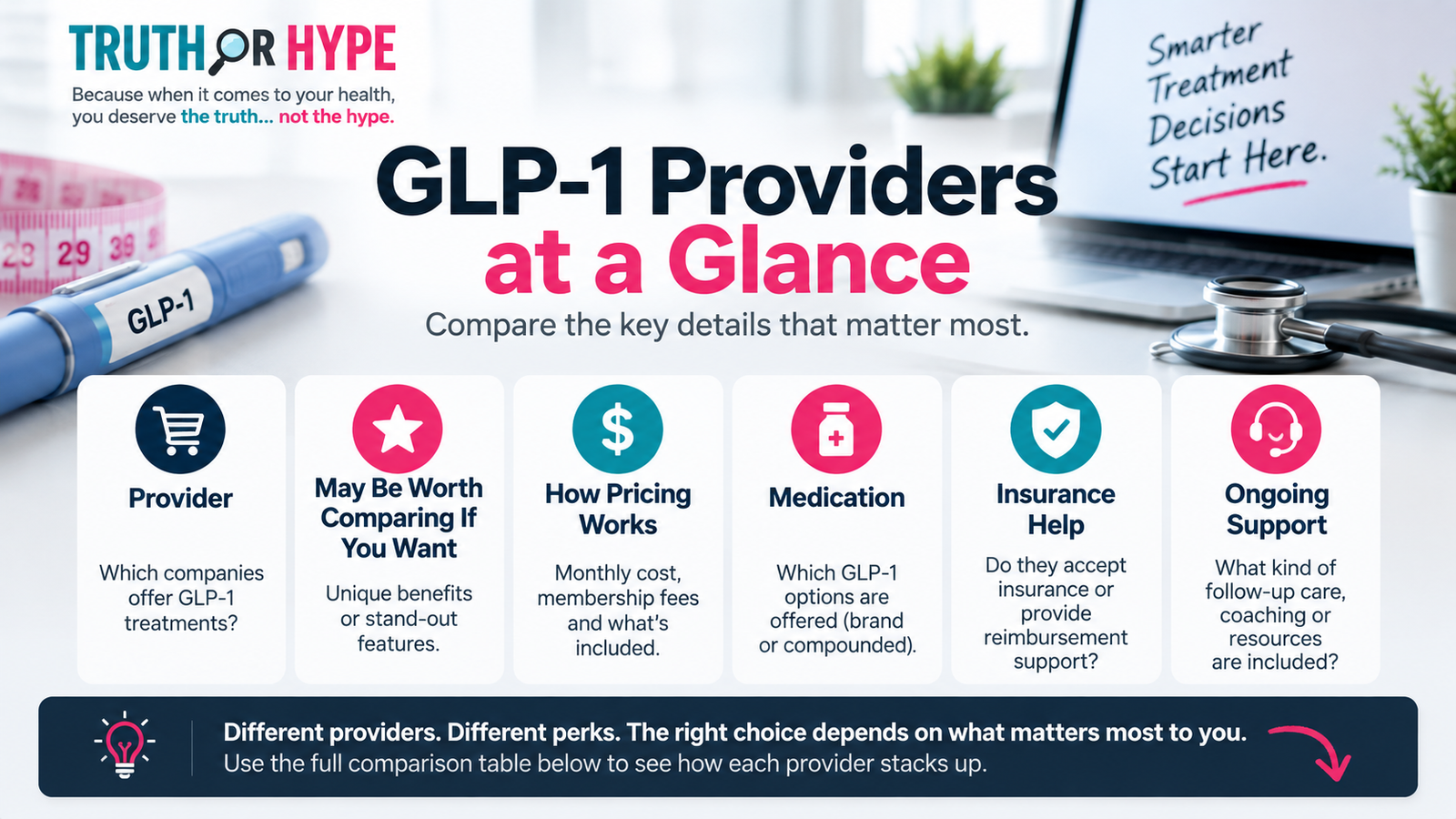
Best GLP-1 Providers of 2026: Side-by-Side Comparison
| Provider | May Be Worth Comparing If You Want | How Pricing Works | Medication | Insurance Help | Ongoing Support |
|---|---|---|---|---|---|
| Amazon One Medical | Traditional primary-care style support | Visits may be billed to insurance or patient; annual membership also available | Prescription treatment when appropriate | Accepts many major insurance plans | Primary care, virtual care, nutrition and ongoing care |
| Ro | Insurance navigation + FDA-approved GLP-1 access | $39 first month; then $74–$149/mo membership depending on plan; medication separate | FDA-approved options | Yes | Provider messaging, dose adjustments, side-effect support |
| WeightWatchers Med+ | Medication care plus lifestyle program | Membership typically $74/mo on current 12-month structure after introductory offer; medication separate | FDA-approved options | Yes | Clinical care + WeightWatchers behavioral/lifestyle program |
| Mochi Health | More provider/dietitian access with cash-pay options | Membership plus medication; compounded pricing listed separately | Brand options may depend on coverage; compounded options advertised | Coverage support available | Physician + dietitian access |
| Fridays | Bundled coaching/care or compounded cash-pay options | Some compounded plans bundle medication and care; brand programs differ | Brand-name and compounded options | Yes | Provider visits, dietitian and coaching support |
Important: This table is a snapshot, not a quote. Eligibility, medication availability, insurance coverage, promotions and pricing can change. Always verify the final cost directly before enrolling.
Why Truth or Hype Doesn’t Pick One Winner
Here’s the problem with declaring one company the “best GLP-1 provider.”
Best for whom?
Someone with excellent insurance may care most about getting a prior authorization approved.
Someone whose plan excludes weight-loss medication entirely may care about cash pricing.
Someone starting treatment for the first time may want easy access to a clinician.
Someone else may want nutrition coaching and behavioral support.
And another person may already have a doctor they trust and simply want help accessing the medication they’re prescribed.
Those people aren’t shopping for the same thing.
So instead of manufacturing a winner, we compare providers using six things we think matter:
Pricing transparency. Medication options. Insurance assistance. Clinical oversight. Ongoing support. And convenience.
Then you decide which tradeoffs are worth making.
That’s also how we approach all of our telehealth provider reviews.
What We Looked At
1. What Does It Really Cost?
This is where we start.
We’ve already looked at why a $99 GLP-1 price may not be what you actually pay, including membership fees, labs, shipping and other costs that can change the final price.
Not:
“Starting at $99!”
We want to know what happens after you click the button.
Does that price include the medication?
Is there a membership fee?
Are consultations included?
Does the price increase with the dose?
Do you have to prepay for six or twelve months to get the advertised price?
Are there shipping, lab or cancellation costs?
Those questions can matter more than the number printed in the biggest font.
We’ve already seen why in our investigation of why a $99 GLP-1 price may not be what you actually pay.
2. What Medication Can You Actually Get?
We distinguish between access to FDA-approved medications and compounded products.
That’s particularly important in 2026.
FDA has warned telehealth companies against marketing compounded GLP-1 drugs in ways that falsely imply they’re the same as FDA-approved products. FDA specifically says compounded drugs are not FDA-approved and are not reviewed for safety, effectiveness or quality before marketing.
That doesn’t mean every compounded medication is automatically inappropriate. Compounding has legitimate medical uses.
It means consumers deserve to know what they’re being sold.
3. Will They Help With Insurance?
Insurance can completely change the math.
A provider charging a membership fee may still end up being the less expensive option if it successfully helps you obtain coverage for an FDA-approved medication.
We look for help with things such as prior authorizations, coverage questions and appeals.
And there’s another major 2026 development worth knowing about: eligible Medicare Part D beneficiaries can now access certain qualifying weight-management GLP-1 drugs through the Medicare GLP-1 Bridge for a $50 copay. The program began July 1, 2026 and is scheduled to continue through December 31, 2027.
4. What Happens After You Get the Prescription?
Getting approved isn’t the end of GLP-1 treatment.
Can you reach a clinician if you’re having side effects?
Can your dose be adjusted?
Are follow-ups included?
Is nutritional or behavioral support available?
Does the service essentially help you obtain medication, or is it designed to provide more comprehensive ongoing care?
Neither model is automatically right or wrong.
But you should know which one you’re buying.
The Providers We’d Compare
Amazon One Medical: Worth Comparing for Insurance-Based Primary Care
Amazon One Medical is different from many of the GLP-1-specific companies in this comparison because it’s fundamentally a primary-care service rather than a weight-loss medication storefront.
One Medical says its weight-management care can include personalized treatment plans, nutrition counseling, exercise guidance, prescriptions when appropriate and access to providers. It also accepts many major insurance plans.
Its standard annual One Medical membership is currently listed at $199, although patients can also access certain visits without a membership and have appointments billed to themselves or insurance.
The tradeoff
This isn’t the easiest service to compare with a simple “$X per month including medication” number.
That’s partly the point.
If you want something closer to traditional medical care with insurance billing, One Medical may deserve a look.
If you simply want a predictable all-inclusive cash price for GLP-1 treatment, another model may be easier to understand.
Truth or Hype take: Don’t compare One Medical’s membership price directly with an all-inclusive GLP-1 program. They’re selling different types of services.
Ro: Worth Comparing for Insurance Navigation and FDA-Approved Options
Ro has one of the clearest examples of why consumers need to separate membership cost from medication cost.
As of September 2026, Ro advertises its Body program at $39 for the first month, followed by $74 to $149 per month, depending on the membership plan selected.
The medication is not included in that membership price.
The membership includes access to licensed providers, ongoing care, side-effect management, dose adjustments and insurance coverage support. Ro also says its insurance concierge assists with coverage and prior authorization.
The tradeoff
Ro’s headline membership price isn’t your total GLP-1 cost.
You need to add the medication cost—or determine what your insurance will cover.
For someone with insurance, that model may make sense.
For someone paying completely out of pocket, compare the combined monthly total, not the membership fee.
Truth or Hype take: Ro makes more sense when you evaluate the whole package than when you stare at the introductory price.
WeightWatchers Med+: Worth Comparing If You Want Lifestyle Support Too
WeightWatchers brings something different to the table: an established behavioral weight-management program wrapped around medical care.
Its Med+ program provides clinical care through WeightWatchers Clinic and includes insurance navigation. Medication costs are separate from the membership. Current standard longer-term membership pricing is generally around $74 per month on the 12-month structure after introductory pricing, with other commitment options available.
WeightWatchers currently provides access to several FDA-approved medication options when clinically appropriate, including Wegovy, Zepbound and the newly approved oral Foundayo. Cash medication pricing varies by drug and dose.
The tradeoff
You’re paying for more than prescription access.
That’s valuable if you want the WeightWatchers ecosystem and behavioral support.
It’s less compelling if you don’t plan to use those services.
Truth or Hype take: Don’t ask only, “Is WeightWatchers cheaper?” Ask whether you’ll actually use what you’re paying for.
Mochi Health: Worth Comparing for Physician and Dietitian Access
Mochi uses another hybrid pricing model.
Its current monthly membership is listed at $79, with lower effective monthly pricing available through longer commitments. Membership includes access to physicians and dietitians, nutrition coaching and support.
Mochi currently lists compounded semaglutide at $99 per month and compounded tirzepatide at $199 per month, with shipping included, in addition to the membership structure.
That means the medication advertisement by itself still isn’t the whole monthly cost.
The tradeoff
The combination of clinician and dietitian access may be attractive to someone who wants ongoing support.
But if you’re comparing Mochi against another provider, add the membership + medication before deciding which one is cheaper.
And if you’re considering a compounded medication, understand that compounded products are not FDA-approved.
Truth or Hype take: This is a perfect example of why we compare the real monthly structure instead of one advertised number.
Fridays: Worth Comparing for Bundled Care and Multiple Medication Paths
Fridays takes yet another approach.
Its current pricing page advertises compounded semaglutide and tirzepatide programs with medication, provider visits and coaching bundled into certain plans. The lowest advertised prices generally require longer commitments or promotional offers; month-to-month pricing is higher.
Fridays also advertises brand-name prescription programs and insurance concierge support. Its program includes provider visits, nutrition and mental-health coaching and dietitian/journey support.
To its credit, Fridays also states on its pricing page that its compounded medications have not been evaluated or approved by FDA for safety, efficacy or quality.
The tradeoff
The lowest advertised monthly number may require prepayment or a longer commitment.
So compare the price you would actually choose—not simply the cheapest number displayed on the page.
Truth or Hype take: Bundling can make comparison easier, but promotional pricing can make it harder. Check the commitment and renewal price before paying.
Truth or Hype? The Cheapest GLP-1 Provider Is the Best Deal
Hype.
At least as a general rule.
Price matters. A lot.
But two companies advertising $199 per month may be selling completely different things.
One might include medication.
Another might charge $199 for medication plus a membership.
One may include provider follow-ups.
Another may include dietitian access and coaching you don’t actually want.
And another may help navigate insurance that could dramatically reduce the cost of an FDA-approved medication.
The useful number isn’t:
“What’s the cheapest advertised price?”
It’s:
“What will I actually pay for the level of care and medication I want?”
That’s the number we’d compare.
One Big Change in 2026: There Are More FDA-Approved Options
The GLP-1 market didn’t stand still.
On April 1, 2026, FDA approved Foundayo (orforglipron), an oral GLP-1 medication for chronic weight management in qualifying adults.
CMS subsequently added Foundayo to the Medicare GLP-1 Bridge alongside eligible formulations of Wegovy and Zepbound.
That matters when comparing telehealth providers because medication access is changing quickly.
A provider comparison written six months ago may already be missing an option—or quoting a price or program that no longer exists.
That’s why we’ll keep updating this page.
Compounded GLP-1s Deserve an Extra Question
We’re not going to tell you that every compounded GLP-1 is “bad.”
We’re also not going to pretend it’s identical to an FDA-approved product.
FDA has been unusually clear about this distinction.
In March 2026, the agency announced warning letters to 30 telehealth companies over false or misleading marketing involving compounded GLP-1 products. Among the issues FDA identified were claims implying compounded products were the same as FDA-approved drugs and marketing that obscured the source of compounded products.
So if a provider offers compounded semaglutide or tirzepatide, we’d ask:
What exactly am I getting, who is prescribing it, where is it being compounded, and why is a compounded medication being recommended for me?
If the website makes that difficult to figure out, that’s information too.
What We’d Check Before Choosing a GLP-1 Provider
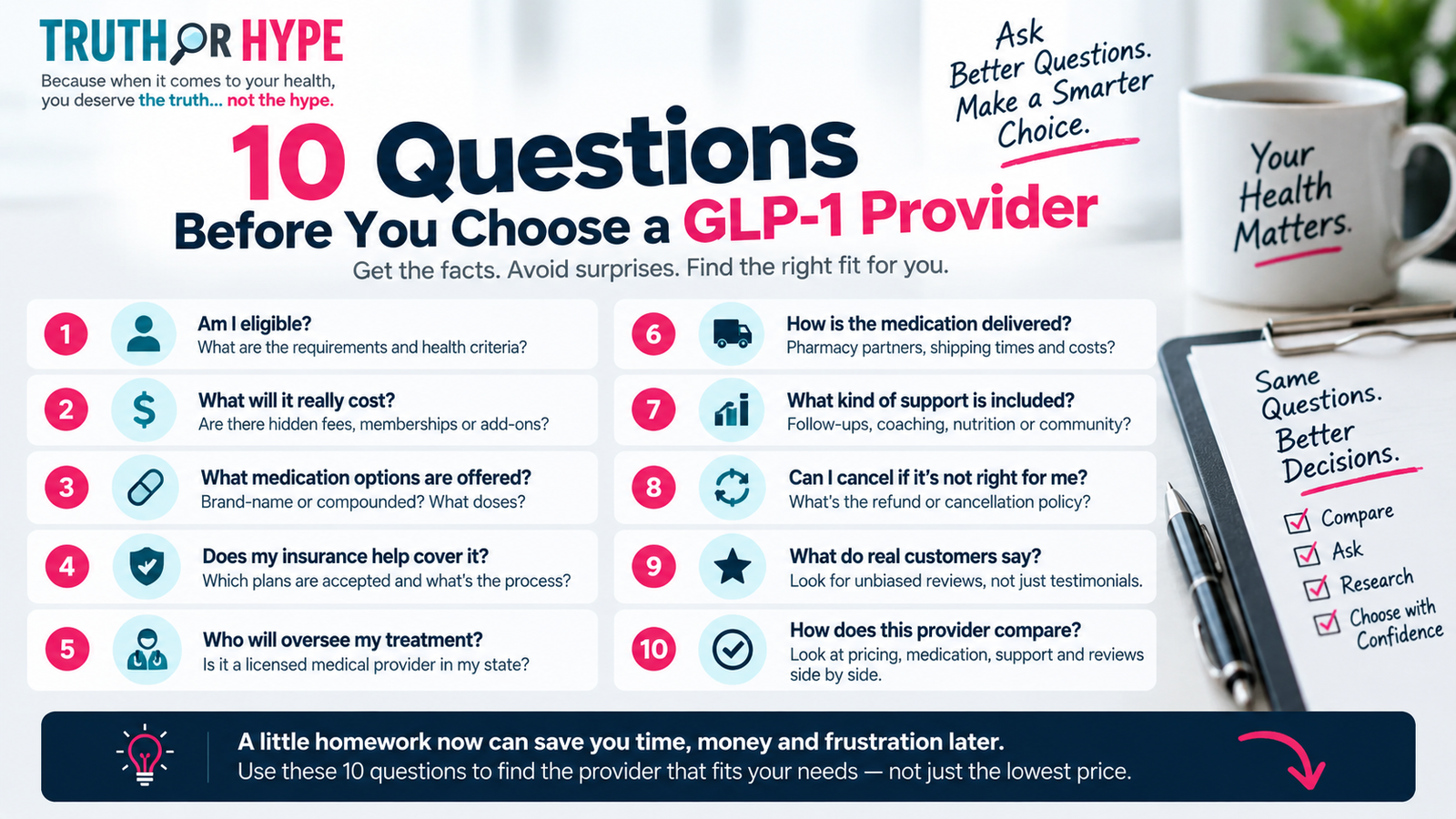
Before entering a credit card number, we’d want answers to these questions:
- Is the advertised price the total price?
- Is medication included?
- Is the medication FDA-approved or compounded?
- Is there a separate membership fee?
- Does the price increase with dosage?
- Are labs, consultations and shipping included?
- Will the provider help with insurance or prior authorization?
- How do I contact a clinician if I have questions or side effects?
- Am I committing to one month, several months or a year?
- What happens if I want to cancel?
If you can answer those ten questions, you’re already in a much better position than someone choosing from an Instagram ad and a giant “STARTING AT $99” button.
Bottom Line
There isn’t one best GLP-1 provider in 2026.
And we think that’s a more useful answer than pretending there is.
Amazon One Medical may appeal to someone who wants a primary-care model that works with insurance.
Ro may deserve consideration if insurance navigation and FDA-approved medication access are priorities.
WeightWatchers Med+ may make sense if you want clinical treatment alongside an established behavioral weight-management program.
Mochi Health may appeal to someone who values physician and dietitian access while comparing cash-pay options.
Fridays may be worth comparing if you want bundled support and multiple medication pathways.
But none of those statements means that company is automatically best for you.
Compare the medication.
Compare the support.
Compare the commitment.
And most importantly:
Compare what you’ll actually pay.
Because when it comes to choosing a GLP-1 provider, we don’t care which company you choose.
We care that you know what you’re choosing.
Frequently Asked Questions
What is the best GLP-1 provider in 2026?
There isn’t one provider that’s best for everyone. Someone using insurance may benefit from a provider with strong prior-authorization support, while someone paying cash may care more about transparent all-in pricing. Clinical support, medication type and commitment requirements should also be compared.
Are compounded GLP-1 medications FDA-approved?
No. FDA says compounded drugs are not FDA-approved and are not reviewed by the agency for safety, effectiveness or quality before marketing. They also should not be described as generic versions of FDA-approved GLP-1 drugs.
Does Medicare cover GLP-1 medications for weight loss in 2026?
Some eligible Medicare Part D beneficiaries can access certain qualifying GLP-1 medications through the Medicare GLP-1 Bridge. The program launched July 1, 2026, has a $50 copay for eligible beneficiaries, and currently runs through December 31, 2027. Eligibility requirements apply.
Medical note: Truth or Hype provides consumer information, not medical advice. GLP-1 medications require evaluation by an appropriate licensed healthcare professional. Medication choice, eligibility, risks and monitoring depend on your individual health history.
Pricing note: Telehealth prices and promotions change frequently. Prices shown here were checked in September 2026 and should be confirmed directly with the provider before enrolling.