By Dan Brown · Published September 16, 2026

Quick Answer: Before you cancel GLP-1 provider services, first find out exactly what you’re canceling.
Canceling may stop future charges without refunding money you’ve already paid. Before you cancel, check your next billing date, whether medication has already been processed or dispensed, your provider’s refund policy, and exactly how the cancellation request must be submitted.
Most importantly, don’t assume “cancel anytime” means “refund anytime.”
Article at a Glance
- Canceling future service does not necessarily mean you’ll receive a refund for money already paid.
- A price advertised “per month” doesn’t always tell you how much will actually be charged at checkout.
- Membership fees and medication charges may be handled separately.
- Medication that has already been processed, dispensed, or shipped may be subject to different refund rules depending on the provider.
- Save screenshots, emails, receipts, and cancellation confirmations.
- If you’re switching providers, think about continuity of care before your current access ends.
What Happens When You Cancel GLP-1 Provider Services?
It depends on the provider.
That’s not a very exciting answer, but it’s the accurate one.
Telehealth GLP-1 companies don’t all use the same billing model. Some charge month-to-month. Some offer longer prepaid plans. Some charge a membership fee separately from medication. Others bundle services together.
That means the word “cancel” can mean different things depending on what you signed up for.
You might be canceling:
- a recurring telehealth membership
- future medication orders
- automatic renewal of a prepaid plan
- access to the provider or platform
- or some combination of those
That’s why your first question shouldn’t be:
“Can I cancel?”
It should be:
“What exactly happens when I cancel?”
“Cancel Anytime” Does Not Always Mean “Refund Anytime”
This is probably the biggest misunderstanding.
A provider can allow you to cancel whenever you want while still having a policy that certain charges you’ve already paid are non-refundable.
Those are two different things.
For example, imagine you paid for a treatment cycle and then canceled two weeks later.
The provider might stop your next renewal, but that doesn’t automatically mean you’ll receive money back from the current treatment cycle.
Whether you qualify for a refund can depend on the provider’s terms and how far your prescription or medication order has progressed.
Truth or Hype?
Hype: “Cancel anytime” means I can cancel today and get my money back.
Not necessarily.
Truth: Cancellation and refunds are separate questions.
Before paying, find out both:
Can I cancel?
and
What happens to money I’ve already paid if I do?
That small distinction could save you a very expensive surprise.
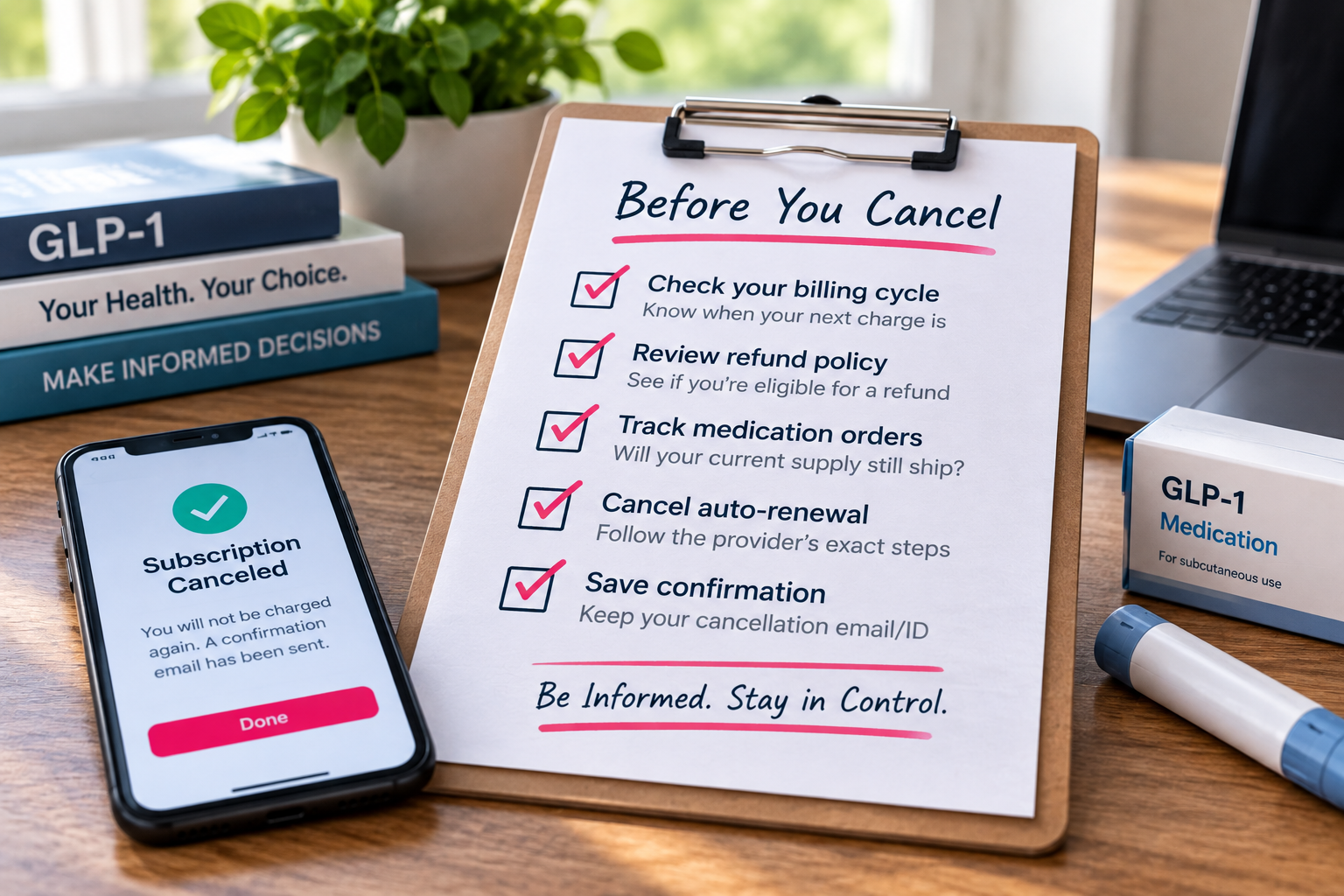
Check These 5 Things Before You Cancel
Before clicking a button, sending an email, or calling customer service, spend a few minutes figuring out where you stand.
1. When Is Your Next Charge?
Find your next billing or renewal date.
Don’t wait until the day before renewal if the provider’s terms require advance notice.
If you can’t find the date in your account, check your original confirmation email, billing history, or the provider’s current cancellation terms.
2. Has Your Medication Already Been Processed?
This can matter.
Prescription medications aren’t the same as returning a pair of shoes.
Depending on the provider and pharmacy, the refund policy may change after a prescription has been processed, medication has been dispensed, or an order has shipped.
Don’t assume which point matters.
Check the provider’s actual policy.
3. Did You Pay Monthly or Prepay?
This is another place where advertised pricing can get confusing.
A website might describe a plan using a monthly equivalent—such as “$149/month”—while requiring payment for several months at once.
Those aren’t necessarily the same thing.
Before enrolling, the number we care about most is:
How much will actually be charged to my card today?
And if you’re already enrolled, determine how much of that payment covered the current treatment period and what the refund terms say about it.
4. Are Medication and Membership Billed Separately?
Some telehealth programs charge separately for provider access and medication. Our guide to GLP-1 provider membership fees explains how these different pricing models work and what to check before signing up.
That creates an important question:
Does canceling one automatically cancel the other?
Don’t assume it does.
If you have separate charges on your statement, confirm that you’ve stopped every recurring service you intend to stop.
5. How Does the Provider Require You to Cancel?
Look for the official cancellation instructions.
Depending on the company, that could mean:
- using your patient portal
- contacting customer support
- sending an email
- completing an online cancellation form
- calling customer service
Follow the provider’s stated process and keep proof that you did it.
The FTC recommends keeping copies of cancellation requests and records of conversations about cancellation. It also recommends watching your bank or credit-card statements afterward for additional charges.
Can I Get a Refund After I Cancel?
Maybe.
But canceling and getting a refund are not the same thing.
Your refund eligibility can depend on things such as:
- what you purchased
- whether it was prepaid
- the provider’s refund policy
- when you requested cancellation
- whether a prescription has already been processed
- whether medication has been dispensed or shipped
That’s why we wouldn’t tell you that GLP-1 providers “usually” refund—or “usually” don’t refund—your money.
Read the policy for the company you actually use.
And read the version that’s current when you make your decision. Telehealth pricing and policies can change.
What If I Prepaid for Several Months?
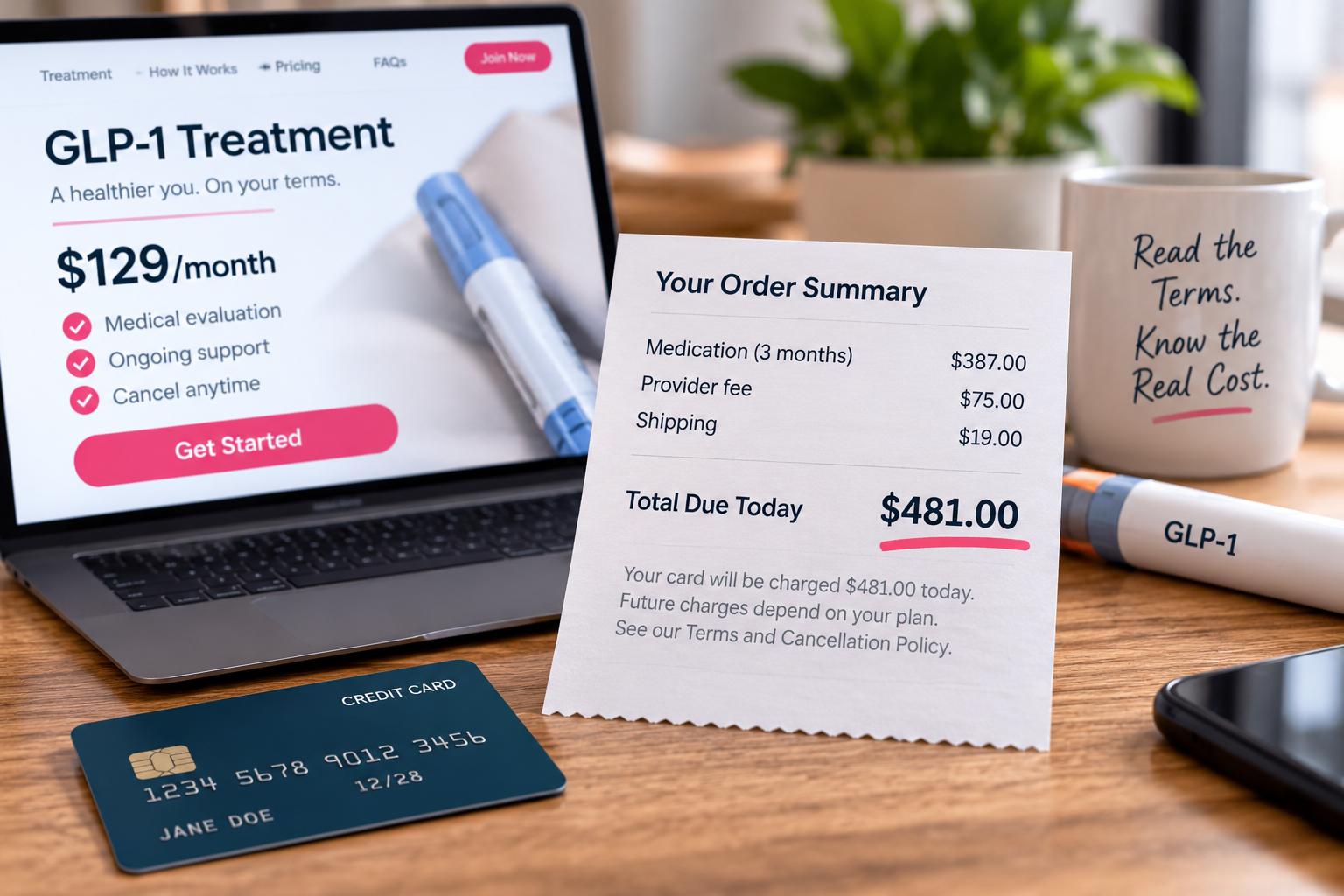
This deserves special attention because monthly price and monthly billing are not necessarily the same thing.
Suppose a provider advertises a treatment plan as:
$129 per month
That doesn’t necessarily mean your credit card will be charged $129 every month.
It could mean $129 is the monthly equivalent of a longer prepaid plan.
Before purchasing, look for:
Total due today: $___
That’s the number that tells you your immediate financial commitment.
If you’ve already prepaid and now want to cancel, check whether cancellation affects the current prepaid period or only prevents another purchase or renewal.
Don’t try to reverse-engineer the answer from the advertisement.
Read the cancellation and refund terms.
What Happens to Medication I’ve Already Paid For?
This is where the provider’s specific terms become especially important.
Prescription medication may already be somewhere in the prescribing, processing, dispensing, or shipping process when you submit your cancellation.
Those stages aren’t interchangeable.
And different providers can attach different cancellation or refund consequences to them.
So ask a very specific question:
“My cancellation was submitted today. Has my medication already been processed or dispensed, and what does that mean under your refund policy?”
Get the answer in writing if possible.
What If I Want to Switch GLP-1 Providers?
Canceling the billing relationship is only half the issue if you intend to continue treatment somewhere else.
You also need to think about continuity of care.
Before leaving, it can be useful to have records of:
- your current medication
- current dose
- how long you’ve been taking it
- previous dose changes
- side effects you’ve experienced
- relevant lab results
- other information your new clinician requests
Your new provider should determine what prescription and treatment plan are appropriate rather than simply assuming your previous regimen should continue unchanged.
And don’t change or stop a prescribed medication solely because you’ve canceled a subscription.
If you’re thinking about stopping treatment, our guide to what happens when you stop taking a GLP-1 explains what research has found about appetite, weight regain, and what may happen after treatment ends.
Talk with the clinician managing your care before changing your treatment.
Seven Questions to Ask Before Joining Your Next GLP-1 Provider
Here’s one part of Wordform’s monster that I would keep, because the idea is excellent.
But I’d simplify it.
Before entering your credit card, ask:
- What exact amount will I be charged today?
- Is this month-to-month or am I prepaying for multiple months?
- Does the price include medication?
- Are there separate membership, provider, lab, or shipping fees?
- When does any part of my payment become non-refundable?
- Exactly how do I cancel, and is there a deadline before the next charge?
- What happens if I need to pause treatment or switch providers?
If you can’t find an answer, ask customer support.
And whenever possible, save the answer in writing.
That’s not paranoia.
That’s keeping a receipt.
What We’d Check Before Choosing
At Truth or Hype, we don’t automatically prefer a provider because it has no membership fee, and we don’t automatically reject one because it does.
The same applies to cancellation policies.
A provider with automatic renewal isn’t automatically bad.
A prepaid plan isn’t automatically bad.
A membership isn’t automatically bad.
What matters is whether you understand what you’re buying, what you’ll be charged, what you’re getting for that money, and what happens if you decide to leave.
Before choosing a provider, we’d look for four numbers or answers:
What do I pay today?
When will I be charged again?
How do I stop the next charge?
What happens to money I’ve already paid?
If those answers are clear before checkout, you’re in a much better position to decide whether the arrangement works for you.
What If I Canceled but I’m Still Being Charged?
Start with the provider.
Follow its official cancellation process and keep a copy of your request, confirmation, emails, chat transcripts, and any other documentation.
Then monitor your statements.
The FTC advises consumers who continue receiving charges after trying to cancel to dispute the charge with their credit- or debit-card company. It also recommends keeping records that document what happened.
That’s a much better approach than immediately assuming every charge is fraudulent.
First determine what you agreed to, what you canceled, when you canceled it, and what happened afterward.
One More Thing About Compounded GLP-1 Programs
Canceling a telehealth provider and deciding whether to use a compounded medication are separate decisions.
We wouldn’t lump them together.
Compounded drugs are not FDA-approved, and FDA says they don’t undergo the agency’s premarket review for safety, effectiveness, and quality that approved drugs do. The rules surrounding compounded semaglutide and tirzepatide have also changed considerably as shortages ended.
If you’re considering changing from one type of medication to another because you’re leaving a provider, that’s a medical decision to discuss with your clinician.
You can also read our Compounded vs. Brand-Name GLP-1 guide for a plain-English explanation of the differences.
No 800-word detour necessary. 😂
The Bottom Line
If you want to cancel a GLP-1 provider, don’t start by assuming the word “cancel” tells you everything you need to know.
Find out what you’re canceling.
Check your next billing date. Determine whether you prepaid. Find out whether your medication has already been processed or dispensed. Read the refund policy. Make sure a separate membership or medication order isn’t still active.
Then follow the provider’s cancellation instructions and save the confirmation.
And before choosing your next provider, ask those questions before entering your credit card.
Because the easiest cancellation problem to solve is the one you understand before you sign up.
We don’t care which company you choose. We care that you know what you’re choosing.
Frequently Asked Questions
If I cancel my GLP-1 provider, will I get a refund?
Not necessarily. Cancellation may prevent future billing without refunding charges you’ve already paid. Refund eligibility depends on the provider’s current terms, what you purchased, when you canceled, and potentially where your medication is in the processing or dispensing process.
Does canceling my membership automatically cancel my GLP-1 medication?
Don’t assume it does. Some providers separate membership or clinical-service charges from medication charges. Confirm exactly which services and future charges your cancellation stops.
Should I stop taking my GLP-1 medication when I cancel my provider?
Canceling a telehealth service is not the same as making a medical decision to stop treatment. If you’re considering stopping or changing a prescribed medication, discuss that decision with the clinician managing your care.