By Dan Brown · Published September 21, 2026

If you’re trying to decide between semaglutide and tirzepatide, you’re probably seeing a lot of conflicting advice.
One person says tirzepatide is stronger. Someone else swears by semaglutide. An ad tells you one is cheaper. A Reddit post tells you the other caused fewer side effects.
So which one is actually better?
Here’s the important distinction: tirzepatide produced greater average weight loss than semaglutide in a major head-to-head obesity trial. But that doesn’t automatically make tirzepatide the better medication for every person.
Your health history, treatment goals, side effects, insurance coverage, preferred way of taking the medication, and FDA-approved indications can all matter.
Truth or Hype Takeaway:
Don’t ask only, “Which drug causes more weight loss?” Ask, “Which one makes the most sense for my situation?”
Article at a Glance
- Semaglutide activates the GLP-1 receptor. Tirzepatide activates both GIP and GLP-1 receptors.
- In the 72-week SURMOUNT-5 head-to-head obesity trial, participants taking tirzepatide lost 20.2% of their body weight on average, compared with 13.7% with semaglutide.
- Both medications commonly cause gastrointestinal side effects, especially while the dose is being increased.
- Semaglutide currently offers both weekly injection and daily tablet options for weight management, while tirzepatide is administered as a weekly injection.
- FDA-approved uses differ between the medications, which can matter beyond weight loss.
- Your actual cost may depend more on insurance coverage, eligibility and manufacturer programs than on the medication’s headline price.
Quick Answer: Semaglutide vs. Tirzepatide
If your only question is which medication produced more average weight loss in a direct comparison, tirzepatide has the advantage.
In SURMOUNT-5, a randomized head-to-head study of 751 adults with obesity but without type 2 diabetes, participants receiving tirzepatide lost an average of 20.2% of their starting weight after 72 weeks. Those receiving semaglutide lost 13.7%.
But that’s one important outcome in one specific study population—not an answer to which medication every person should take.
Semaglutide has different FDA-approved uses and now offers an oral Wegovy option in addition to injections. Tirzepatide has its own advantages and indications, including FDA approval of Zepbound for moderate-to-severe obstructive sleep apnea in adults with obesity.
That’s why this comparison requires more than putting two weight-loss percentages next to each other.
Semaglutide vs. Tirzepatide: What’s the Difference?
These medications are related, but they aren’t identical.
Semaglutide is a GLP-1 receptor agonist. Tirzepatide activates two receptors: GIP and GLP-1.
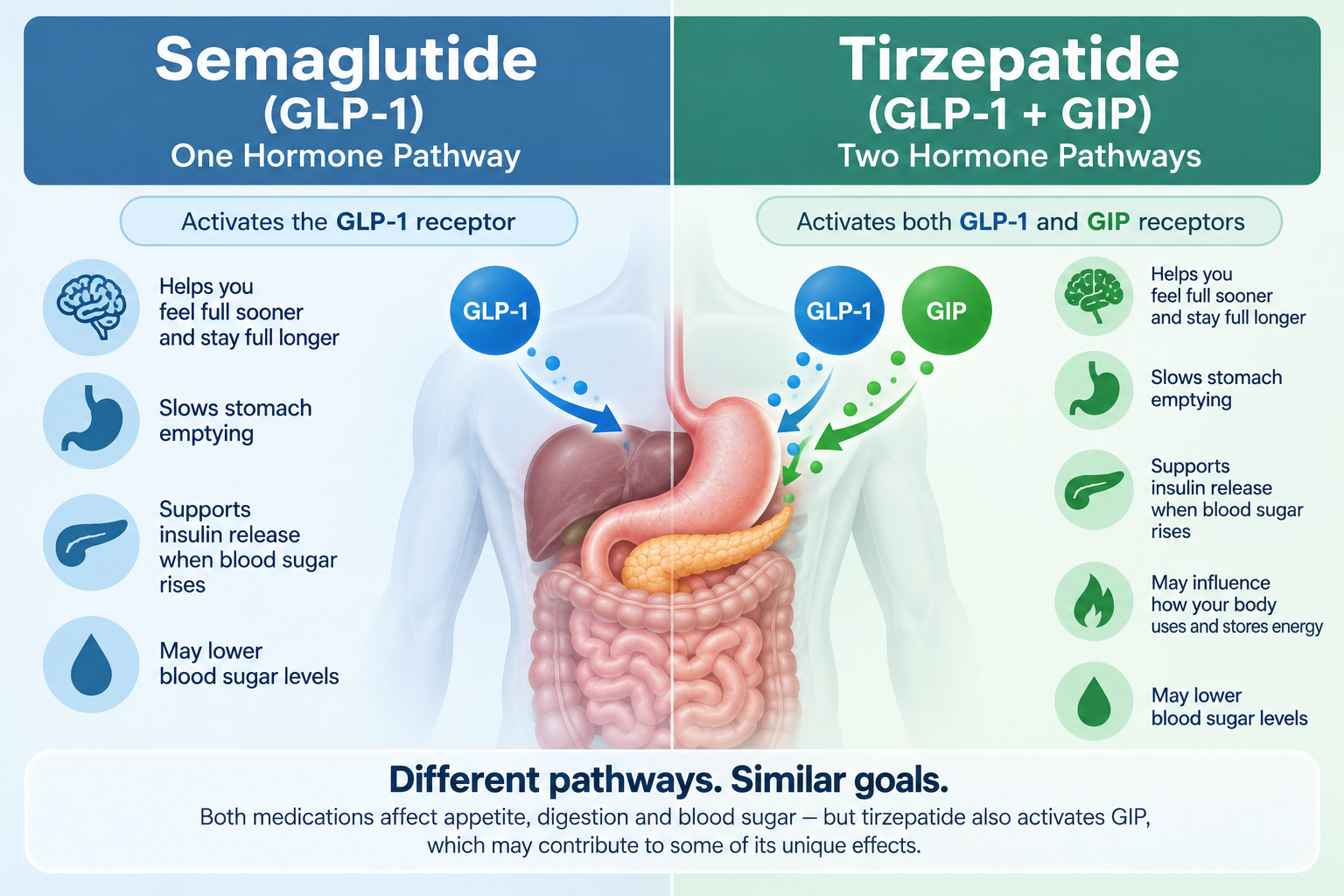
In normal-person language, both medications interact with hormone systems involved in appetite, blood sugar and digestion. Tirzepatide works through an additional pathway.
You’ll sometimes see this reduced to:
“One hormone versus two.”
That’s technically pointing toward a real difference, but it’s too simplistic to tell you which medication is right for you.
More pathways don’t automatically mean a medication is better for every person.
What matters is what those differences have produced in actual clinical studies—and how they fit the individual patient.
Which One Causes More Weight Loss?
This is where we have unusually useful evidence because researchers have actually put these medications head-to-head.
What SURMOUNT-5 Found
The SURMOUNT-5 trial enrolled 751 adults with obesity but without type 2 diabetes.
Participants received the maximum tolerated dose of either:
- tirzepatide, 10 mg or 15 mg weekly, or
- semaglutide, 1.7 mg or 2.4 mg weekly.
After 72 weeks, average weight loss was:
| Medication | Average Weight Loss |
|---|---|
| Tirzepatide | 20.2% |
| Semaglutide | 13.7% |
Average waist circumference also fell more with tirzepatide: 18.4 cm versus 13.0 cm with semaglutide.
That’s a meaningful difference.
And this is one place where we shouldn’t create false balance just because we’re a comparison site.
Truth or Hype?
Claim: Tirzepatide produces more weight loss than semaglutide.
TRUTH — with an important qualification.
In SURMOUNT-5, tirzepatide produced significantly greater average weight loss than semaglutide in adults with obesity without diabetes.
But “greater average weight loss” is not the same as “better medication for everyone.”
Clinical trials tell us what happened across groups of people. They can’t tell you exactly what will happen to you.
That’s the distinction we’d want to remember.
What About Side Effects?
Both medications can cause gastrointestinal problems.
Common issues include nausea, diarrhea, vomiting, constipation and abdominal discomfort. These problems frequently show up while the dose is being increased.
In SURMOUNT-5, gastrointestinal events were the most common adverse events in both groups, and most were mild to moderate.
Interestingly, 5.6% of semaglutide participants discontinued treatment because of gastrointestinal adverse events compared with 2.7% of tirzepatide participants.
That doesn’t mean tirzepatide will automatically be easier on your stomach.
It means that in this particular trial, fewer participants receiving tirzepatide stopped treatment because of gastrointestinal problems.
Researchers continue to study whether tirzepatide’s GIP activity helps explain some differences in tolerability. That’s an interesting possibility, but it shouldn’t be presented as settled fact.
Serious Risks Matter Too
Both medications carry an FDA boxed warning related to thyroid C-cell tumors observed in animal studies. Wegovy is contraindicated in people with a personal or family history of medullary thyroid carcinoma or people with Multiple Endocrine Neoplasia syndrome type 2 (MEN 2).
There are additional warnings and precautions, which is one reason your medical history matters more than an online comparison chart.
This isn’t a decision that should be made based only on which medication produced the larger number on the scale.
Semaglutide Has More Than One Form
Here’s a practical difference that has become more important in 2026.
Semaglutide is available in several branded forms, including Ozempic, Wegovy and Rybelsus, depending on the indication.
For weight management, Wegovy now comes as both a once-weekly injection and a once-daily tablet. Current FDA prescribing information lists Wegovy tablets in 1.5 mg, 4 mg, 9 mg and 25 mg strengths, with 25 mg as the recommended adult maintenance dose for weight reduction and cardiovascular risk reduction.
Tirzepatide’s major U.S. brands are Mounjaro for type 2 diabetes and Zepbound for chronic weight management and certain other approved uses.
For someone who strongly prefers a pill over an injection, semaglutide’s oral option could therefore become an important part of the conversation.
But convenience isn’t the only difference.
FDA-Approved Uses Can Matter
One of the easiest mistakes in comparing these drugs is treating “semaglutide” and “tirzepatide” as though each were one product approved for one purpose.
They’re not.
The specific brand and indication matter.
Wegovy injection is FDA-approved for chronic weight management in eligible adults and adolescents 12 and older. It is also approved to reduce the risk of cardiovascular death, heart attack and stroke in certain adults with established cardiovascular disease and overweight or obesity.
Wegovy injection also has an accelerated FDA approval for certain adults with noncirrhotic metabolic dysfunction-associated steatohepatitis (MASH) and moderate-to-advanced liver fibrosis.
Zepbound is FDA-approved for chronic weight management in eligible adults and was also approved for moderate-to-severe obstructive sleep apnea in adults with obesity.
Those differences can be more important for a particular patient than which medication won a weight-loss comparison.
What About Cost?
This is where a simple “Drug A costs this and Drug B costs that” chart can become misleading very quickly.
What you actually pay can depend on:
- your insurance plan
- why the medication is being prescribed
- prior authorization requirements
- manufacturer savings eligibility
- whether you’re paying cash
- the dose or formulation
- whether you’re eligible for a government program
And current manufacturer offers can change.
For example, NovoCare currently lists standard self-pay pricing of $349 per month for Wegovy injection at the usual doses, with a temporary $199 introductory offer for the first two fills for eligible new patients through the end of 2026. Oral Wegovy self-pay pricing currently varies by dose, starting at $149 per month.
LillyDirect currently advertises self-pay Zepbound KwikPen pricing starting at $449 per month under its program terms.
Commercially insured patients may have different savings options, while government beneficiaries face different rules.
So don’t choose between semaglutide and tirzepatide based on an advertised number until you know your actual ongoing cost.
That’s the number that matters.
What About Medicare Coverage in 2026?
This part changed significantly in 2026.
CMS launched the Medicare GLP-1 Bridge on July 1, 2026. The temporary demonstration gives qualifying Medicare Part D beneficiaries access to certain eligible GLP-1 medications for a $50 monthly copay and is currently scheduled to run through December 31, 2027.
CMS currently lists eligible products including Wegovy injection and tablets and Zepbound KwikPen, along with Foundayo. Eligibility requirements apply.
That means a comparison article from even a year ago may already contain outdated Medicare information.
And it’s another reason we don’t like declaring one medication “cheaper” without asking who is paying for it and under what coverage.
Which One Is Easier to Stay On?
This question doesn’t get nearly as much attention as it deserves.
A medication can look incredible in a clinical trial and still be a poor choice for someone who can’t tolerate it, afford it or realistically continue taking it.
That’s why we think “Can I stay on this treatment?” deserves to sit right beside “How much weight could I lose?”
Things worth considering include:
- How are you tolerating the medication?
- Does your insurance cover it?
- What will it cost month after month?
- Are you comfortable with injections?
- Would a daily tablet be easier?
- Do you have other health conditions that affect the decision?
- Can you realistically continue treatment if your coverage changes?
The strongest medication on paper doesn’t help much if you have to stop taking it.
Should You Switch From Semaglutide to Tirzepatide?
Maybe—but this is where we’d be careful with advice from Reddit, Facebook groups or even overly confident health websites.
There isn’t a simple dose-for-dose conversion where someone can say:
“You’re taking this much semaglutide, so take this much tirzepatide.”
They’re different medications with different dosing schedules.
If semaglutide isn’t producing the expected results, side effects are difficult, insurance coverage changes or another indication makes tirzepatide worth considering, that’s a reasonable conversation to have with your prescriber.
But switching medications—and deciding the appropriate starting dose and timing—is a medical decision.
This is one area where we’d rather give you a good question to ask than pretend there’s one universal internet answer.
What We’d Ask Before Choosing
If we were sitting down with a prescriber to discuss semaglutide vs. tirzepatide, these are the questions we’d bring:
- Based on my health history, is there a medical reason you prefer one over the other?
- What results are realistic for someone like me?
- Are there side effects or risks in my history that make one less appropriate?
- Does either medication have an FDA-approved indication that’s especially relevant to my health?
- What does my insurance actually cover?
- What will my ongoing monthly cost be—not just the introductory price?
- What happens if I don’t tolerate the medication?
- How will we decide whether it’s working well enough to continue?
Those questions are more useful than walking into the appointment and asking:
“Which GLP-1 is best?”
The Biggest Mistake in Comparing These Two Drugs
It’s tempting to turn the entire decision into this:
20.2% vs. 13.7%.
Those are important numbers.
But they’re not the whole decision.
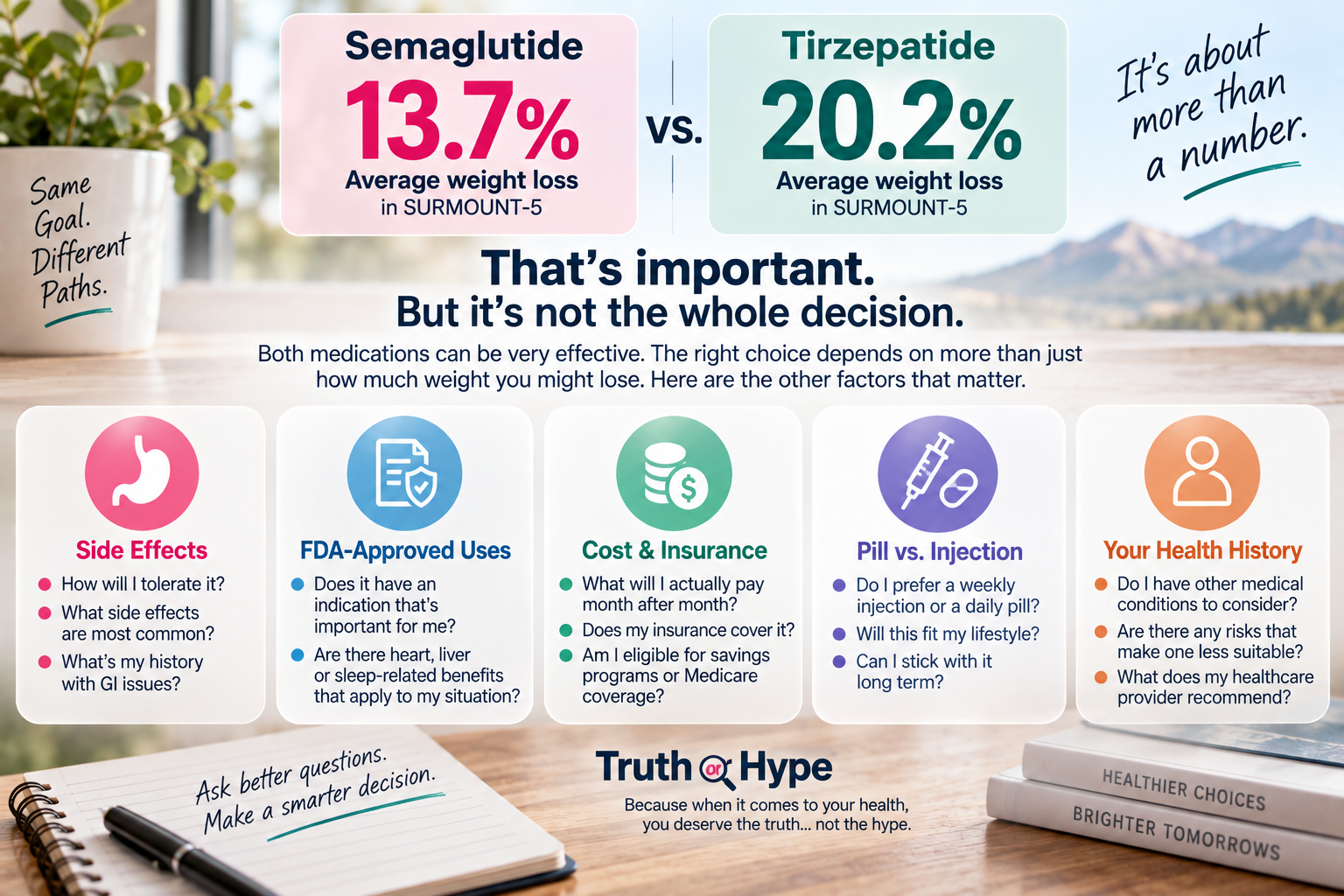
SURMOUNT-5 tells us that tirzepatide produced greater average weight loss than semaglutide in the population studied. It doesn’t tell us that every individual should take tirzepatide.
Someone may have an FDA-approved reason that makes semaglutide particularly relevant.
Someone else may have coverage for Zepbound but not Wegovy.
Another person may strongly prefer an oral medication.
Someone else may respond beautifully to semaglutide and have absolutely no reason to change.
That’s why the useful question isn’t simply:
Which drug won the trial?
It’s:
Which differences actually matter to me?
Truth or Hype Verdict
“Tirzepatide is better than semaglutide.”
Too simple.
If by “better” someone means greater average weight loss in the SURMOUNT-5 head-to-head obesity trial, the evidence favors tirzepatide. That’s not marketing. That’s what the study found.
But if “better” means the right medication for every person, the evidence doesn’t support that conclusion.
Semaglutide and tirzepatide differ in how they work, their available formulations, FDA-approved indications, costs, coverage and how individual patients respond to them.
We don’t pick winners. We explain the tradeoffs.
And this is a perfect example of why.
Bottom Line
Semaglutide and tirzepatide are both important medications, but they’re not interchangeable.
Tirzepatide produced substantially greater average weight loss in the strongest direct obesity comparison we currently have. Semaglutide, meanwhile, has its own practical and medical advantages, including oral and injectable options and FDA-approved indications that may matter for certain patients.
So don’t choose based on one number, one advertisement or one person’s experience online.
Look at the evidence. Look at your health. Look at your coverage. Look at what you can realistically continue.
Then take those facts into the conversation with your healthcare provider.
Because the best comparison doesn’t make the decision for you. It helps you ask better questions before you make it.
Frequently Asked Questions
Is tirzepatide more effective than semaglutide for weight loss?
In the SURMOUNT-5 trial, yes on average. Adults with obesity but without diabetes lost an average of 20.2% of body weight with tirzepatide compared with 13.7% with semaglutide after 72 weeks. Individual results can differ.
Does tirzepatide have fewer side effects than semaglutide?
Both commonly cause gastrointestinal side effects. In SURMOUNT-5, gastrointestinal problems caused treatment discontinuation in 2.7% of tirzepatide participants compared with 5.6% of semaglutide participants. That doesn’t guarantee an individual will tolerate tirzepatide better.
Can I take semaglutide and tirzepatide together?
These aren’t medications to combine on your own. FDA prescribing information for Wegovy says using it with other GLP-1 receptor agonists is not recommended. If you’re considering switching medications, the timing and dose should be determined with your prescriber.
Last updated: September 20, 2026
Medical note: This article is for educational purposes and isn’t a substitute for individualized medical advice. Medication choice should be made with a qualified healthcare professional who knows your medical history.