By Dan Brown · Published September 17, 2026

Article at a Glance
- The FDA says the shortages of semaglutide and tirzepatide injections have been resolved.
- That means the broad shortage-era pathway that allowed copies of these drugs to be compounded has largely ended.
- Compounded GLP-1 medications have not disappeared, but the rules governing when they can legally be made are now much tighter.
- The FDA is increasing scrutiny of compounded GLP-1 products and how telehealth companies market them.
- Compounded drugs are not FDA-approved, even when they’re prescribed by a licensed provider or made by a legitimate compounding pharmacy.
- If you’re considering a compounded GLP-1, the important question isn’t simply “Is compounding good or bad?” It’s what are you actually getting, who made it, and why is it being compounded for you?
Quick Answer
The FDA compounded GLP-1 update is more complicated than headlines suggesting compounded semaglutide and tirzepatide are simply “banned” or “still available as usual.”
The shortages that opened the door to widespread compounding of semaglutide and tirzepatide have been resolved. FDA says compounders now must comply with the normal federal rules that restrict making products that are essentially copies of commercially available FDA-approved drugs. FDA is also stepping up enforcement against misleading marketing and raising safety concerns about some compounded GLP-1 products.
That doesn’t mean every compounded GLP-1 prescription is automatically illegal or unsafe. It means consumers need to look more carefully at why the medication is being compounded, where it comes from, and exactly what they’re being sold.
What Actually Changed With Compounded GLP-1s?
During the GLP-1 shortages, federal law gave compounders more flexibility to make versions of medications patients couldn’t reliably obtain.
That was important. Demand for medications such as Wegovy, Ozempic, Zepbound and Mounjaro exploded faster than manufacturers could consistently supply them.
But shortages don’t last forever.
FDA determined the tirzepatide injection shortage was resolved in October 2024 and the semaglutide injection shortage was resolved in February 2025. FDA then provided temporary enforcement-discretion periods intended to avoid an abrupt disruption while compounders transitioned away from shortage-based production. Those periods have ended.
That’s the part many advertisements don’t explain very well.
The old shortage-era rules are no longer the reason a company can simply mass-produce copies of semaglutide or tirzepatide.
Does That Mean Compounded GLP-1s Are Now Illegal?
No. That’s too simple.
Compounding itself remains legal and serves an important medical purpose. A compounded medication may be appropriate when an FDA-approved product cannot meet an individual patient’s medical needs.
But federal law places restrictions on compounders making medications that are essentially copies of commercially available FDA-approved drugs.
FDA specifically reminded compounders of those restrictions in April 2026.
So when you see an advertisement that makes compounded semaglutide sound like nothing more than “Wegovy without the brand-name price,” that’s where we’d start asking questions.
503A vs. 503B: What Does That Actually Mean?
You’ll see these numbers thrown around constantly when researching compounded medications.
Here’s the normal-person translation.
503A Compounding Pharmacies
These are generally state-licensed pharmacies that compound medications based on prescriptions for individual patients.
There are circumstances where a prescriber can determine that a compounded version provides a significant difference for an identified patient compared with the commercially available drug.
That’s very different from simply mass-producing a cheaper copy for everybody.
503B Outsourcing Facilities
These are larger facilities that register with FDA and operate under additional federal requirements, including current good manufacturing practice requirements.
They can produce larger quantities of compounded drugs under certain conditions.
But there’s another important 2026 development.
In April 2026, FDA proposed excluding semaglutide, tirzepatide and liraglutide from the 503B bulks list, saying it had not identified a clinical need for outsourcing facilities to compound these medications from bulk drug substances. The proposal went through a public-comment period; it should not be described as a final rule unless FDA finalizes it.
That’s another reason the rules are considerably tighter than they were during the shortage.
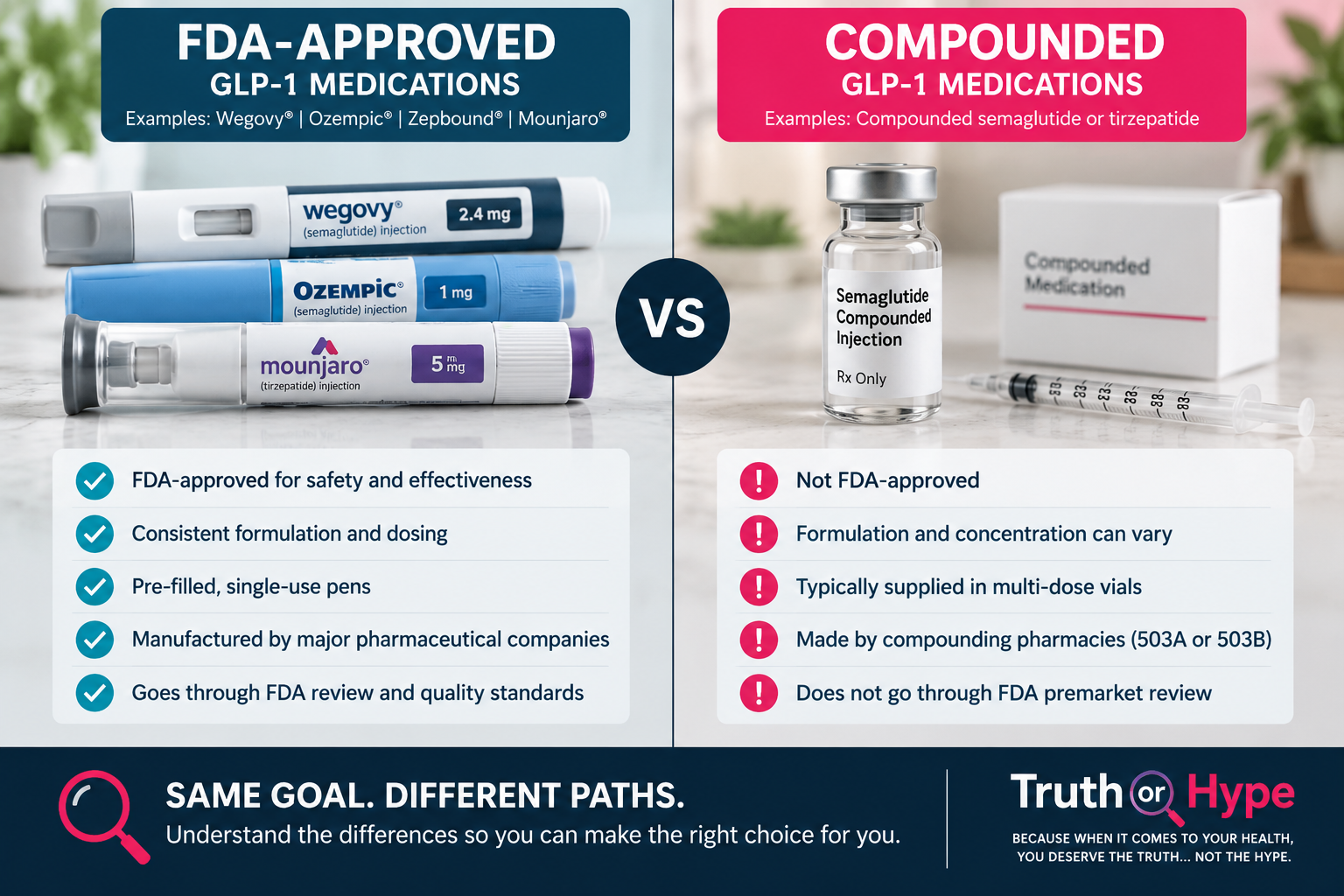
Compounded Does Not Mean FDA-Approved
This may be the single most important distinction in the entire article.
FDA-approved medications go through the agency’s premarket review for safety, effectiveness and quality.
Compounded medications do not.
That doesn’t automatically make a compounded medication bad. Compounding has legitimate medical uses and can be important for patients with needs that commercially available products can’t meet.
But consumers deserve to understand the difference.
A compounded medication should not be advertised in a way that makes you believe FDA reviewed and approved that finished product just as it reviewed Wegovy, Ozempic, Zepbound or Mounjaro.
FDA has become particularly aggressive about this distinction.
In 2026, the agency warned companies about marketing that implied compounded GLP-1 products were FDA-approved, were generic versions of approved drugs, produced the same results, or came from an “FDA-approved” compounding pharmacy. FDA says those descriptions can be false or misleading.
That’s exactly the kind of fine print we care about at the Truth or Hype.
FDA’s Safety Concerns About Compounded GLP-1s
FDA’s concerns aren’t limited to legal technicalities.
Some involve actual medication errors.
Dosing Errors
Many FDA-approved injectable GLP-1 medications come in prefilled pens designed to deliver specific doses.
Some compounded medications come in multidose vials. Patients may need to draw medication into a syringe themselves.
That’s where things can get confusing.
A prescription might describe the dose in milligrams while syringe instructions use milliliters or “units.” Concentrations can also vary between compounded products.
FDA has received reports of patients accidentally injecting five to 20 times the intended amount of compounded semaglutide. Some patients required medical treatment or hospitalization.
That’s not an argument that everyone using a vial will make a mistake.
It is an argument for making sure you understand exactly how much medication you’re supposed to draw into the syringe before you inject it.
Different Concentrations
One compounded semaglutide vial isn’t necessarily identical to another.
FDA notes that compounded products may be offered in different concentrations, containers and dosing formats. That means instructions that worked for one vial shouldn’t automatically be assumed to apply to another.
This is one of those boring details that suddenly becomes extremely important when you’re holding the syringe.
Semaglutide Salt Forms
FDA has also raised concerns about compounders using semaglutide sodium or semaglutide acetate.
Those are different active ingredients from the base form of semaglutide used in FDA-approved products.
FDA says it is not aware of a basis for using those salt forms that would satisfy the federal conditions for the active ingredients that can be used in compounding.
So this is a very reasonable question to ask:
What form of semaglutide is actually in my medication?
FDA Is Also Looking Harder at Telehealth Advertising
This part is especially relevant to Truth or Hype because many people encounter GLP-1 treatment through an Instagram ad or telehealth website rather than their local doctor’s office.
The marketing can make everything look remarkably simple:
Same medication. Lower price. Delivered to your door.
FDA says companies need to be much more careful than that.
In February 2026, FDA announced plans to increase enforcement involving non-FDA-approved compounded GLP-1 products and misleading direct-to-consumer marketing. The agency specifically objected to claims presenting compounded products as generic versions of, the same as, or clinically proven to produce the same results as FDA-approved GLP-1 drugs.
That’s an important consumer distinction.
A low advertised price may still be attractive.
But price doesn’t make two medications equivalent.
“We’ve also looked at why an advertised GLP-1 price may be very different from what you actually pay.”
Truth or Hype?
“Compounded semaglutide is just generic Wegovy.”
Hype.
There is no FDA-approved generic Wegovy simply hiding behind a different label in a compounded vial. A compounded product is not an FDA-approved generic version of Wegovy.
“The FDA banned all compounded GLP-1 medications.”
Hype.
The shortage-era ability to routinely produce copies has changed substantially, but legitimate patient-specific compounding can still exist under federal law when applicable requirements are satisfied.
“Compounded GLP-1s aren’t FDA-approved.”
Truth.
FDA does not review compounded medications for safety, effectiveness and quality before they reach patients the way it reviews FDA-approved drugs.
“If my compounding pharmacy is FDA-approved, I’m protected.”
Hype — and watch that wording.
FDA specifically says compounding pharmacies and outsourcing facilities should not be represented as “FDA-approved” or “FDA-licensed.” A 503B outsourcing facility can be FDA-registered and subject to FDA oversight, but that’s not the same thing as FDA approving the pharmacy or every drug it produces.
That one is worth remembering when you’re reading a provider’s sales page.
What We’d Check Before Choosing a Compounded GLP-1
You don’t need to become a pharmacist.
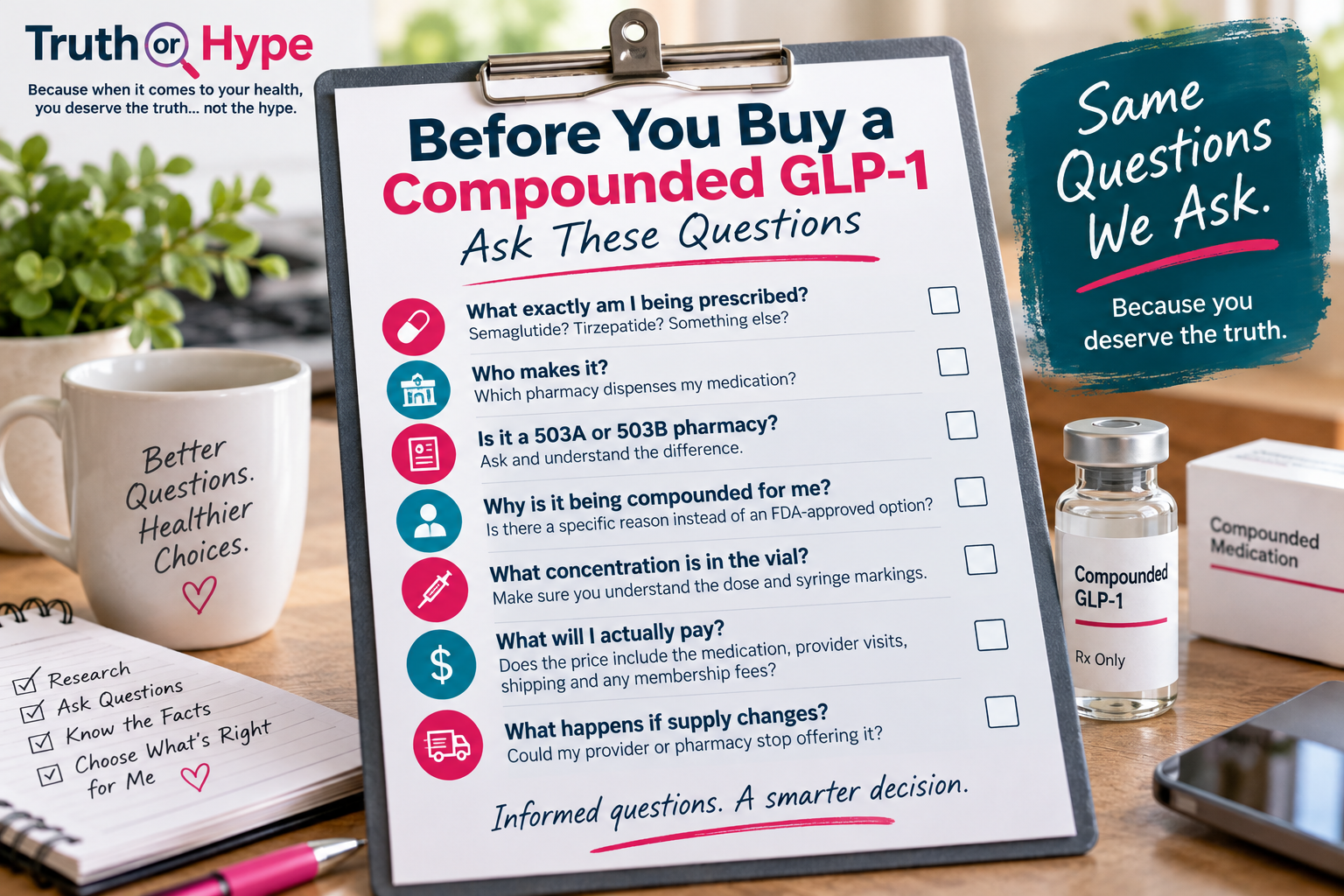
You do need satisfactory answers to a few basic questions:
- What exactly am I being prescribed? Semaglutide? Tirzepatide? Something combined with another ingredient?
- Which pharmacy makes it? The provider should be willing to identify the pharmacy dispensing your medication.
- Is it a 503A pharmacy or 503B outsourcing facility?
- Why is a compounded medication appropriate for me instead of an available FDA-approved product?
- What concentration is in the vial?
- What dose am I supposed to inject, and how does that translate to the markings on my syringe?
- Is the advertised price introductory or ongoing? And does it include medication, provider visits, shipping and membership fees?
- What happens if the pharmacy or provider can no longer supply the medication?
If a company can explain those things clearly, great.
If getting a straight answer feels like pulling teeth, that’s information too.
What If You’re Already Taking a Compounded GLP-1?
Don’t panic because you read an FDA headline, and don’t make abrupt medication changes based on an article on the internet — including this one.
Instead, this is a good time to ask your prescriber a few questions.
Find out exactly what you’re receiving, which pharmacy dispenses it, what concentration you’re using, and whether anything about your prescription or supply is expected to change.
If you’re drawing medication from a vial and you’re uncertain about the dose, don’t guess.
FDA specifically recommends that patients talk with their healthcare provider or compounder about how to measure and administer the intended dose.
That’s a five-minute question that can prevent a very unpleasant mistake.
Bottom Line
The compounded GLP-1 story has changed.
During the shortages, compounded semaglutide and tirzepatide became widely available because FDA-approved products couldn’t keep up with demand.
Those shortages have been resolved.
That doesn’t mean compounded GLP-1 medications suddenly vanished or that every compounded prescription is inappropriate. It does mean the broad shortage-era environment has ended, federal restrictions on copying commercially available drugs matter again, and FDA is paying much closer attention to how these products are made and marketed.
Our biggest concern isn’t whether the word “compounded” appears on the vial.
It’s whether you understand what you’re buying.
Who made it? What’s in it? Why is it being compounded? How much should you inject? What are you really paying? And what happens if your access changes?
“Still trying to sort out costs, providers, insurance or treatment? Our GLP-1 Answers page brings all of our guides together in one place.”
Frequently Asked Questions
Can I still get compounded semaglutide in 2026?
Compounded semaglutide has not simply been outlawed. However, the semaglutide shortage has been resolved, and compounders once again face the normal federal restrictions on making drugs that are essentially copies of commercially available FDA-approved products. Certain patient-specific compounding may still be permissible when applicable legal requirements are met.
Is compounded semaglutide the same as Wegovy or Ozempic?
No. Compounded semaglutide products are not FDA-approved versions or FDA-approved generics of Wegovy or Ozempic. Formulation, concentration, packaging and dosing instructions can differ. FDA has specifically warned companies against misleading consumers about equivalence.
Is a 503B pharmacy safer than a 503A pharmacy?
503B outsourcing facilities operate under different federal requirements, including current good manufacturing practice requirements and FDA oversight, while 503A pharmacies generally compound prescriptions for individual patients and are primarily overseen by states. That distinction matters, but the label 503A or 503B by itself isn’t enough to judge whether a particular prescription is appropriate for you.
Sources
FDA — GLP-1 compounding policies as supply stabilizes
FDA — Dosing errors with compounded injectable semaglutide
FDA — 2026 action involving non-FDA-approved GLP-1 drugs
Last Updated: September 17, 2026