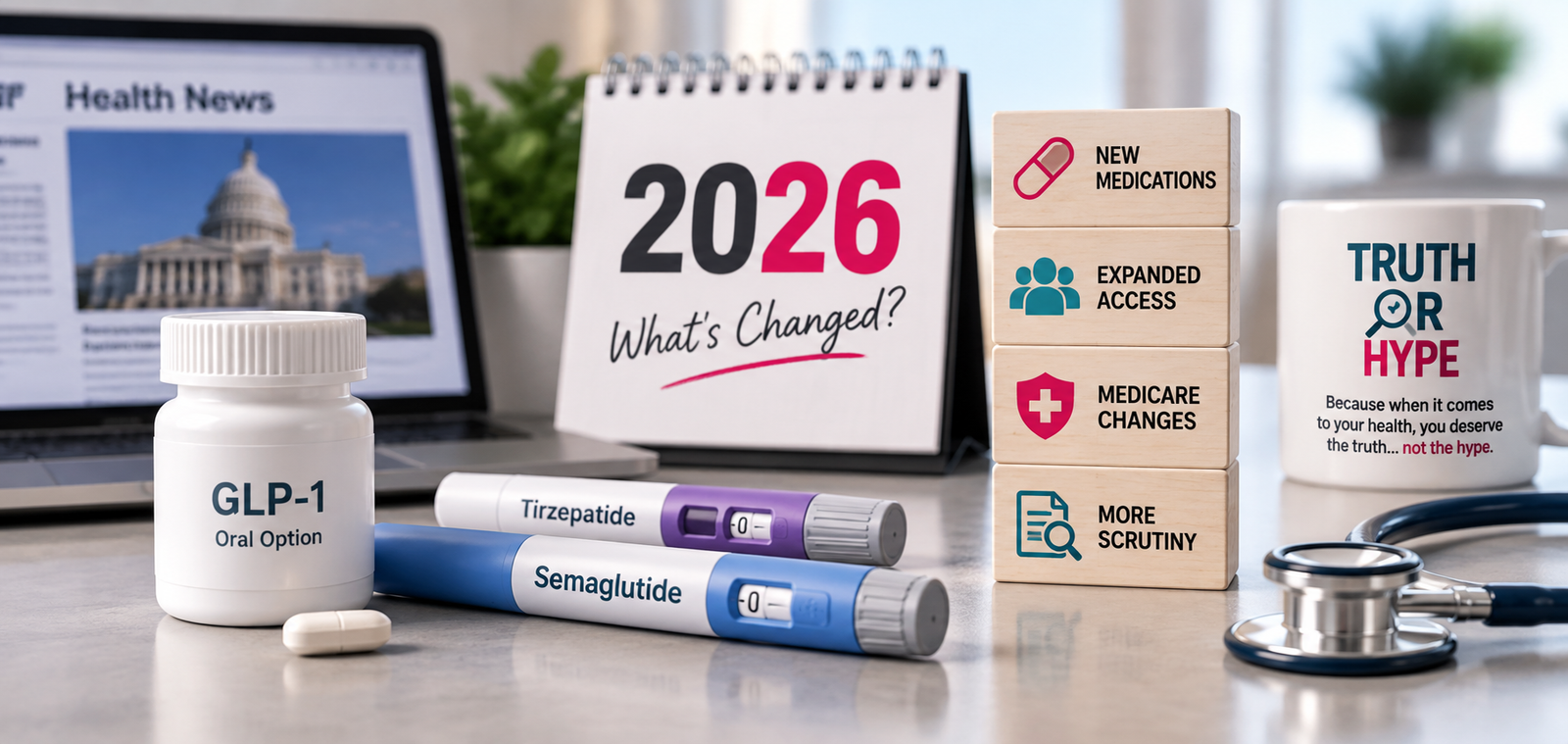
The biggest GLP-1 changes 2026 has brought are not limited to another weight-loss drug hitting the market.
This year brought new oral treatment options, a newly approved GLP-1 molecule, a higher-dose Wegovy injection, major changes to Medicare access, tighter rules around compounded semaglutide and tirzepatide, and more scrutiny of how telehealth companies advertise these medications.
That is a lot of change in less than a year.
For consumers, though, the important question isn’t:
“What’s new?”
It’s:
“What actually changes my choices, my cost or the treatment I may be offered?”
Here are the developments we think matter most.
Article at a Glance
- Oral GLP-1 treatment became much more important in 2026, giving some patients an alternative to injections.
- The FDA approved Foundayo (orforglipron) on April 1, 2026, adding a new once-daily oral GLP-1 option for chronic weight management in qualifying adults.
- The FDA approved Wegovy HD 7.2 mg in March, creating a higher-dose semaglutide injection option for certain adults.
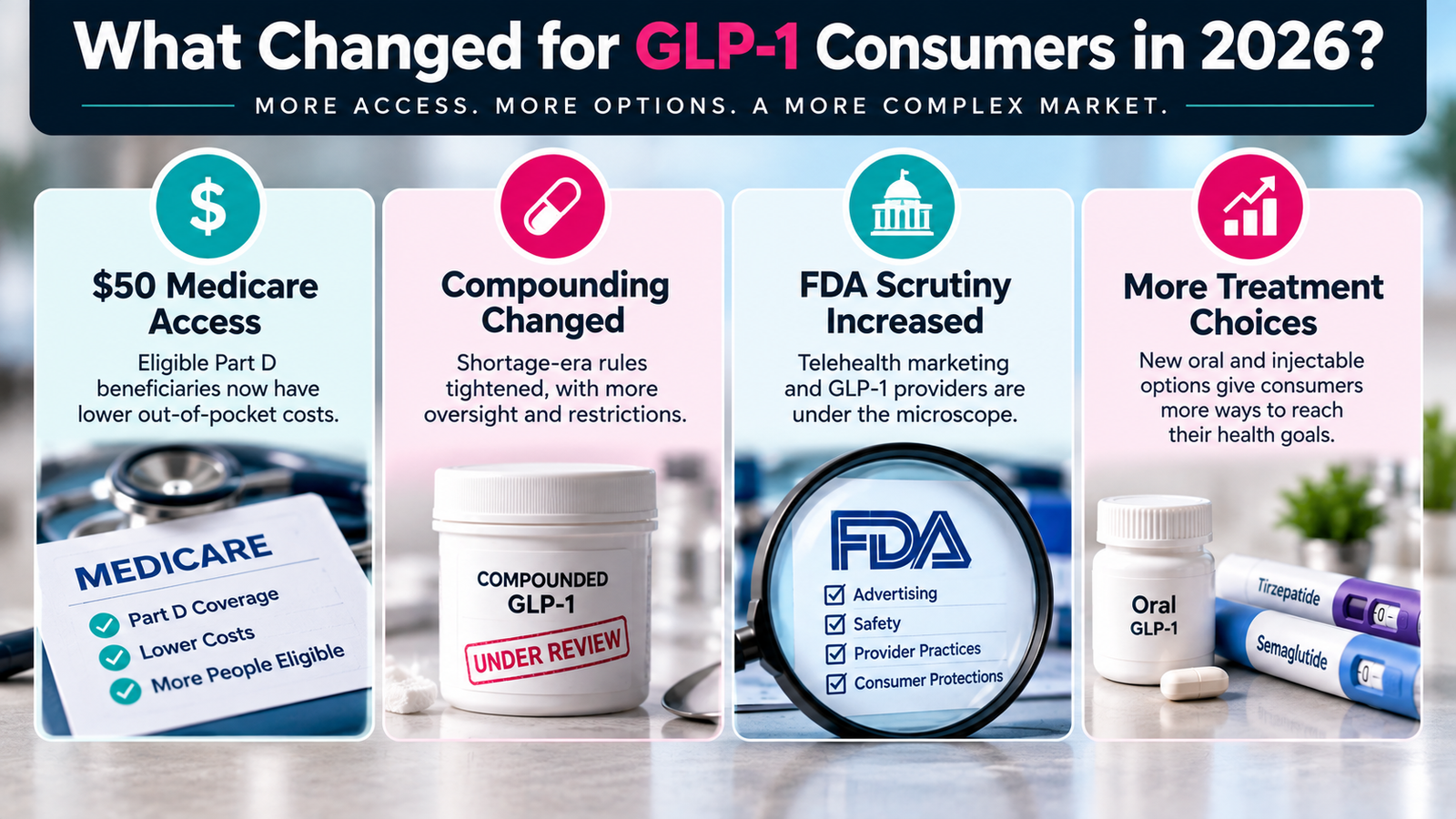
- Medicare launched a $50-per-month GLP-1 Bridge for eligible Part D beneficiaries beginning July 1, 2026.
- The era of widespread shortage-based compounding changed after semaglutide and tirzepatide shortages were declared resolved.
- FDA enforcement against misleading compounded GLP-1 advertising increased substantially in 2026.
Last checked: September 2026
Quick Answer: What Are the Biggest GLP-1 Changes 2026 Has Brought?
The biggest GLP-1 changes in 2026 involve more treatment choices, new ways to take the medications, changing access and much tighter scrutiny of compounded products.
Consumers now have more FDA-approved oral and injectable options than they did a year ago.
Medicare has opened a new pathway for some beneficiaries seeking weight-management treatment.
At the same time, the shortage conditions that helped fuel the compounded GLP-1 market have changed, and the FDA has become much more aggressive about misleading telehealth advertising.
In other words:
There are more choices—but there’s also more fine print to understand.
1. Oral GLP-1 Treatment Became a Much Bigger Deal
For years, most of the GLP-1 conversation revolved around injections.
That’s changing.
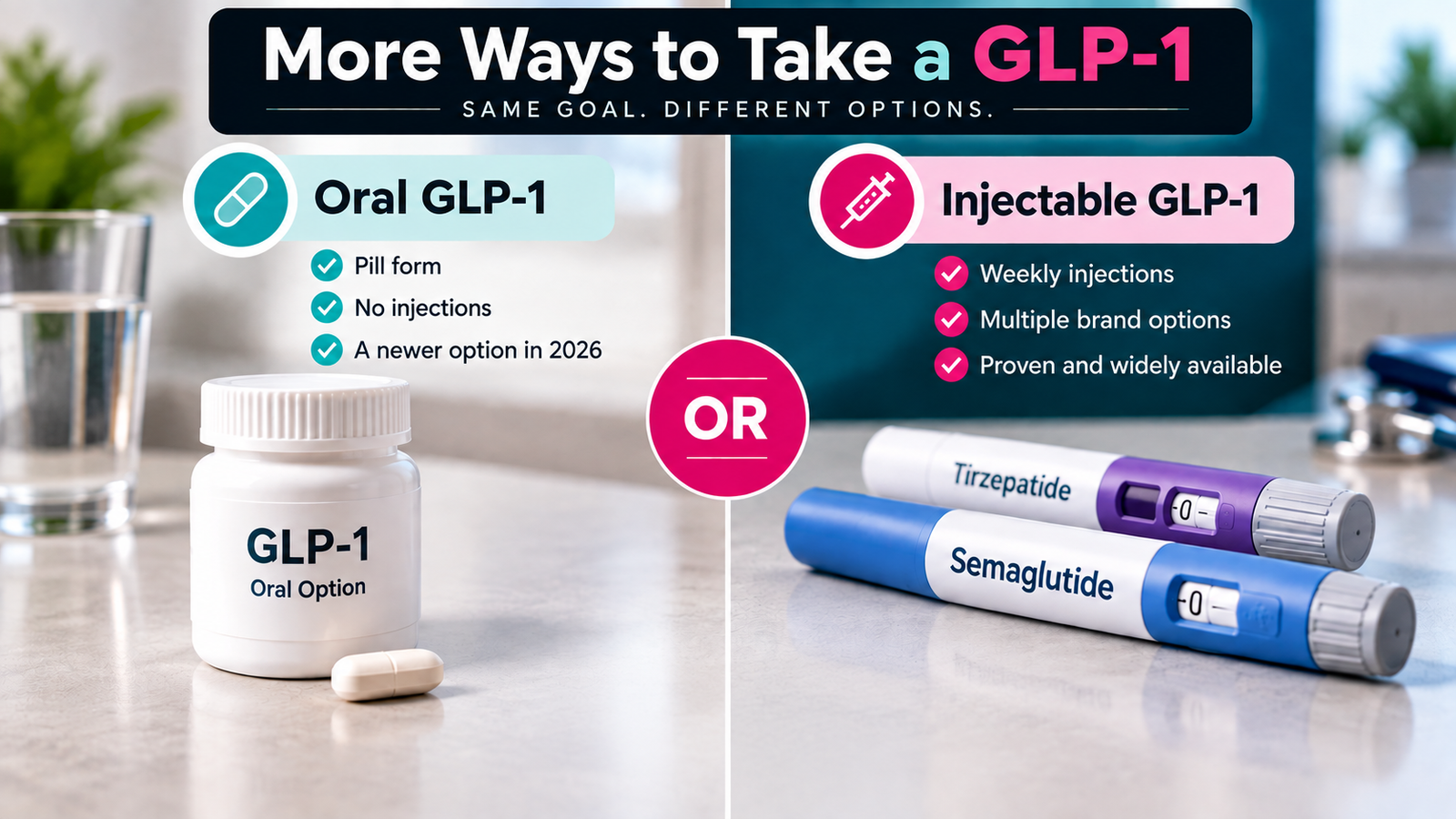
Oral semaglutide wasn’t completely new—Rybelsus has existed for Type 2 diabetes for years—but FDA approval of Wegovy tablets in late 2025 created an oral semaglutide option specifically approved for chronic weight management and certain cardiovascular-risk reduction uses.
That made 2026 the first full year in which consumers could seriously compare oral versus injectable GLP-1 weight-management treatment.
For some people, that matters enormously.
Fear of needles, comfort with self-injection, storage considerations and simply fitting treatment into daily life can all affect whether someone stays with a medication.
But the tablets shouldn’t be viewed as simply “Wegovy without the needle.”
Administration instructions, dosing and pharmacology can differ.
That’s why we’d compare the specific medication and treatment plan, not just the delivery method.
What This Means for You
Consumers now have another question to ask a clinician:
“Would an oral GLP-1 option make sense for me, or is an injectable still a better fit?”
That’s a genuine choice patients didn’t have to the same extent before.
2. Foundayo Added an Entirely New Oral GLP-1 Option
This is one of the biggest stories Wordform almost turned into an outdated prediction.
Orforglipron isn’t “coming soon.”
It arrived.
On April 1, 2026, the FDA approved Foundayo (orforglipron) for use with reduced-calorie diet and increased physical activity to reduce excess body weight and maintain weight reduction long term in adults with obesity or adults with overweight plus at least one weight-related condition.
What makes Foundayo particularly interesting is that it is an oral, non-peptide GLP-1 receptor agonist.
Unlike oral semaglutide, FDA labeling says Foundayo can be taken with or without food.
That’s a meaningful convenience difference.
It doesn’t mean one medication is automatically better than another. Effectiveness, side effects, medical history, price, insurance and availability still matter.
But it does mean the oral GLP-1 category is no longer built around one basic approach.
What This Means for You
When comparing treatment options, “pill or injection?” is no longer the end of the conversation.
Now it can also be:
Which pill? What are the dosing requirements? What’s covered? And what makes sense medically?
That’s a much more competitive marketplace than we had even a year ago.
3. Wegovy Got a Higher-Dose Option
Another real 2026 change received much less attention than the new pills.
On March 19, 2026, the FDA approved Wegovy HD, a new 7.2 mg weekly dose of semaglutide injection for weight reduction and long-term maintenance in qualifying adults.
That doesn’t mean everyone taking Wegovy should move to the higher dose.
It means clinicians now have another FDA-approved dosing option for appropriate patients.
And that matters because the GLP-1 market is increasingly moving away from a simple:
“Which drug are you taking?”
toward:
“Which drug, which formulation and which dose?”
Those distinctions can affect effectiveness, side effects, pricing and insurance coverage.
What This Means for You
If a provider advertises “Wegovy,” we wouldn’t assume all Wegovy treatment is identical.
We’d want to know:
Which formulation? Which dose? What’s the escalation plan? And does the price change at higher doses?
That last question is especially important if you’re paying cash.
Our 2026 GLP-1 medication cost guide breaks down how advertised pricing, manufacturer programs and dose-related costs can differ.
4. Medicare Opened a New $50 GLP-1 Access Pathway
This may be the biggest access story of 2026.
Beginning July 1, CMS launched the Medicare GLP-1 Bridge, a temporary demonstration that gives eligible Medicare Part D beneficiaries access to certain GLP-1 medications for weight management for a $50 copay per monthly supply. The program currently runs through December 31, 2027.
CMS currently lists eligible products including:
- Foundayo
- Wegovy injection and tablets
- Zepbound KwikPen
Eligibility requirements apply.
This is important because Medicare access to weight-management drugs has historically been one of the biggest barriers in the market.
The Bridge isn’t blanket coverage for every beneficiary and every GLP-1.
But for people who qualify, a predictable $50 monthly cost can dramatically change the affordability calculation.
What This Means for You
If you have Medicare Part D and previously assumed GLP-1 weight-management treatment was automatically out of reach, check again.
Don’t rely on what was true in 2025.
The rules changed in 2026.
5. The Compounded GLP-1 Market Changed After the Shortages Ended
This development probably matters more than most consumers realize.
A major reason compounded semaglutide and tirzepatide became so widely available was that the FDA-approved drugs had been in shortage.
But those shortage determinations changed.
FDA determined the tirzepatide injection shortage was resolved in December 2024 and the semaglutide injection shortage was resolved in February 2025. Transition periods for shortage-related enforcement discretion subsequently ended.
Then in April 2026, FDA issued another important clarification.
The agency reiterated that compounders must satisfy specific conditions under sections 503A and 503B, including restrictions involving products that are essentially copies of commercially available drugs.
FDA also stated that semaglutide and tirzepatide do not currently appear on either the FDA drug shortage list or the 503B bulks list.
That doesn’t mean compounding suddenly became illegal in every circumstance.
There can still be legitimate patient-specific uses under applicable law.
But the shortage-era environment that allowed much broader production of compounded copies has changed considerably.
What This Means for You
If a telehealth provider offers compounded semaglutide or tirzepatide, we’d ask more questions in 2026 than we might have a couple years ago.
Who is actually making it?
Why is a compounded version being prescribed?
What exact product are you receiving?
Is it coming from a 503A pharmacy or 503B outsourcing facility?
Our guide to compounded vs brand-name GLP-1 medications goes much deeper into those differences.
6. FDA Started Paying Much More Attention to GLP-1 Advertising
Another major change isn’t about the medications themselves.
It’s about how they’re being sold.
On March 3, 2026, the FDA announced warning letters to 30 telehealth companies over false or misleading claims involving compounded GLP-1 products.
Among the problems the agency identified were marketing that:
- implied compounded drugs were the same as FDA-approved medications;
- obscured the actual source of the compounded drug;
- made compounded products sound like FDA-approved generics.
FDA subsequently reminded telehealth companies that compounded drugs should not be promoted as though they have been FDA-approved or shown to produce the same results as FDA-approved medications.
This matters because telehealth advertising can make the buying process look incredibly simple:
Pick your medication. Pay your monthly fee. Lose weight.
Real medical care is more complicated than that.
Truth or Hype: “If a Website Says It’s Generic Ozempic, It Basically Is.”
HYPE.
A compounded semaglutide product is not an FDA-approved generic version of Ozempic or Wegovy.
FDA made that distinction explicit in its 2026 enforcement activity.
That’s why we’re increasingly suspicious of marketing that uses a famous brand-name drug to sell a different compounded product without making the distinction obvious.
Similar marketing language does not make two medications legally or medically equivalent.
7. GLP-1s Are Becoming More Than “Weight-Loss Drugs”
This is the broader story behind all the headlines.
GLP-1 medications started as diabetes treatments.
Then weight management became the story.
Now approved indications and clinical research increasingly involve cardiovascular disease, kidney outcomes, liver disease and other metabolic conditions.
But this is where we want to be especially careful.
There’s a big difference between:
“Researchers are studying this.”
and:
“The FDA has approved this medication for this condition.”
Those are not interchangeable.
For example, Wegovy already has FDA-approved uses beyond weight management, including reducing certain major cardiovascular risks in qualifying adults.
Oral Wegovy’s FDA approval also includes cardiovascular-risk reduction for qualifying adults.
Meanwhile, other conditions and treatments remain areas of active research.
What This Means for You
Expect the GLP-1 category to keep expanding.
But whenever you see a headline saying GLP-1s “treat” another disease, we’d check one thing first:
Is this an approved indication—or promising research?
That one question eliminates a lot of hype.
What Hasn’t Changed in 2026
With all the headlines, it’s easy to think GLP-1 treatment has suddenly become simple.
It hasn’t.
These are still prescription medications with risks, side effects, contraindications and different eligibility requirements.
Insurance remains complicated.
Provider quality varies.
Advertised prices aren’t always total prices.
And the newest drug isn’t automatically the best drug for a particular person.
That’s why we wouldn’t make a treatment decision based on:
“What’s hottest in 2026?”
We’d ask:
What medication fits my health situation, what will it actually cost me, and what support will I receive once I start?
That answer matters much more.
What We’d Check Before Choosing a GLP-1 Provider in 2026
The market changed this year, so some of the questions consumers should ask changed with it.
Before paying a provider, we’d want to know:
- Am I being prescribed an FDA-approved medication or a compounded one?
- What exact drug and formulation will I receive?
- Is an oral option appropriate for me?
- Will my price change as my dose increases?
- Does the provider help with insurance or prior authorization?
- Could I qualify for the Medicare GLP-1 Bridge?
- Who actually fills the prescription?
- What medical screening happens before treatment?
- What follow-up support is included?
- What is the total monthly cost—not just the advertised price?
Our Best GLP-1 Providers of 2026 comparison looks at many of those tradeoffs across telehealth providers.
Because at this point, choosing a provider isn’t just about finding somebody who can write a prescription.
It’s about understanding what you’re buying into after the prescription is written.
The Bottom Line
The most important GLP-1 changes in 2026 aren’t just flashy new drug launches.
They’re changes in choice, access and accountability.
Consumers have more oral treatment options.
Foundayo introduced a new type of oral GLP-1.
Wegovy gained a higher-dose injectable option.
Medicare created a new $50 access pathway for some beneficiaries.
The shortage-driven compounded market changed.
And the FDA became much more aggressive about misleading telehealth marketing.
That’s a lot of progress.
It’s also a lot more information for consumers to sort through.
So our advice hasn’t changed:
Don’t choose based on the loudest ad or newest headline.
Understand the medication.
Understand the provider.
Understand the real cost.
And understand what changed before assuming what you heard last year is still true today.
We don’t care which company you choose. We care that you know what you’re choosing.
Frequently Asked Questions
What are the biggest GLP-1 changes in 2026?
Major developments include the FDA approval of Foundayo (orforglipron), approval of the higher-dose Wegovy HD injection, increased availability of oral GLP-1 weight-management treatment, the Medicare GLP-1 Bridge, tighter rules affecting shortage-based compounding, and increased FDA enforcement involving misleading telehealth GLP-1 advertising.
Is there now a GLP-1 weight-loss pill?
Yes. Wegovy tablets were FDA-approved in late 2025 for chronic weight management in qualifying adults, and Foundayo (orforglipron), another oral GLP-1 option, was FDA-approved in April 2026.
Can Medicare pay for GLP-1 medications for weight loss in 2026?
Some eligible Medicare Part D beneficiaries can access certain GLP-1 medications through the Medicare GLP-1 Bridge for a $50 monthly copay. The demonstration began July 1, 2026, and currently runs through December 31, 2027. Eligibility requirements apply.
Are compounded semaglutide and tirzepatide still available?
They may still be compounded in certain circumstances when applicable legal requirements are met, but the shortage-based environment has changed. FDA states semaglutide and tirzepatide are not currently on its drug shortage list, and it has clarified restrictions involving compounded products that are essentially copies of commercially available drugs.
Is Foundayo the same thing as oral Wegovy?
No. Wegovy tablets contain semaglutide. Foundayo contains orforglipron, a different GLP-1 receptor agonist. FDA describes Foundayo as a once-daily oral medication that may be taken with or without food.
Medical note: This article is for educational purposes and isn’t medical advice. Medication choice, dosing and treatment decisions should be discussed with a qualified healthcare professional who knows your medical history.
Last checked: September 2026. GLP-1 approvals, pricing, insurance programs and regulatory policies can change.