Comparing Mochi vs Henry Meds vs OrderlyMeds isn’t as simple as finding the lowest advertised monthly price.
All three offer online weight-loss care. All three can connect eligible patients with prescription treatment. And all three currently offer compounded GLP-1 options.
But the way they charge, what they include, how they structure ongoing care, and how much support you get can be very different.
That is the part most comparison articles skip.
At Truth or Hype, we don’t pick winners. We show you what you’re actually buying.
Article at a Glance
- Mochi uses a membership model, with medical support included in the membership and medication priced separately.
- Henry Meds currently bundles provider access, medication, supplies, and shipping into its advertised weight-management subscription pricing.
- OrderlyMeds currently publishes some of the clearest all-in compounded GLP-1 pricing of the three, with no separate membership fee on those plans.
- Current Trustpilot ratings are strong for Mochi and Henry Meds, while OrderlyMeds is notably lower — but review scores should be treated as one signal, not a medical recommendation.
- The biggest differences are not just price. They include medication options, how pricing changes over time, cancellation rules, support, and how much ongoing care you want.
Quick Answer: Mochi vs Henry Meds vs OrderlyMeds
If you want a more guided program with ongoing physician access and care-team support, Mochi may appeal more to you.
If you prefer a bundled telehealth subscription where the advertised price includes the medication, provider access, supplies, and shipping, Henry Meds may feel more straightforward.
If you care most about simple published compounded GLP-1 pricing without a separate membership fee, OrderlyMeds currently makes that part easier to understand.
But none is automatically the “best” provider.
The better question is:
Which model fits the way you want to receive care — and what will it actually cost you after the introductory price disappears?
Mochi vs Henry Meds vs OrderlyMeds: Side-by-Side
| Factor | Mochi Health | Henry Meds | OrderlyMeds |
|---|---|---|---|
| Basic model | Membership + medication | Bundled telehealth subscription | Medication-focused monthly plans |
| Membership fee | Yes | Built into plan pricing | No separate membership fee on listed GLP-1 plans |
| Compounded semaglutide | Yes | Yes | Yes |
| Compounded tirzepatide | Yes | Oral option listed; offerings vary | Yes |
| Brand-name GLP-1 options | Yes | Varies by program | Wegovy and Zepbound listed |
| Provider support | Unlimited physician/care-team access with membership | Ongoing provider access included | Provider consultations/support included |
| Shipping | Included in medication price | Included | Included |
| Dose-based pricing | Yes | Depends on program | Current standard compounded monthly pricing does not increase by dose |
| Insurance help | Available for some brand-name treatment paths | Primarily self-pay | Primarily self-pay pricing |
| Current Trustpilot rating* | 4.5/5 | 4.4/5 | 3.6/5 |
*Trustpilot ratings change over time and should not be treated as proof of clinical quality.
Mochi currently shows more than 18,000 Trustpilot reviews with a 4.5 rating. Henry Meds is currently around 4.4 with more than 12,000 reviews. OrderlyMeds is currently around 3.6 with more than 600 reviews.
1. Mochi: More Structured Care, But Two Separate Costs
Mochi is built more like an ongoing weight-management program than a simple medication checkout page.
Its standard month-to-month membership is currently $79 per month, although new members may see a first-month promotional price of $39. That membership includes unlimited physician and care-team access, care coaching, messaging, and ongoing support.
Medication is not included in that membership fee.
That distinction matters.
If you see a Mochi ad promoting a low medication price, you still need to add the membership cost to understand your true monthly spend.
Mochi changed its pricing in 2026
This is one place where older comparison articles can already be wrong.
In August 2026, Mochi moved from flat medication pricing to per-dose pricing.
Compounded semaglutide currently starts at $60 per month, and compounded tirzepatide starts at $90 per month at the lowest doses. Mochi says the amount you pay depends on the dose prescribed.
So the real question isn’t:
“How much does Mochi start at?”
It is:
“What will my total cost be at the dose I am actually prescribed, including the membership?”
That is a much better number to compare.
What Mochi does well
Mochi includes more ongoing care than many medication-first platforms.
Its membership advertises unlimited physician access, care-team support, coaching and messaging. It also provides assistance with insurance documentation when a medication is on a patient’s formulary.
For someone who wants more hand-holding and ongoing contact, that may be worth paying a separate membership fee.
The tradeoff
Mochi’s pricing requires a little more math.
You have:
membership + medication + possible diagnostic costs
rather than one simple all-in number.
That does not make it bad pricing. It simply means you need to compare the total instead of the headline number.
2. Henry Meds: More Bundled Than Wordform Made It Sound
Henry Meds is often described as a simpler telehealth platform, but that can undersell what is actually included.
Its current weight-management page says that if treatment is prescribed, the subscription includes:
provider access, medication, applicable supplies and shipping.
Current advertised options include:
- Compounded injectable semaglutide: $197/month
- Compounded oral semaglutide: $164/month
- Compounded semaglutide microdose injection: $149/month
- Compounded oral microdose semaglutide: $99/month
- Compounded oral tirzepatide: $234/month
- Compounded liraglutide injection: $119/month
Those prices and promotions can change, so they should always be checked before enrolling.
What Henry Meds does well
The advantage is simplicity.
Instead of mentally adding a membership fee to the medication price, Henry’s current weight-management subscription presents many programs as bundled plans.
That can make the monthly cost easier to understand at first glance.
Henry also describes its model as ongoing care rather than one-and-done prescribing, with provider follow-up and treatment adjustments available over time.
The tradeoff
Henry’s legal terms deserve attention before signup.
Its current terms say subscriptions automatically renew unless canceled before renewal, and prescription products are generally final sale once shipped.
Multi-month commitments can also have different cancellation consequences than month-to-month plans.
That is exactly why we tell readers to look beyond the advertised monthly number.
Price matters. So does the exit door.
3. OrderlyMeds: The Clearest Compounded Pricing of the Three?
This was one of Wordform’s biggest misses.
OrderlyMeds actually publishes quite a bit of pricing information.
Its current pricing page lists standard monthly compounded semaglutide at $149 per month and compounded tirzepatide at $299 per month.
It also advertises lower introductory two-month starter pricing for new patients who qualify.
Orderly says there are no membership fees or hidden costs on those listed plans and that the price does not increase with the dose for the standard compounded medication pricing shown.
That is a meaningful difference.
What OrderlyMeds includes
Its compounded GLP-1 plans include medication if prescribed, provider consultation and support, syringes and supplies, and shipping.
Orderly also currently lists brand-name Wegovy and Zepbound plans, although the direct monthly prices shown on its site are much higher than the compounded options.
The tradeoff
Orderly’s current Trustpilot score is substantially lower than Mochi’s or Henry Meds’.
As of this review, OrderlyMeds is around 3.6 out of 5, with complaints in recent reviews involving shipping, billing, communication and customer-service resolution.
That does not mean every patient will have a poor experience.
It does mean we would not ignore the difference.
What Do the Review Scores Actually Tell Us?
This is where I would completely throw out Wordform’s strange 83.6-versus-64.6 scoring system.
Trustpilot currently shows:
- Mochi Health: 4.5/5, more than 18,000 reviews
- Henry Meds: 4.4/5, more than 12,000 reviews
- OrderlyMeds: about 3.6/5, more than 600 reviews
Those are useful signals.
But they are not a clinical ranking.
Review sites can tell you a lot about things like:
billing, shipping, support, communication and onboarding.
They are much less useful for deciding whether a particular medication is medically appropriate for you.
That’s a healthcare decision.
What the recent complaints have in common
Across these providers, negative reviews frequently mention some version of the same problems:
delayed responses, shipment problems, billing confusion or frustration getting an issue resolved.
At the same time, many positive reviewers describe smooth onboarding, helpful providers and successful support experiences.
The point is not that one side is “right.”
The point is that when a telehealth system works, people tend to love the convenience.
When something breaks, the quality of the support system suddenly matters a lot more.
Truth or Hype? The Cheapest GLP-1 Provider Is the Best Deal
HYPE.
A lower monthly medication price can absolutely matter.
But the cheapest advertised number does not tell you:
- whether a separate membership is required
- whether the price rises with dose
- whether shipping is included
- whether provider follow-up is included
- whether insurance help is available
- whether you’re locking into multiple months
- whether cancellation is easy
- whether prescription medication is refundable
- or what happens when an order is delayed
A cheap program with poor support can become expensive very quickly.
And a more expensive program may be worth it for someone who values more clinical contact.
Price is one part of the decision — not the entire decision.
That’s exactly why we investigated why a $99 GLP-1 price may not be what you actually pay.
The Biggest Pricing Difference: How Each Company Charges
Here’s the simplest way to think about these three.
Mochi
You pay for the membership, then pay separately for the medication.
Current standard membership: $79/month
Compounded semaglutide: starting at $60/month
Compounded tirzepatide: starting at $90/month
Because medication is dose-priced, your actual total can change as your prescribed dose changes.
Henry Meds
Many current weight-management programs are presented as bundled monthly subscriptions.
For example, compounded injectable semaglutide is currently advertised at $197/month, including provider access, medication, supplies and shipping if prescribed.
OrderlyMeds
Current standard compounded monthly pricing is listed as:
Semaglutide: $149/month
Tirzepatide: $299/month
with no separate membership fee on those plans.
Orderly also says standard compounded pricing does not increase by dosage.
That’s why simply comparing three advertisements can be misleading.
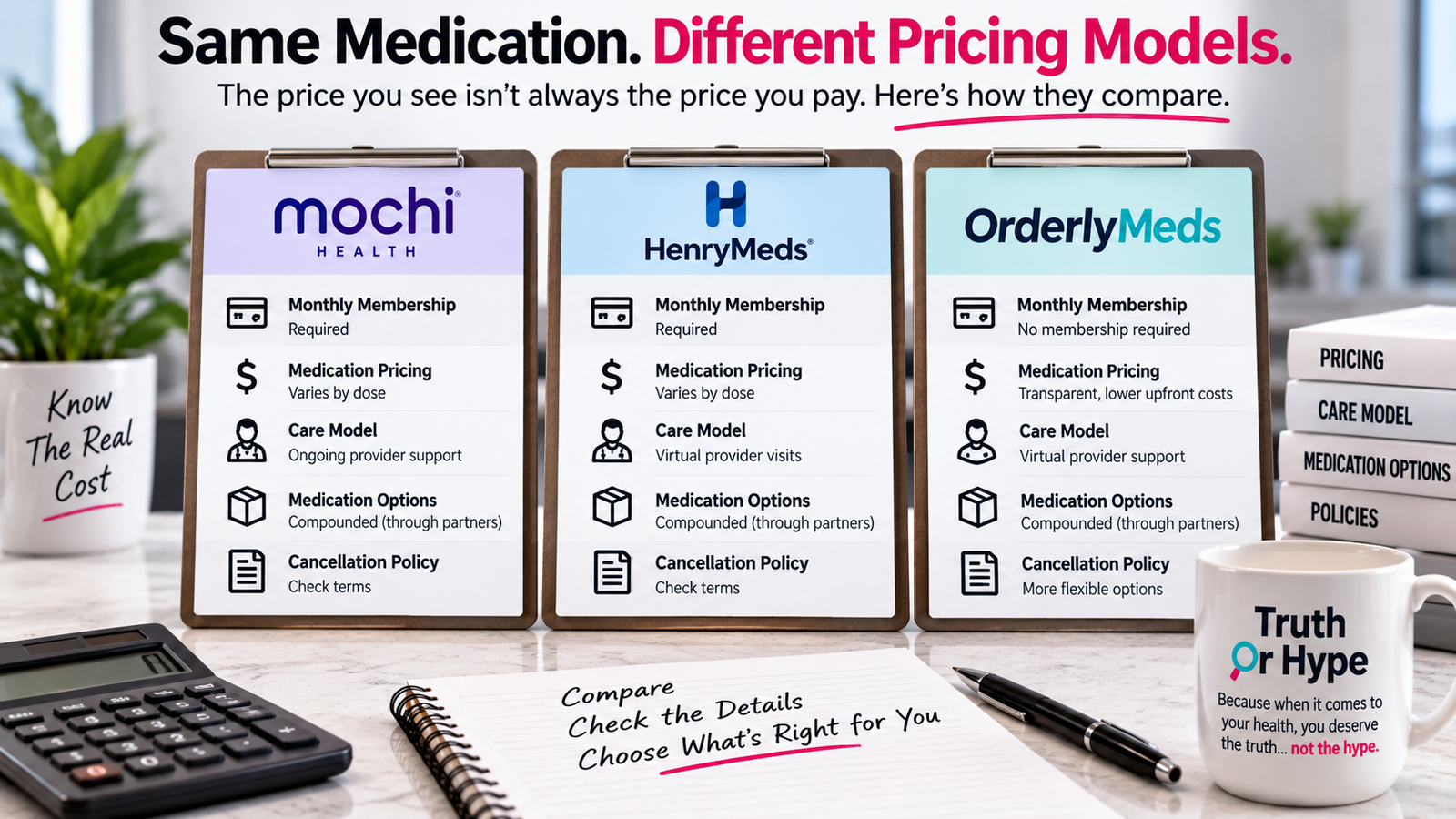
We’ve also broken down GLP-1 medication costs in 2026, including medication prices, insurance and the extra costs consumers should check.
They’re not always advertising the same thing.
What About Brand-Name GLP-1 Medications?
This matters because not every patient wants compounded medication.
Mochi currently offers access to branded medications including Zepbound and Mounjaro, with medication costs separate from the membership.
OrderlyMeds currently lists both Wegovy and Zepbound plans in addition to compounded options.
Henry’s weight-management lineup currently emphasizes compounded options on the public pricing pages we reviewed.
That difference may matter if your priority is specifically receiving an FDA-approved brand-name medication rather than a compounded preparation.
A Very Important Note About Compounded GLP-1s
This is another place Wordform gave us stale information.
Compounded GLP-1 medications are not FDA-approved, and FDA does not review them for safety, effectiveness or quality before they are marketed.
The shortage environment has also changed.
Semaglutide and tirzepatide are no longer on FDA’s shortage list, and the broad shortage-era environment that allowed widespread copies of branded products has narrowed considerably.
Compounding may still occur under specific legal conditions and based on individual patient needs, but it is no longer accurate to simply say:
“These drugs can be compounded because Wegovy or Zepbound are in shortage.”
That is outdated.
This is why our earlier guide on compounded vs. brand-name GLP-1 medications is worth reading before choosing any provider offering a compounded option.
Cancellation Rules Could Matter More Than You Think
This is one area I would check before entering a credit card.
Mochi
Prescription medication sales are final and cannot generally be returned or refunded.
Henry Meds
Henry says you can cancel through your account or support channels, but multi-month plans may require paying the remaining balance unless treatment must stop for medical reasons.
Its current terms also say subscription fees are generally non-refundable once used and medications are final sale once shipped.
OrderlyMeds
Orderly says you can cancel before the doctor finalizes your prescription.
After the prescription is written, cancellation is generally no longer possible for that order.
Multi-month plans have additional restrictions.
That is why our rule is simple:
Read the cancellation policy before you need the cancellation policy.
Which Provider Might Fit Which Type of Consumer?
We wouldn’t declare one universal winner.
But there are clear tradeoffs.
Mochi may make more sense if…
You want ongoing physician access, coaching, messaging and a more structured program.
You’re comfortable paying a membership plus medication separately.
And you value help navigating insurance for certain brand-name medications.
Henry Meds may make more sense if…
You prefer bundled pricing and a familiar telehealth model.
You want provider access, medication, supplies and shipping rolled into one advertised subscription.
And you understand the renewal and cancellation terms before enrolling.
OrderlyMeds may make more sense if…
You want clearly published compounded semaglutide or tirzepatide pricing without a separate membership fee.
You like the idea of flat standard compounded pricing that doesn’t rise with dosage.
And you’re comfortable weighing that pricing simplicity against its lower current consumer-review rating.
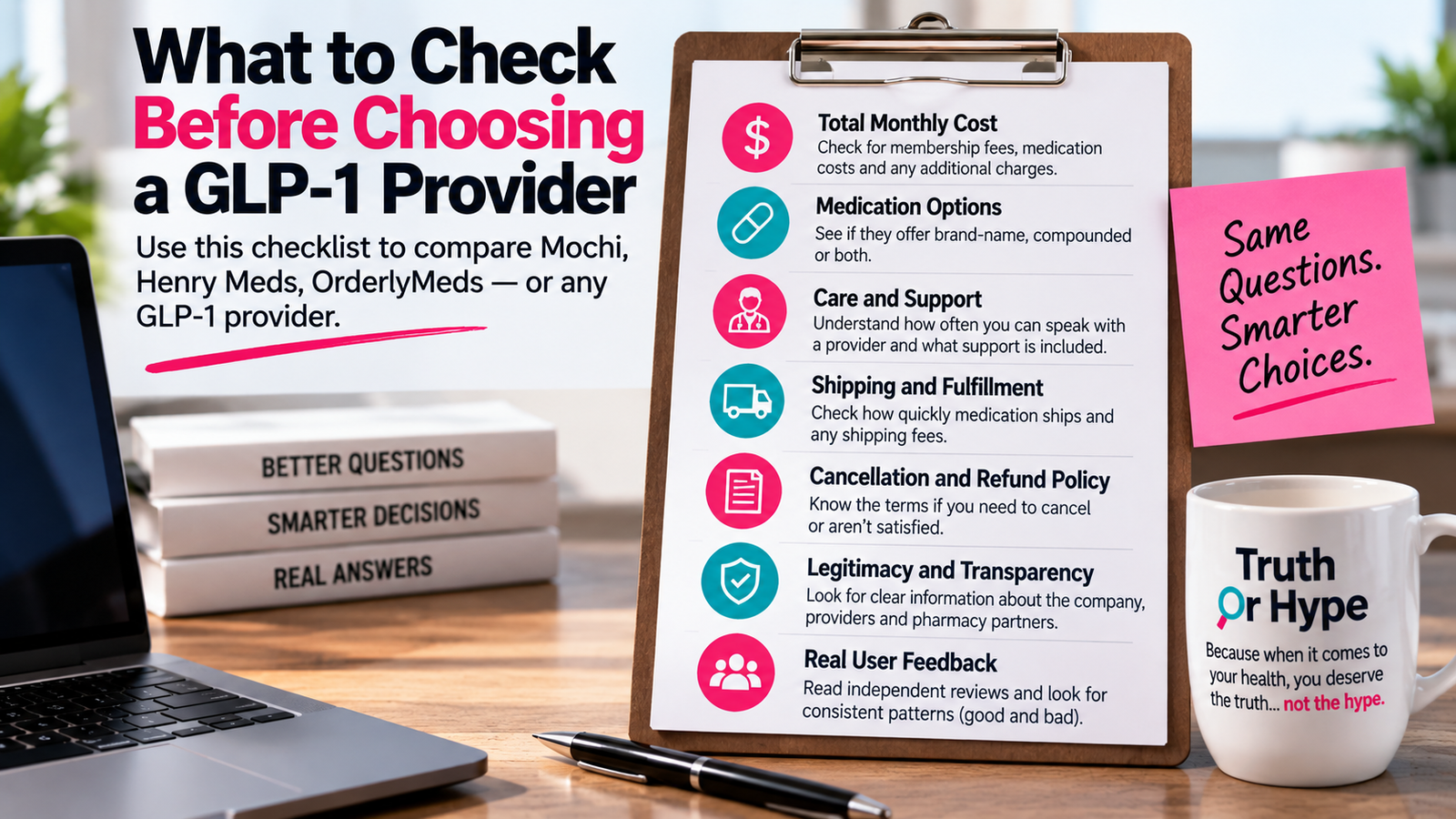
What We’d Check Before Choosing Any of the Three
Before signing up, we would ask:
- What exact medication will I receive?
- Is it FDA-approved or compounded?
- What pharmacy will fill the prescription?
- What is my total cost this month?
- Can my cost increase if my dose changes?
- Is there a separate membership fee?
- Is shipping included?
- Are provider follow-ups included?
- Is insurance or prior-authorization help available?
- Am I committing to one month or several?
- When does the next charge occur?
- What happens if I cancel?
- Can prescription medication be refunded?
- Who do I contact if a shipment is late?
- What happens if I need a dosage adjustment?
If a provider cannot answer those questions clearly, that tells you something too.
Bottom Line
The biggest difference between Mochi vs Henry Meds vs OrderlyMeds is not which one has the flashiest price.
It is how each company packages care.
Mochi separates its membership from medication and offers a more structured support model.
Henry Meds currently bundles many weight-management services into one subscription price.
OrderlyMeds currently offers the simplest published standard pricing for compounded semaglutide and tirzepatide, without a separate membership fee.
None is automatically right for everyone.
And that’s exactly why we don’t name a winner.
We don’t care which company you choose. We care that you know what you’re choosing.
Frequently Asked Questions
Is Mochi cheaper than Henry Meds?
Not necessarily.
Mochi currently charges a $79 monthly membership plus the cost of medication. Its compounded semaglutide starts at $60 at the lowest dose, meaning an entry-level total could begin around $139 before any other applicable costs.
Henry Meds currently advertises compounded injectable semaglutide at $197 per month as a bundled subscription including provider access, medication, supplies and shipping if prescribed.
The better comparison is your total ongoing cost at the dose you actually use.
Does OrderlyMeds charge a membership fee?
Its current compounded GLP-1 pricing page says there are no separate membership fees or hidden costs on the listed plans.
Does the price increase with dose at OrderlyMeds?
OrderlyMeds currently says its standard compounded medication price is the same regardless of dosage.
Which one has the best reviews?
At the moment, Mochi and Henry Meds both have significantly higher Trustpilot ratings than OrderlyMeds.
But consumer-review scores should be treated as one piece of evidence, not as a substitute for evaluating medical care, medication suitability, pricing and policies.
Are compounded GLP-1 medications the same as Ozempic, Wegovy or Zepbound?
No.
Compounded products are not FDA-approved copies or generics of those medications, even when they involve the same named active ingredient.
FDA-approved brand-name products and compounded preparations operate under different regulatory frameworks.
Medical note: This article is for consumer education and is not medical advice. Eligibility, medication choice and dosing should be determined by a licensed healthcare professional.
Pricing note: Prices, promotions, medication availability and provider policies can change. Pricing above was checked in September 2026 and should be confirmed with the provider before enrolling.