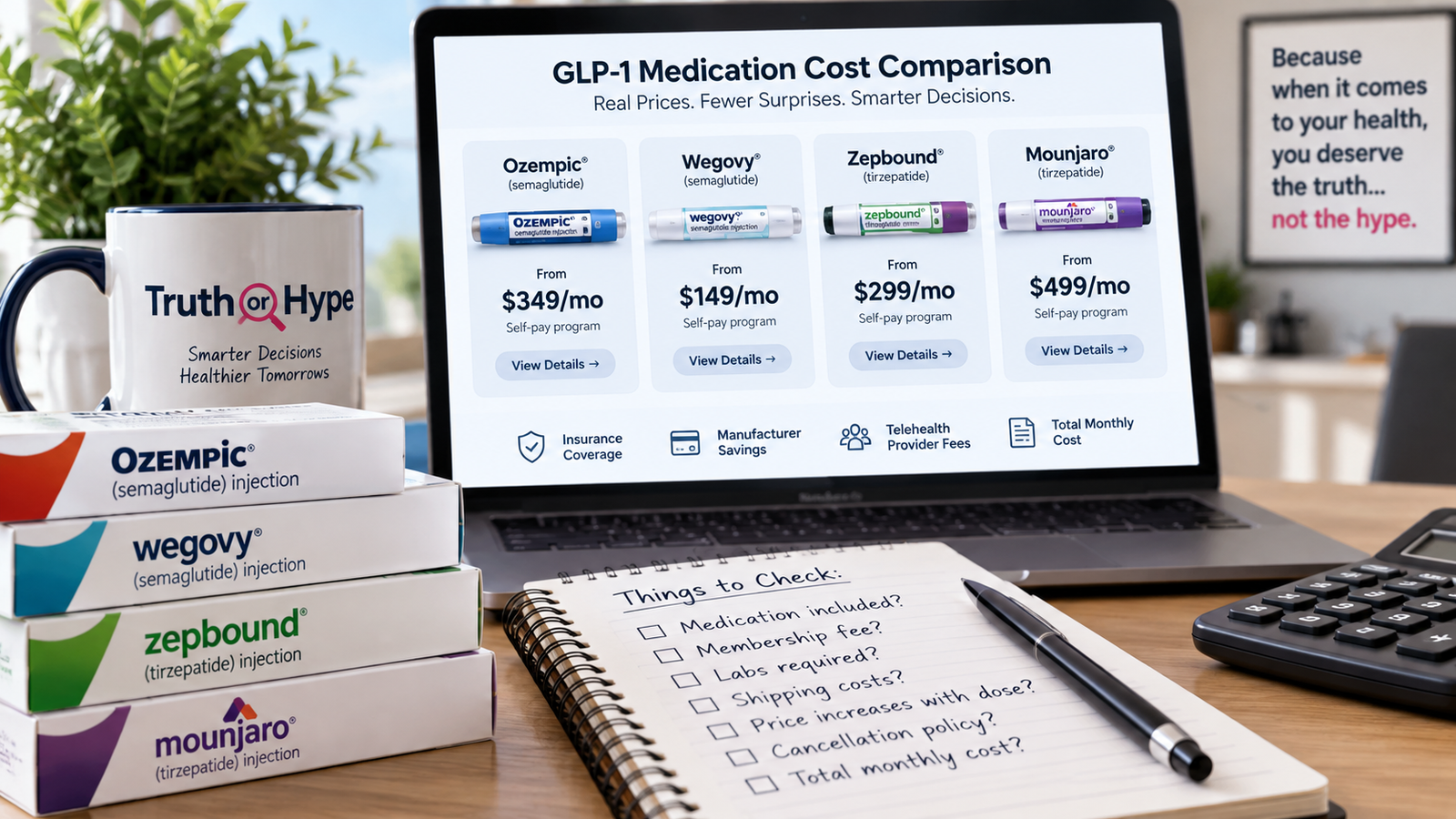
Quick Answer
GLP-1 medication costs in 2026 can range from $25 to well over $1,000 per month, depending on the drug, your insurance, the dose, and whether you qualify for a manufacturer savings or self-pay program.
Depending on the drug, your insurance, the dose, and whether you qualify for a manufacturer savings or self-pay program.
That huge range is exactly why GLP-1 pricing can be so confusing.
For example, Wegovy carries a manufacturer list price of $1,349.02 per package, but Novo Nordisk currently offers much lower direct self-pay pricing for eligible patients.
Zepbound also has manufacturer-direct self-pay options starting at $299 per month, with the price changing by dose and program terms.
And if you’re comparing online GLP-1 providers, there’s another wrinkle: the price in the advertisement may not be the total price you’ll actually pay.
Membership fees, medication charges, lab costs, shipping, dose increases, and other fees can change the real monthly cost.
So before deciding whether a GLP-1 treatment fits your budget, don’t ask only:
“What’s the monthly price?”
Ask:
“What will I actually pay each month for everything I need?”
Key Takeaways
- There is no single GLP-1 price. List price, insurance price, manufacturer self-pay price, and telehealth pricing can all be very different.
- Manufacturer self-pay programs have changed the math. Some branded GLP-1 options now cost hundreds of dollars less than their official list prices for eligible patients.
- Always compare the total cost of treatment. A low advertised price doesn’t mean much if required membership fees, medication charges, labs, shipping, or higher-dose pricing are added later.
Why Are GLP-1 Prices So Confusing?
Because the number you see first may not be the number that matters.
There are several different prices you may encounter while shopping for or researching GLP-1 treatment.
List price is the manufacturer’s published price before insurance, rebates, discounts, or assistance.
Insurance price is what you’re responsible for after your health plan processes the prescription. That can vary enormously from one plan to another.
Manufacturer self-pay price is a special cash price offered directly through programs from drug manufacturers such as Novo Nordisk or Eli Lilly. Eligibility and program rules apply.
Telehealth price is what an online provider advertises for its service or treatment program. Depending on the provider, that number may or may not include the medication and other required costs.
That’s why comparing two GLP-1 prices without knowing what each price includes can be misleading.
How Much Does Ozempic Cost in 2026?
Novo Nordisk currently lists Ozempic at $1,027.51 per pen.
But that doesn’t mean everyone pays $1,027.51.
Novo Nordisk’s current NovoCare self-pay program lists Ozempic at $349 per month for the 0.25/0.5 mg and 1 mg pens and $499 per month for the 2 mg pen, subject to eligibility and program terms.
As of September 2026, new eligible patients can also receive the 0.25/0.5 mg pen for $199 for each of their first two 28-day fills under a limited-time offer scheduled to run through December 31, 2026.
Insurance can reduce the patient’s cost further depending on coverage and eligibility for savings programs.
The important distinction is this:
$1,027.51 is the list price. It isn’t automatically your price.
How Much Does Wegovy Cost in 2026?
Wegovy’s manufacturer list price is currently $1,349.02 per package.
But Novo Nordisk also offers substantially lower self-pay pricing.
For Wegovy injection, eligible new patients can currently pay $199 per month for the first two 28-day fills of the 0.25 mg and 0.5 mg doses under a limited-time offer through December 31, 2026.
After the introductory offer, NovoCare currently lists the standard self-pay price at $349 per month for Wegovy injection doses from 0.25 mg through 2.4 mg, while the 7.2 mg HD injection is listed at $399 per month.
Wegovy is also now available as a daily pill. Current NovoCare self-pay pricing starts at $149 per month for the 1.5 mg dose, with higher doses costing more.
Again, the difference between a $1,349 list price and a much lower manufacturer self-pay price shows why simply searching for “the price of Wegovy” doesn’t tell you the whole story.
How Much Does Zepbound Cost in 2026?
Zepbound provides another good example of why the dose and program matter.
Eli Lilly currently offers Zepbound through its self-pay program starting at:
| Zepbound dose | Current self-pay price* |
|---|---|
| 2.5 mg | $299/month |
| 5 mg | $399/month |
| 7.5 mg–15 mg | $449/month with qualifying Self Pay Journey Program pricing |
**Important: The $449 monthly price for the 7.5 mg, 10 mg, 12.5 mg, and 15 mg doses is tied to Lilly’s Self Pay Journey Program.
To continue receiving that price, the next refill purchase generally must be completed within 45 days of receiving the previous prescription.
If that requirement isn’t met, Lilly currently lists regular prices of $499 for 7.5 mg and $699 for the 10 mg, 12.5 mg, and 15 mg doses. Eligibility, taxes, fees, and other program terms apply.
There’s an important catch with the $449 higher-dose price.
To continue receiving that Self Pay Journey Program price for the 7.5 mg through 15 mg doses, Lilly currently requires the refill purchase to be completed within 45 days of receiving the previous prescription.
If that condition isn’t met, Lilly’s regular self-pay prices are higher.
That’s exactly the kind of detail we think consumers should know before deciding what something costs.
What About Mounjaro?
Mounjaro contains tirzepatide, the same active ingredient used in Zepbound, but Mounjaro is indicated for Type 2 diabetes rather than weight management.
Lilly currently lists Mounjaro’s official list price at $1,112.16 for a 28-day supply.
Lilly currently offers savings options that can reduce what eligible commercially insured patients pay for Mounjaro.
For patients with commercial insurance that does not cover Mounjaro, Lilly’s current savings program may reduce the cost to $499 for a one-month prescription, subject to eligibility, maximum savings, and program terms.
Patients whose commercial insurance covers Mounjaro may qualify to pay as little as $25 for a one- or three-month prescription, also subject to program limits and eligibility.
Insurance coverage can again change the amount a patient actually pays.
This is also why comparing Mounjaro and Zepbound solely by active ingredient can be misleading. Their indications, insurance coverage and manufacturer pricing programs can differ even though both contain tirzepatide.
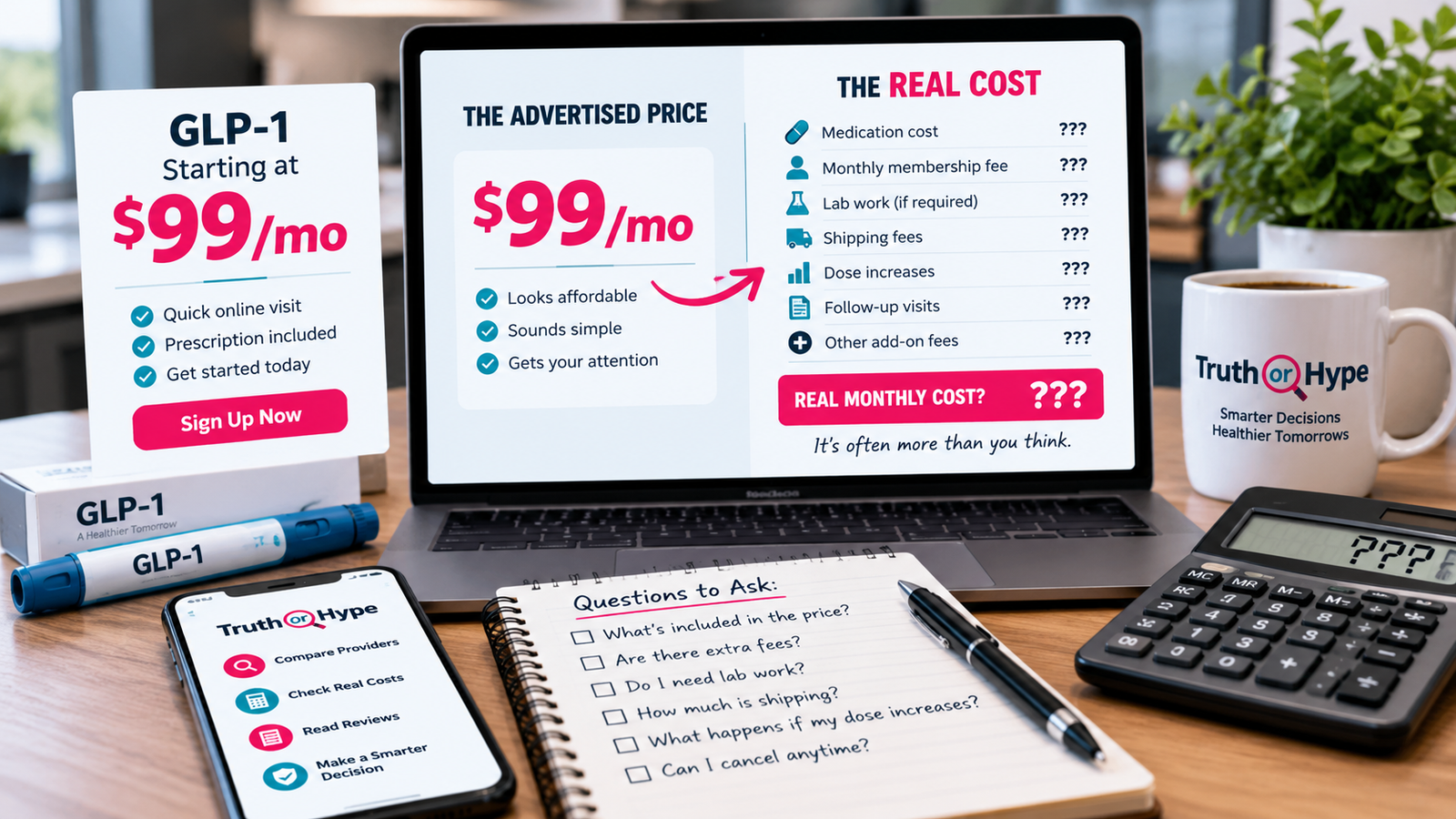
Why Can an Online GLP-1 Program Advertise $99 or $199 a Month?
This is where we think consumers need to slow down and read carefully.
An advertised price isn’t necessarily fake.
But it also isn’t necessarily the total price of treatment.
We broke down why a $99 GLP-1 price may not be what you actually pay in our deeper investigation.
A telehealth company may advertise:
“GLP-1 treatment starting at $99/month.”
Before assuming that’s your final cost, check whether the advertised amount includes:
- the medication
- the telehealth membership
- provider consultations
- required laboratory testing
- shipping
- supplies
- higher medication doses
- follow-up appointments
- cancellation or minimum-commitment requirements
A company could legitimately advertise a low starting price while the amount some customers ultimately pays is considerably higher.
That’s why we care much more about total monthly cost than the biggest number in an advertisement.
Truth or Hype: “GLP-1 Treatment for $99 a Month”
TRUTH: A company may legitimately offer part of its GLP-1 program, an introductory period, or a particular medication or dose at a very low starting price.
HYPE: Assuming that advertised price automatically represents everything you’ll pay each month.
The question isn’t whether the advertised number is technically true.
The better question is:
What’s included — and what’s not?
That’s the number we’d want to know before handing over a credit card.
Does Insurance Make GLP-1 Medications Cheaper?
It certainly can, but coverage depends on the medication, why it was prescribed, and your specific health plan.
That’s one reason two people taking a GLP-1 medication can have completely different out-of-pocket costs.
Commercially insured patients may also qualify for manufacturer savings programs. For example, Novo Nordisk currently says eligible commercially insured Wegovy patients may pay as little as $25 per month, subject to program limits and restrictions.
Government insurance is different, and manufacturer savings cards generally have restrictions involving government-funded coverage.
There’s also been a major Medicare development in 2026.
CMS launched the Medicare GLP-1 Bridge on July 1, 2026. Under the temporary program, eligible Medicare Part D beneficiaries can obtain certain qualifying GLP-1 medications for weight management with a $50 copay.
The program has specific eligibility rules and currently runs through December 31, 2027.
We’re keeping the Medicare discussion short here because Medicare GLP-1 coverage deserves its own guide.
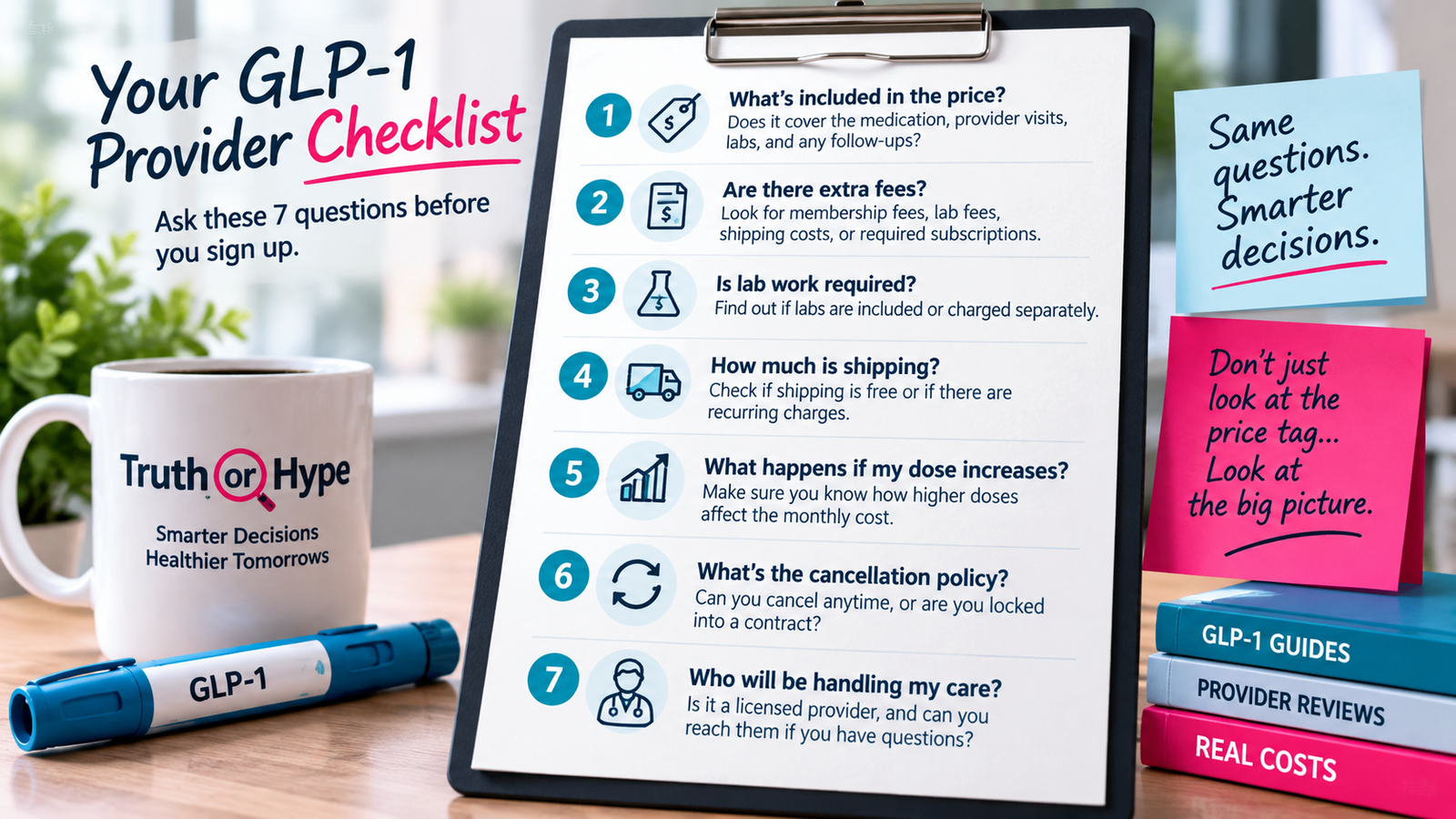
What Should You Check Before Choosing a GLP-1 Provider?
Before signing up for an online GLP-1 program, we’d want clear answers to these questions:
1. Is the medication included in the advertised price?
Don’t assume it is.
2. Is that the regular price or an introductory price?
Find out what you’ll pay after the promotion ends.
3. Does the price increase as your dose increases?
This can make a substantial difference over time.
4. Is there a separate monthly membership fee?
A cheap medication price plus an expensive membership isn’t necessarily a cheap program.
5. Are labs, consultations, supplies, and shipping included?
Small recurring charges add up.
6. Is there a minimum commitment or cancellation fee?
Know how easy — and expensive — it is to leave.
7. What would 6 months actually cost?
This may be the most useful question of all.
Take every required charge you can identify and calculate the total.
A program advertised at $199 per month that actually costs $350 per month after required fees isn’t necessarily a bad deal.
But you deserve to know it’s a $350 deal before you buy it.
The Bottom Line
GLP-1 medications can still be expensive in 2026, but the old idea that everyone without insurance has to pay $1,000 or more per month is no longer accurate.
Manufacturer self-pay programs have created legitimate branded options in the hundreds of dollars per month, and insurance or other qualifying programs can sometimes reduce the cost considerably further.
But lower prices have also made comparison shopping more complicated.
Don’t compare advertisements. Compare total costs.
Before choosing a medication or provider, find out:
What am I getting?
What’s included?
What isn’t included?
Does the price change later?
And what will I actually spend over the next six months?
That’s the number that matters.
At Truth or Hype, we don’t care which company you choose.
We care that you know what you’re choosing.
Frequently Asked Questions
What is the cheapest GLP-1 medication without insurance in 2026?
There isn’t one answer for everyone because prices depend on the medication, formulation, dose, eligibility, and available manufacturer programs. Among the branded options discussed here, current manufacturer self-pay pricing can start in the hundreds of dollars per month, with some Wegovy options starting at $149 and Zepbound starting at $299. Limited-time introductory offers may reduce certain prices further. Always check the current manufacturer terms because these programs can change.
Can you really get a GLP-1 for $199 a month?
Yes, in some situations. For example, Novo Nordisk currently offers qualifying new patients certain starting doses of Wegovy injection and Ozempic for $199 per month for their first two eligible fills under limited-time offers. But a $199 telehealth advertisement can mean something completely different, so check whether medication, membership, labs, shipping, and other required costs are included.
Why does one website say a GLP-1 costs $1,000 while another says $299?
They may be quoting different types of prices. One could be the manufacturer’s official list price while another is a special self-pay price, insurance price, savings-program price, introductory offer, or telehealth starting price. Before comparing two numbers, make sure you’re comparing the same thing.
Last updated: September 8, 2026
Editorial note: Prices and savings programs can change. We verify pricing against manufacturer and government sources when this guide is updated, but readers should confirm current eligibility, program terms, coverage and final cost directly with the manufacturer, insurer, pharmacy or provider before making a decision. This article is for consumer education and is not medical advice.