
Reaching your goal weight on a GLP-1 can feel like crossing the finish line.
Except there’s one problem.
You may not actually be at the finish line.
You’ve lost the weight. Your clothes fit differently. Maybe your blood pressure, blood sugar or other health markers improved along the way.
So now comes a question that thousands of people taking these medications eventually have to answer:
What am I supposed to do now?
Continue the medication? Lower the dose? Stop altogether? Keep eating exactly the same way? Worry about gaining everything back?
There isn’t one answer that fits everyone.
But there is enough research now to know that reaching your GLP-1 goal weight deserves a plan of its own.
Article at a Glance
- Reaching goal weight doesn’t automatically mean it’s time to stop your GLP-1 medication.
- Clinical trials show substantial weight regain is common after semaglutide or tirzepatide is withdrawn.
- There is no universally proven tapering schedule for coming off a GLP-1 after weight loss.
- Maintenance treatment should be individualized around your health, medication response, side effects, cost and goals.
- Nutrition, physical activity, strength, sleep and continued medical follow-up still matter after the scale reaches your target.
Quick Answer: What Happens After You Reach Your GLP-1 Goal Weight?
Reaching your goal weight usually changes the conversation from losing weight to maintaining it.
For some people, that may mean continuing their current medication. For others, a clinician may adjust the treatment based on effectiveness, side effects, other medical conditions and personal circumstances.
What shouldn’t happen is assuming that reaching a certain number on the scale automatically means the medication has finished its job.
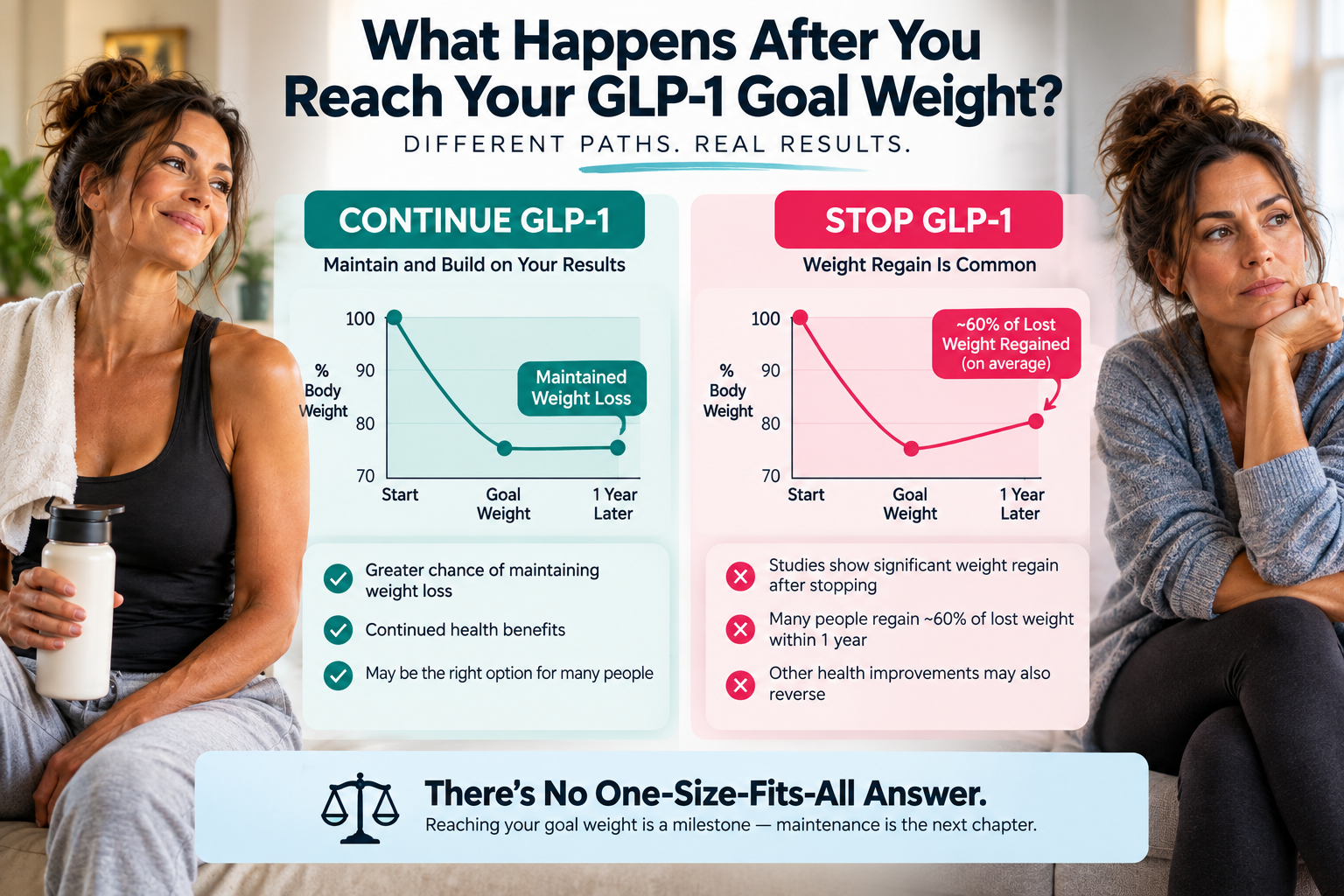
Research consistently shows that weight regain can occur after GLP-1 treatment is stopped. A 2026 systematic review found that, on average, about 60% of the weight lost during treatment had been regained one year after GLP-1 therapy ended.
That doesn’t mean everyone regains the weight.
It does mean maintenance deserves its own strategy.
Reaching Goal Weight on a GLP-1 Is a New Phase — Not Necessarily the End
One of the easiest mistakes to make is thinking of a GLP-1 medication the same way you might think about an antibiotic:
Take it. Fix the problem. Stop taking it.
Weight management doesn’t necessarily work that way.
Obesity is increasingly treated as a chronic, relapsing condition, and current medical guidance recognizes that some people may need ongoing pharmacotherapy after weight-loss goals have been reached. The 2026 American Diabetes Association Standards of Care, for example, specifically notes that obesity medications may need to continue after weight reduction to help sustain weight and health benefits.
That doesn’t mean everyone must stay on a GLP-1 forever.
It means reaching your goal weight is a good time to ask:
“What does maintenance look like for me?”
That’s a much better question than simply:
“Can I stop now?”
What Happens If You Stop Taking a GLP-1 After Reaching Goal Weight?
We wrote an entire guide about what happens when you stop taking a GLP-1, but the short version is this:
For many people, some weight regain occurs.
And that’s not based on internet horror stories.
It’s what clinical trials have found.
What happened after semaglutide was stopped?
In the STEP 1 extension, participants taking semaglutide 2.4 mg lost an average of 17.3% of their starting body weight during treatment.
One year after semaglutide and the study lifestyle intervention were stopped, participants had regained 11.6 percentage points of that loss — roughly two-thirds of the weight they had previously lost.
Several cardiometabolic improvements also moved back toward baseline.
What happened after tirzepatide was stopped?
Tirzepatide produced a similar lesson.
In the SURMOUNT-4 trial, people first received tirzepatide and lost substantial weight. Participants were then randomized either to continue tirzepatide or switch to placebo.
Those who continued treatment maintained and added to their weight loss.
Those who stopped regained a significant amount.
More recent analysis of SURMOUNT-4 found that most participants who had tirzepatide withdrawn regained at least 25% of the weight they had initially lost within the following year. Greater regain was also associated with greater reversal of improvements in measures such as waist circumference, blood pressure and blood sugar.
And a larger 2026 systematic review looking across GLP-1 studies estimated that participants had regained about 60% of their lost weight one year after treatment stopped.
That’s much more useful than saying:
“Everybody gains everything back.”
Because that isn’t what the evidence says either.
Truth or Hype?
“Once You Reach Your Goal Weight, You’re Done With the GLP-1.”
HYPE.
Reaching goal weight does not automatically tell you whether you should continue, reduce, change or stop treatment.
Withdrawal studies show that substantial weight regain can occur after GLP-1 and GIP/GLP-1 medications are discontinued.
But they also don’t prove that every person needs the same medication at the same dose forever.
The better approach is to treat your goal weight as the beginning of a maintenance conversation with your healthcare provider.
The number on the scale tells you where you are. It doesn’t tell you what your treatment should be.
Do You Have to Stay on a GLP-1 Forever?
This is probably the biggest question people have once they reach their goal.
And anyone giving you a universal yes or no is oversimplifying it.
For some people, continued pharmacologic treatment may make sense because the medication remains effective, tolerable and medically appropriate.
For someone else, side effects, cost, insurance changes, pregnancy plans, another health condition or personal preference may change the equation.
Current clinical guidance increasingly treats obesity medication as potentially long-term therapy rather than something that automatically ends after a certain amount of weight loss.
But long-term treatment does not mean identical treatment forever.
Medications such as Zepbound have FDA-approved maintenance doses, and treatment response and tolerability are considerations when choosing among them.
That’s very different from inventing your own maintenance plan.
Should You Lower Your GLP-1 Dose After Reaching Goal Weight?
Maybe.
But this is where the internet gets messy.
You’ll find people describing everything from reducing doses to spacing injections farther apart to stopping gradually.
What we don’t yet have is strong randomized evidence showing that one particular tapering schedule is the proven way to come off these medications.
A 2026 review specifically noted that no randomized controlled trials had established a standard tapering, transition or maintenance regimen after GLP-1 withdrawal. Other 2026 reviews reached essentially the same conclusion: tapering and extended dosing strategies are being explored, but robust evidence is still limited.
So we’re not going to give you one of those:
“Reduce your dose every four weeks and you’ll be fine”
plans.
That would sound useful.
It just wouldn’t be supported well enough yet.
Your prescriber can help determine whether your existing dose still makes sense or whether another approach should be considered.
And don’t turn Reddit into your pharmacist.
Reading other people’s experiences can be helpful.
Copying their medication schedule isn’t.
What About Spacing Your GLP-1 Shots Farther Apart?
This is another huge topic in GLP-1 communities.
Someone reaches goal weight and starts taking an injection every 10 days.
Another person says every two weeks works for them.
Someone else lowers the dose.
Those are real experiences.
They are not the same thing as established treatment guidelines.
Extended-interval and reduced-intensity approaches are being studied, but researchers in 2026 continue to describe the evidence as preliminary.
That makes this a perfect example of what Truth or Hype is supposed to do:
We can tell you what people are trying without pretending science has already proved it works.
What Happens to Hunger and “Food Noise” During Maintenance?
One of the reasons people worry about reaching goal weight isn’t the scale.
It’s this:
“What if the hunger comes back?”
GLP-1 medications affect appetite and satiety while you’re taking them. As medication effects diminish after treatment is discontinued, those effects can diminish too.
How noticeable that feels varies.
Some people describe a return of hunger or what they call “food noise.” Others experience a more gradual change.
What we wouldn’t tell you is that everyone suddenly becomes ravenously hungry the moment a dose is missed.
Bodies don’t work from a script.
But if appetite becomes noticeably harder to manage after a treatment change, that’s useful information to discuss with your prescriber.
Maintenance Isn’t About Keeping the Scale Frozen
Another misconception worth getting rid of:
Your goal weight isn’t supposed to be a mathematically perfect number every morning.
Body weight naturally changes because of hydration, food intake, bowel movements, hormones and other everyday factors.
Maintenance is better thought of as a trend or range, not a contest to see whether you can make the bathroom scale display the exact same number for the next ten years.
And weight isn’t the only thing worth following.
Depending on your health, your clinician may also care about changes in:
- waist circumference
- blood pressure
- blood glucose or A1C
- cholesterol and triglycerides
- medication side effects
- physical strength and function
- nutritional status
You spent months paying attention to the number going down.
Maintenance may require learning to celebrate something much less exciting:
The number basically staying where it is.
😂
That’s success too.
The Habits That Still Matter After Goal Weight
A medication can play an important role in weight management, but reaching your target doesn’t make nutrition, physical activity and recovery irrelevant.
If anything, maintenance is when those habits become more valuable because there is no longer a falling number on the scale constantly rewarding you.
Eat enough nutritious food
GLP-1 medications can make it easier to eat less.
Sometimes that means people also unintentionally eat less protein, fiber, vitamins and minerals than they need.
Rather than chasing one universal gram target from the internet, focus on a varied, nutrient-dense eating pattern and ask your clinician or registered dietitian whether your intake fits your age, health, activity level and goals.
Protect strength and lean mass
Significant weight loss can include loss of lean tissue as well as fat.
Resistance exercise can help preserve or build strength and lean mass and has benefits that go far beyond the scale.
You don’t have to become a bodybuilder.
Walking, strength training and simply staying physically active matter.
Pay attention to hydration
Nausea, vomiting, diarrhea or simply eating and drinking less can sometimes make dehydration easier to overlook while using GLP-1 medications.
Rather than forcing yourself to meet some magical internet water number, pay attention to hydration and discuss persistent GI problems with your healthcare provider.
Don’t ignore sleep
You probably don’t need another article telling you that sleep matters.
But unfortunately, your body hasn’t agreed to let us skip this one. 😂
Adequate sleep supports overall health, activity, appetite regulation and your ability to maintain routines.
Maintenance works better when the rest of your life isn’t running on fumes.
What If You’re Taking a GLP-1 for Type 2 Diabetes?
This deserves special attention.
Not everyone taking Ozempic, Mounjaro or another incretin medication is taking it primarily for weight loss.
If the medication is helping manage type 2 diabetes, reaching a goal weight does not mean the diabetes indication has disappeared.
Stopping or changing treatment can affect blood glucose and may require adjustments to other diabetes medications.
That makes medication changes especially important to discuss with the clinician managing your diabetes.
Your goal weight is not a substitute for your A1C.
What If You Keep Losing Weight After Reaching Your Goal?
Reaching your target doesn’t necessarily cause your body to slam on the brakes.
If you’re continuing to lose more weight than intended, struggling to eat adequately, experiencing persistent GI symptoms, feeling unusually weak or having other concerning symptoms, that’s worth discussing with your healthcare provider.
Maintenance isn’t supposed to mean:
“Keep losing until the medication decides you’re finished.”
Your treatment should still be evaluated around your health and goals.
What If You Need to Stop Because the Medication Is Too Expensive?
Now we’re getting into the real world.
A long-term treatment plan isn’t very useful if you can’t afford it.
People stop GLP-1 medications for all kinds of reasons:
- insurance stops paying
- employer coverage changes
- out-of-pocket costs become too high
- side effects become difficult
- medication availability changes
- personal circumstances change
That’s one reason we’ve spent so much time investigating GLP-1 medication costs and hidden GLP-1 fees.
If cost is forcing the decision, tell your provider before simply disappearing from treatment.
There may be alternatives worth discussing.
And when comparing providers, look beyond the advertised monthly number. Our comparison of GLP-1 providers explains some of the tradeoffs involving medication, memberships, insurance support and ongoing care.
What We’d Ask Before Changing Anything
This is the part I’d personally save.
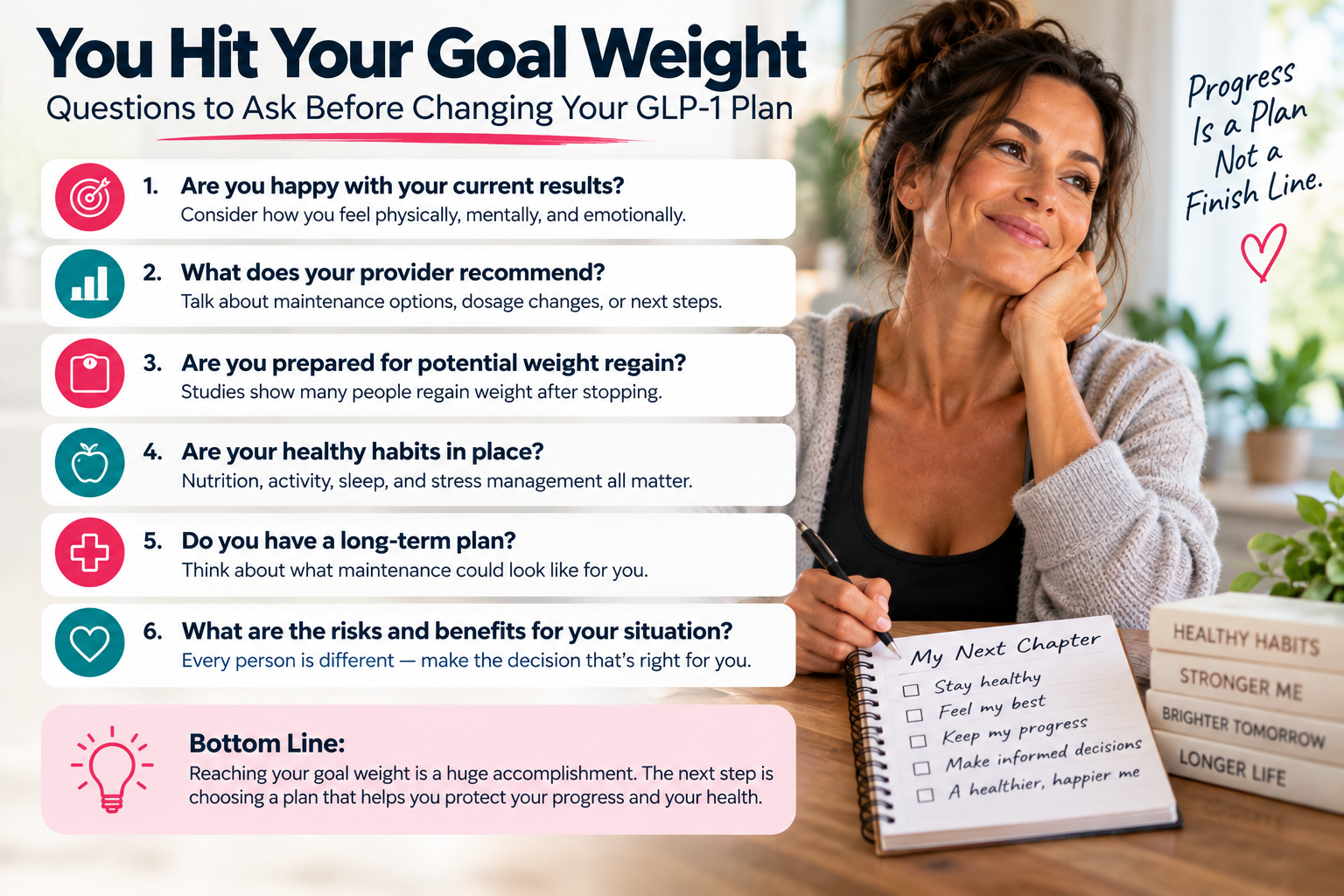
Before deciding you’re “done,” ask yourself — and your provider — these questions:
Why do I want to change my treatment?
Is it because you’ve reached your goal?
Or because of cost, side effects, insurance, pregnancy plans, medication fatigue or something else?
What is the goal now?
Do you want to maintain a range? Improve strength? Keep blood sugar controlled? Continue improving another health condition?
What happens if my appetite changes?
What should you watch for, and when should you contact your provider?
How will we monitor my weight and health?
Not obsessively.
Just enough to notice a meaningful trend before it becomes a much bigger problem.
Does this medication treat anything besides my weight?
Diabetes, cardiovascular risk and other conditions can change the decision significantly.
What is our backup plan?
If the first maintenance approach doesn’t work, what comes next?
That’s the conversation we’d want to have before changing treatment.
Not three months later while wondering where everything went wrong.
The Bottom Line
Reaching your goal weight on a GLP-1 is worth celebrating.
You worked for it.
But there is an important difference between reaching a weight and maintaining a result.
Research increasingly shows that GLP-1 treatment withdrawal is followed by substantial average weight regain for many people. At the same time, scientists still don’t have a universally proven formula for tapering, spacing doses or transitioning every patient off treatment.
Which means your next move shouldn’t come from TikTok, Reddit, a Facebook group — or even an article like this one.
Use those places to discover the questions.
Then make the medical decision with someone who understands your health.
You reached your goal weight.
That’s a hell of an accomplishment.
Now the goal changes:
How do we help you keep the progress you’ve made?
Frequently Asked Questions
Can I stop taking a GLP-1 after reaching my goal weight?
Some people can stop GLP-1 treatment, but reaching goal weight by itself doesn’t determine whether stopping is the right choice. Withdrawal studies have found significant average weight regain after semaglutide and tirzepatide were discontinued. Your medical history, reason for treatment, side effects, cost and other factors should be part of the decision.
Will I regain all the weight if I stop?
Not necessarily.
A 2026 systematic review estimated that about 60% of lost weight had been regained one year after GLP-1 treatment stopped. That is an average across study participants — not a prediction of what will happen to every individual.
Should I taper my GLP-1 instead of stopping it suddenly?
There is not yet a validated, standardized tapering strategy proven by strong randomized evidence to prevent weight regain after GLP-1 discontinuation. Dose reduction and extended dosing approaches are being studied, but treatment changes should be individualized with your prescriber rather than copied from someone else’s regimen.
Is there a maintenance dose for GLP-1 medications?
It depends on the medication. FDA-approved drugs have their own dosing instructions.
For example, Zepbound’s prescribing information lists 5 mg, 10 mg and 15 mg once weekly as maintenance doses for weight reduction and long-term maintenance in adults, with treatment response and tolerability considered when selecting a dose. That does not mean one dose is right for everyone.
Sources
For this article I’d list these at the bottom of the page:
Wilding JP, et al. Weight regain and cardiometabolic effects after withdrawal of semaglutide: The STEP 1 trial extension. Diabetes, Obesity and Metabolism, 2022.
Horn DB, et al. Cardiometabolic Parameter Change by Weight Regain on Tirzepatide Withdrawal in Adults With Obesity: A Post Hoc Analysis of the SURMOUNT-4 Trial. JAMA Internal Medicine, 2026.