
GLP-3 vs GLP-1 sounds like a simple comparison. You’ve probably heard about GLP-1 medications like Ozempic and Wegovy. Now you may be hearing people talk about something called “GLP-3.”
You’ve probably heard about GLP-1 medications such as Ozempic, Wegovy, Mounjaro and Zepbound.
Now another term is starting to show up online:
GLP-3.
It sounds like the next generation of GLP-1 drugs. Maybe even something three times stronger.
There’s just one problem.
There really isn’t a “GLP-3.”
At least not in the way the name makes it sound.
“GLP-3” is an unofficial nickname people are using for drugs that target three hormone receptors instead of one. The drug getting most of the attention is retatrutide, an experimental medication from Eli Lilly.
And yes, the clinical-trial results have gotten people’s attention.
But before anyone starts searching for a “GLP-3” online, there’s something much more important to understand:
Retatrutide is still investigational. It is not FDA approved.
Article at a Glance
- “GLP-3” isn’t an official medical term. It’s an informal nickname being used for triple-agonist drugs such as retatrutide.
- Retatrutide targets three receptors: GLP-1, GIP and glucagon.
- Semaglutide targets GLP-1, while tirzepatide targets GLP-1 and GIP.
- Retatrutide has produced substantial weight loss in Phase 3 trials, including an average 28.7% reduction in body weight at the 12-mg dose in one study involving people with obesity or overweight and knee osteoarthritis.
- Retatrutide is not FDA approved as of September 2026, and FDA says it cannot be used in compounding under federal law.
- Nobody can honestly tell you yet that a “GLP-3” is simply better than today’s approved GLP-1 or dual-agonist medications.
Quick Answer: What’s the Difference Between GLP-3 and GLP-1?
A GLP-1 medication works through the GLP-1 receptor. Semaglutide, the active ingredient in Ozempic and Wegovy, is an example.
What people are calling a “GLP-3” isn’t actually GLP-3 at all.
They’re usually talking about retatrutide, an investigational drug that activates three receptors: GLP-1, GIP and glucagon.
That’s why scientists describe retatrutide as a triple agonist.
It has produced impressive results in clinical trials, but there’s a major difference that shouldn’t get buried underneath those numbers:
Semaglutide and tirzepatide are FDA-approved medications. Retatrutide isn’t.
First Things First: Is GLP-3 Even Real?
This is where much of the confusion starts.
GLP-1 is real.
GLP-2 is also real.
But that doesn’t mean GLP-3 is the next step in some progression.
Eli Lilly itself now describes “GLP-3” as a scientifically inaccurate informal label being used for triple hormone receptor agonists such as retatrutide.
In other words, the name caught on because it’s easy to understand.
Unfortunately, it’s also misleading.
Truth or Hype?
“GLP-3 Is the Next Generation After GLP-1.”
HYPE.
This isn’t an iPhone upgrade where GLP-3 comes after GLP-2 and must therefore be better than GLP-1.
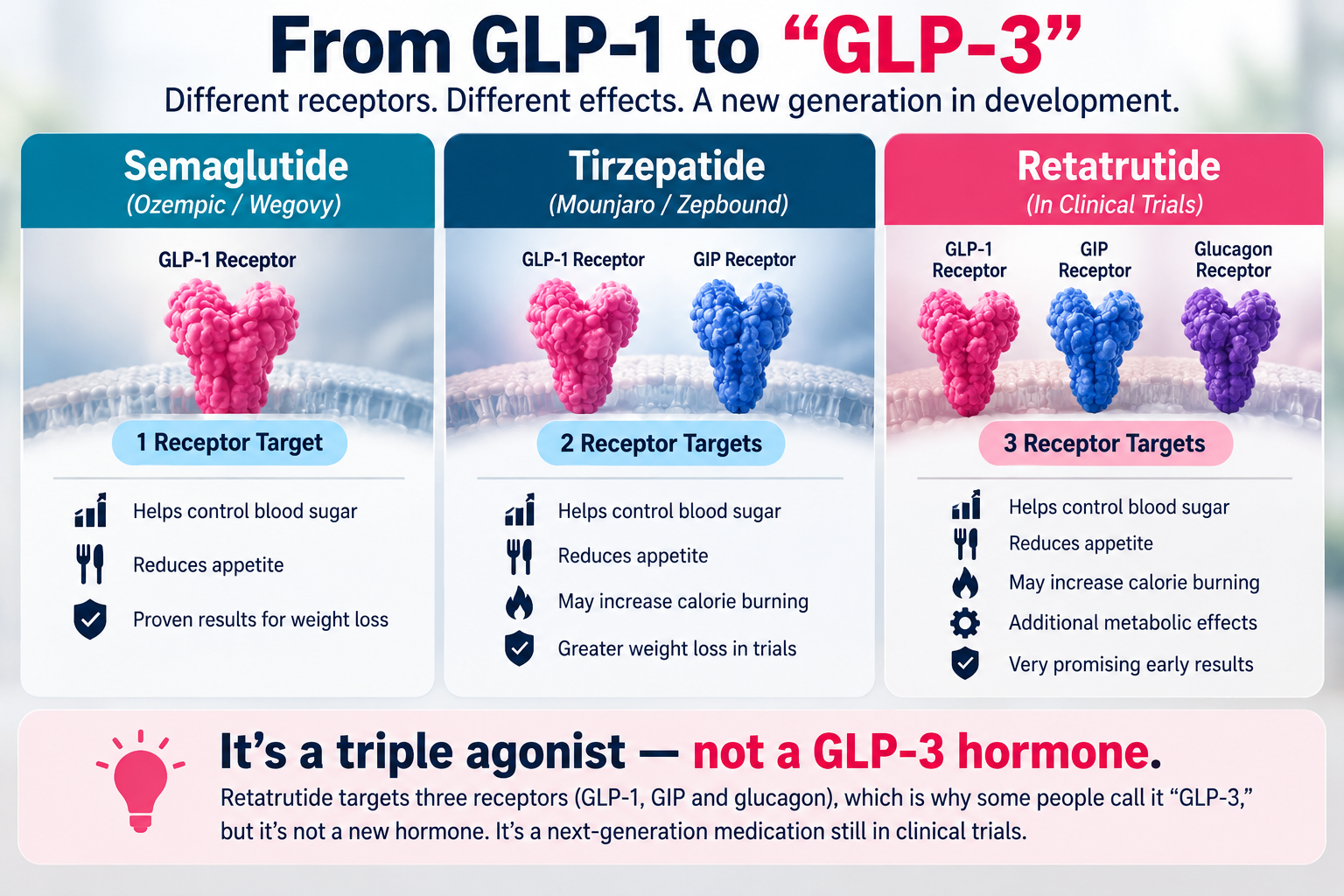
The “three” people are talking about refers to the three receptors targeted by retatrutide:
GLP-1 + GIP + glucagon
That’s very different from discovering a new hormone called GLP-3.
And it matters because calling retatrutide “GLP-3” can make an experimental drug sound more established than it really is.
So What Is Retatrutide?
Retatrutide is an investigational once-weekly medication being developed by Eli Lilly.
Instead of targeting one receptor, as semaglutide does, or two receptors, as tirzepatide does, retatrutide targets three:
GLP-1 + GIP + glucagon
You may hear this described as a triple agonist or triple hormone receptor agonist.
That’s the more accurate terminology.
The easiest way to understand the progression is:
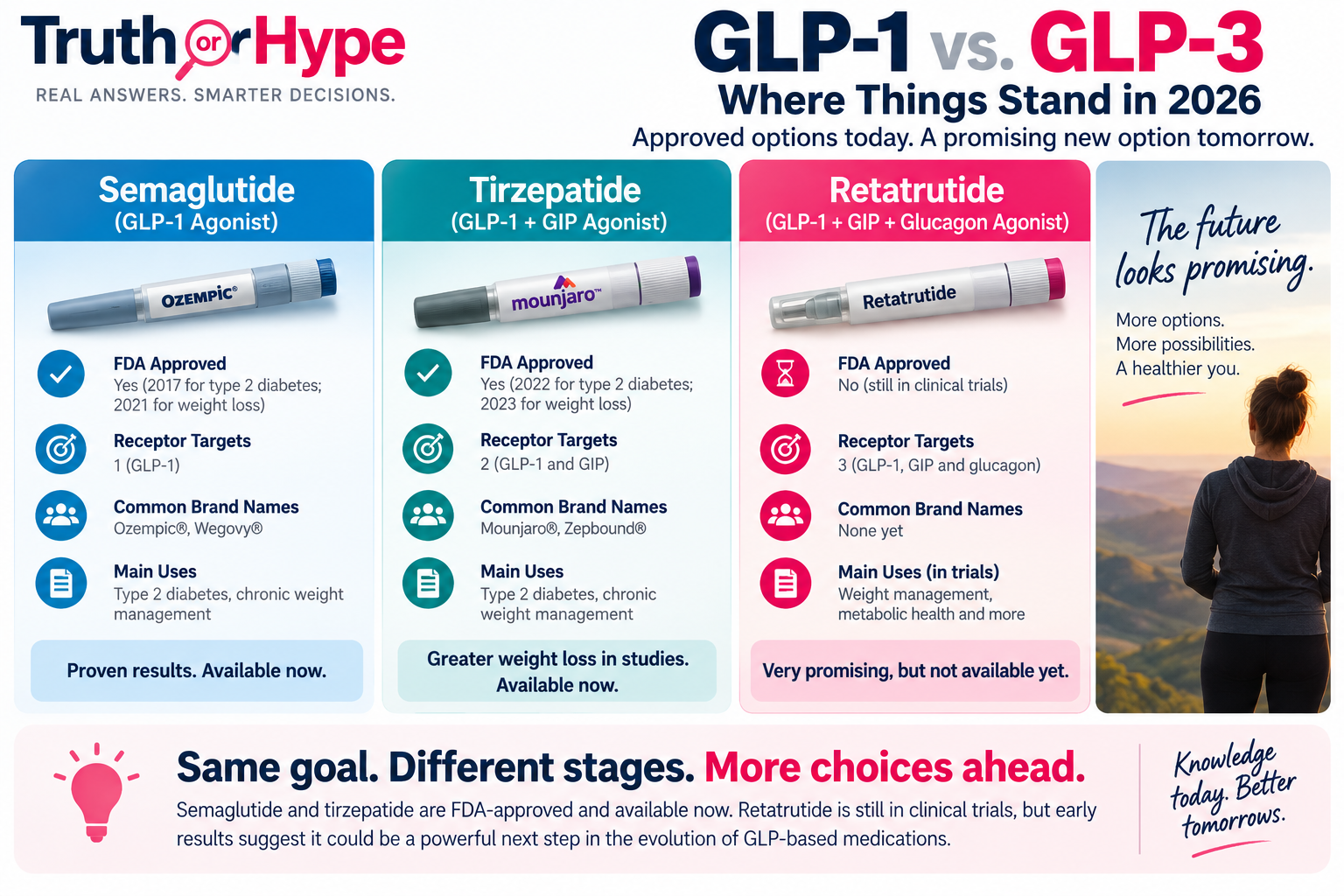
| Medication | What It Targets | FDA Status |
|---|---|---|
| Semaglutide | GLP-1 | Approved |
| Tirzepatide | GLP-1 + GIP | Approved |
| Retatrutide | GLP-1 + GIP + glucagon | Investigational — not approved |
Notice what’s missing from that table?
GLP-3.
That’s because retatrutide doesn’t target a mysterious third GLP hormone. It adds activity at the glucagon receptor.
Why Add a Third Receptor?
This is where the science can get complicated very quickly, so we’ll keep it simple.
GLP-1, GIP and glucagon are involved in different parts of appetite, blood sugar and how the body handles energy.
Researchers are studying whether targeting all three receptors with one medication can produce greater metabolic effects than targeting one or two.
That’s the idea.
But three receptors doesn’t mean three times the benefit.
The effects of these receptors interact, and researchers are still learning what that combination could mean over long-term treatment.
So when you see someone online saying:
“GLP-3 is three times stronger than GLP-1.”
That’s not how this works.
What Have Retatrutide Trials Actually Found?
This is where things get interesting.
An earlier Phase 2 obesity trial published in the New England Journal of Medicine found an average 24.2% weight reduction at 48 weeks among participants receiving the 12-mg dose.
But research has moved considerably beyond that study.
Retatrutide is only one of several major developments we’ve been following in our look at the biggest GLP-1 changes of 2026.
In December 2025, Lilly announced results from the Phase 3 TRIUMPH-4 trial involving adults with obesity or overweight and knee osteoarthritis who did not have diabetes.
Participants receiving 12 mg of retatrutide lost an average 28.7% of their body weight at 68 weeks under the study’s efficacy analysis.
Then came more Phase 3 results.
In TRIUMPH-1, participants without diabetes receiving 12 mg lost an average 28.3% of their body weight over 80 weeks.
And in TRANSCEND-T2D-1, involving adults with type 2 diabetes, retatrutide lowered A1C by up to an average 2.0 percentage points and body weight by up to an average 16.8% at 40 weeks.
Those are substantial results.
They also explain why you’re suddenly hearing so much about retatrutide.
Does That Mean Retatrutide Is Better Than Ozempic or Wegovy?
We don’t think the evidence supports saying that yet.
This is where big percentages can get people into trouble.
You can’t simply take the weight-loss percentage from one retatrutide trial, put it next to the percentage from a semaglutide trial and declare a winner.
The same principle applies when comparing today’s GLP-1 providers—we focus on the tradeoffs rather than declaring one option best for everyone.
Those studies may involve different people, different treatment lengths, different doses and different methods of analyzing results.
That’s not the same thing as putting the drugs against each other in the same randomized trial.
Retatrutide’s results deserve attention.
But promising isn’t the same thing as proven better for everyone.
That’s an important distinction.
What About Tirzepatide?
This comparison is especially interesting because tirzepatide already targets more than one receptor.
Tirzepatide—the active ingredient in Mounjaro and Zepbound—targets:
GLP-1 + GIP
Retatrutide adds a third:
GLP-1 + GIP + glucagon
So the more accurate progression isn’t:
GLP-1 → GLP-2 → GLP-3
It’s closer to:
Single agonist → dual agonist → triple agonist
That’s not nearly as catchy on social media.
But it’s a lot more accurate. 😂
What Side Effects Have Been Seen With Retatrutide?
Retatrutide hasn’t magically escaped the gastrointestinal side effects associated with this broader family of medications.
In the Phase 2 obesity trial, the most common adverse events were gastrointestinal and were mostly mild to moderate. Researchers also observed dose-dependent increases in heart rate that peaked during the study and later declined.
Phase 3 studies are providing considerably more information about safety and tolerability, but retatrutide remains investigational.
That’s one reason FDA approval matters.
Approval isn’t simply someone at FDA looking at the weight-loss number and saying, “Looks good.”
Regulators evaluate a much larger package of evidence about a drug’s benefits, risks, manufacturing and appropriate use before approving it.
Is Retatrutide FDA Approved?
No.
As of September 2026, retatrutide has not been approved by FDA or any other regulatory agency, according to Lilly.
That remains true despite the successful Phase 3 results you’ve probably seen discussed online.
This distinction is worth repeating:
Successful Phase 3 trial ≠ FDA-approved medication.
A drug can produce positive Phase 3 results and still remain investigational while development and regulatory review continue.
Can You Buy “GLP-3” or Retatrutide Right Now?
This may be the most important section of this article.
Because if you search long enough online, you’ll probably find somebody willing to sell you something labeled retatrutide, “GLP-3,” “Reta” or some variation of those names.
That doesn’t mean it’s an approved medication.
FDA says retatrutide cannot be used in compounding under federal law. The agency also says retatrutide is not a component of an FDA-approved drug and has not been found safe and effective for any condition.
If you’re wondering how FDA approval differs from compounded GLP-1 medications that are already being sold, we break that down in our guide to compounded vs. brand-name GLP-1 drugs.
FDA has warned companies marketing unapproved products containing retatrutide, including products sold directly to consumers.
Lilly likewise warns consumers not to use products claiming to be retatrutide outside of its sponsored clinical trials.
That’s a giant red flag.
If a website makes something look official by calling it “GLP-3,” that doesn’t change its regulatory status.
A new name doesn’t turn an unapproved product into an approved drug.
Truth or Hype?
“I Found Retatrutide for Sale Online, So It Must Be Available Now.”
HYPE.
Finding something for sale online tells you one thing:
Someone is willing to sell it to you.
It doesn’t tell you what’s actually in the vial.
It doesn’t tell you whether the dose is accurate.
And it certainly doesn’t mean FDA approved it.
That’s exactly the kind of distinction we think consumers deserve to know before money—or medication—changes hands.
Should You Switch From a GLP-1 to a “GLP-3”?
No—not based on what exists today.
There isn’t an FDA-approved “GLP-3” medication you can simply switch to.
Retatrutide is still investigational.
If you’re currently using semaglutide, tirzepatide or another approved medication and aren’t getting the results you expected, that’s a conversation to have with your healthcare provider.
Cost can also affect that decision, especially when the price you see advertised isn’t the full amount you’ll actually pay.
Our GLP-1 medication cost guide breaks down what consumers should look for.
Buying an unapproved product online because its clinical-trial numbers look better is an entirely different decision—and one with risks that are easy to overlook when social media is focused almost entirely on weight-loss percentages.
Could Retatrutide Eventually Change Weight-Loss Treatment?
Absolutely possible.
The Phase 3 results we’ve seen so far are substantial enough to make retatrutide one of the most interesting obesity drugs in development.
But we don’t need to predict the ending before we get there.
More trial results are being reported, additional studies remain underway, and regulatory decisions still matter. Lilly says Phase 3 data have now been disclosed from five retatrutide trials, with additional studies continuing across obesity, type 2 diabetes and related conditions.
If retatrutide eventually receives FDA approval, we’ll know much more about who it’s approved for, recommended dosing, warnings, contraindications and how clinicians should actually use it.
Until then, investigational is the important word.
What We’d Check Before Believing a “GLP-3” Claim
When you see a GLP-3 or retatrutide claim online, ask a few simple questions:
- Are they actually talking about retatrutide?
- Are they explaining that “GLP-3” is an informal nickname rather than an official drug class?
- Are they telling you retatrutide is not FDA approved?
- Are they quoting results from a real clinical trial—or simply repeating a number from social media?
- Are they comparing different trials as though they were head-to-head studies?
- Most importantly: are they trying to sell you retatrutide right now?
That last question deserves particular attention.
There’s a big difference between reporting on an experimental medication and selling one to consumers.
Bottom Line
“GLP-3” sounds like the obvious successor to GLP-1.
It isn’t.
It’s an unofficial and scientifically inaccurate nickname commonly being used for triple-agonist drugs, particularly retatrutide.
Retatrutide targets GLP-1, GIP and glucagon receptors, and its clinical-trial results have been impressive. Phase 3 studies have reported substantial weight reduction, including average reductions above 28% in certain study populations and analyses.
But there’s another fact that’s even more important today:
Retatrutide is not FDA approved.
So is “GLP-3” better than GLP-1?
We don’t have enough evidence to give you a simple yes.
What we can tell you is that retatrutide is a genuinely interesting investigational drug with strong clinical-trial results.
That’s exciting enough.
We don’t need to turn it into something it isn’t.
Frequently Asked Questions
Is GLP-3 a real drug?
Not exactly. “GLP-3” is an informal nickname sometimes used for drugs that target three hormone receptors. It isn’t an official scientific classification. When people talk about GLP-3 today, they’re often referring to the investigational drug retatrutide.
Is retatrutide FDA approved?
No. As of September 2026, retatrutide remains investigational and is not FDA approved. FDA also says retatrutide cannot be used in compounding under federal law.
Is retatrutide better than semaglutide or tirzepatide?
Retatrutide has produced substantial weight loss in clinical trials, but that doesn’t establish that it’s better for an individual patient. Cross-trial comparisons have important limitations, and retatrutide is still investigational. Its eventual place in treatment will become clearer as the evidence and regulatory process develop.
Sources
For this article, I would use primarily:
- Eli Lilly — current retatrutide development and “GLP-3” explanation.
- FDA — concerns about unapproved GLP-1 drugs and retatrutide; FDA’s statement that retatrutide cannot be used in compounding.
- New England Journal of Medicine — retatrutide Phase 2 obesity trial.