By Dan Brown · Published September 15, 2026
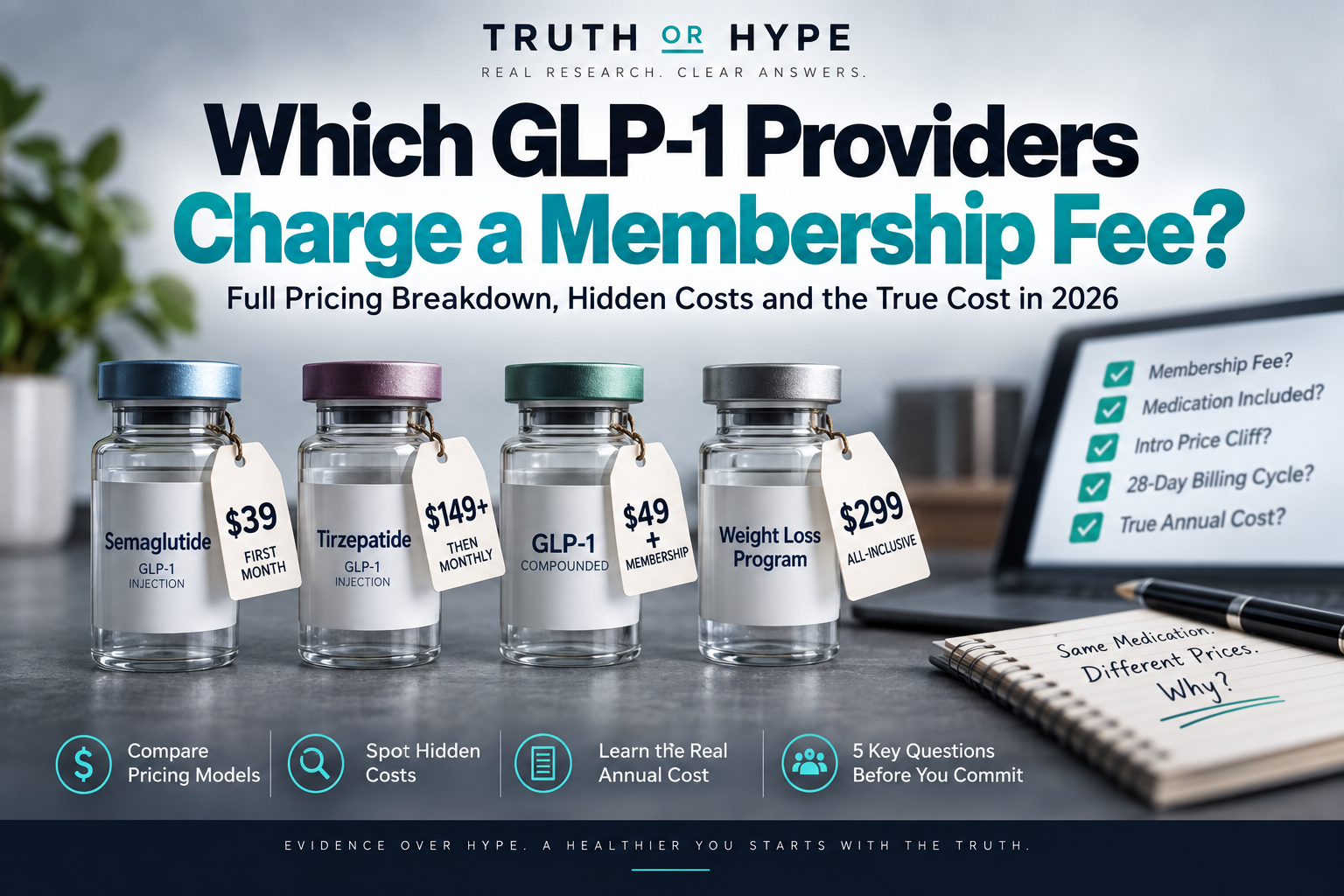
Quick Answer: GLP-1 provider membership fees vary depending on how each telehealth company structures its program.
Some providers charge a recurring membership fee in addition to the medication, while others bundle medication and care into one price or charge per visit.
That doesn’t automatically make one model better than another. The important question is much simpler:
What will you actually pay after the introductory offer ends—and what are you getting for that money?
That’s where GLP-1 pricing can get confusing.
Article at a Glance
- Some major GLP-1 providers charge a monthly membership plus medication.
- Others bundle medication and clinical care into one recurring price.
- A low introductory price can be very different from your ongoing monthly cost.
- Some of the lowest advertised prices require paying several months—or even a year—in advance.
- A membership fee isn’t necessarily bad. What matters is the total cost, what’s included, and whether it’s clearly disclosed before you sign up.
- Always calculate the cost of the whole program, not just the biggest number in the advertisement.
The Medication Price Isn’t Always the Price of the Program
When you’re shopping for GLP-1 treatment online, it’s easy to compare the big numbers.
$39.
$99.
$149.
$299.
But those numbers don’t always represent the same thing.
One provider may be advertising its membership fee.
Another may be advertising the medication only.
Another may include the medication, provider visits, shipping and ongoing support in one price.
And another may show you a low monthly equivalent that is only available if you pay for several months in advance.
That’s why comparing GLP-1 providers by headline price alone can be misleading.
We looked at this problem more closely in Why That $99 GLP-1 Price May Not Be What You Actually Pay, including some of the costs that can get lost behind an advertised starting price.
Before deciding whether one provider is cheaper than another, you need to know what that number actually buys you.
The Three GLP-1 Pricing Models You’ll Commonly See
Most telehealth GLP-1 programs we reviewed fall into one of three broad categories.
1. Membership Plus Medication
You pay a recurring fee for access to the telehealth program, providers and other services.
The medication is then charged separately.
That doesn’t necessarily mean you’re being overcharged.
The membership may include things you value, such as provider messaging, insurance assistance, coaching, side-effect management or other ongoing support.
But you need to add both numbers when calculating your real cost.
2. Medication and Care Bundled Together
Other providers combine medication, provider oversight and certain other services into one recurring price.
That’s easier to understand, but don’t automatically assume it’s cheaper.
You still need to check exactly what’s included, whether the advertised price changes after the first month, whether higher doses cost more, and whether getting the lowest price requires prepayment.
3. Pay Per Visit
A third model skips the monthly subscription altogether.
Instead, you pay when you need a consultation or follow-up visit, while medication is purchased separately.
That can make sense for someone who doesn’t want another monthly subscription, although the total cost depends on how frequently follow-up care is needed.
Which GLP-1 Providers Charge a Membership Fee?
Here is what we found from current provider pricing information in September 2026.
GLP-1 provider membership fees only tell part of the story, so we’ve also included whether medication is separate and any important pricing details we found.
| Provider | Membership | Medication | Important Detail |
|---|---|---|---|
| Ro | $39 first month; $149/mo month-to-month | Separate | $74/mo membership requires annual prepayment |
| Hims | $39 first month; $149/mo after | Separate | Active membership required for its GLP-1 program |
| Eden | $39 first month; $99/mo after | Separate | Advertised medication prices do not include membership |
| Lemonaid | $49/mo | Separate | Membership covers ongoing treatment support |
| Walgreens | None | Separate | $49 per visit instead |
| MEDVi | No separate membership advertised | Included in program price | Injectable offer currently $179 first month, then $299/mo |
| Willow | No separate membership shown | Bundled with treatment program | Compounded semaglutide currently $299/mo |
| PlexusDx | None | Bundled | Current protocols advertised from $129–$279/mo |
Prices and programs change frequently. These figures reflect provider-published information we reviewed in September 2026 and may vary by medication, dose, plan, eligibility, insurance status or commitment length.
Membership fees are only one part of choosing a provider. Our Best GLP-1 Providers of 2026: Side-by-Side Comparison looks at pricing, medication options, insurance help, support and the other tradeoffs worth considering.
That’s already a much different picture from simply asking:
“Who’s cheapest?”
Let’s look at what you’re actually paying for.
Ro: Membership Plus Medication
Ro’s current weight-loss program charges $39 for the first month of membership.
After that, the standard month-to-month membership is $149 per month.
Ro also advertises membership as low as $74 per month, but there’s an important detail: that rate requires a 12-month prepaid plan. Ro also offers intermediate prepaid options.
Medication is not included in the membership price.
The membership includes services such as provider support, insurance assistance, side-effect management, dose adjustments, coaching and other program features.
So neither “$39” nor “$74” tells you what your complete treatment will cost.
You need to add the medication cost—or insurance copay, if applicable—to the membership.
That’s not inherently good or bad.
It’s simply the math you need before comparing Ro with another provider.
Hims: $39 to Start, Then $149 Plus Medication
Hims currently charges $39 for the first month of its Weight Loss Membership and $149 per month afterward.
Medication is not included.
The membership includes access to the care team, provider messaging, treatment support, weight tracking and other program benefits.
Again, that means someone comparing Hims with an all-inclusive provider shouldn’t compare the other provider’s complete price against Hims’ $39 introductory membership.
They’re two different numbers representing two different things.
You need the membership + medication to make a meaningful comparison.
Eden: Membership and Medication Are Two Separate Prices
Eden currently advertises compounded semaglutide at $99 per month and compounded tirzepatide at $199 per month.
But those numbers are medication prices.
An active Eden membership is also required.
The membership costs $39 for the first month and automatically renews at $99 per month thereafter, according to Eden’s current published pricing.
That makes Eden a perfect example of why you should read what the advertised number represents.
A “$99/month” medication doesn’t necessarily mean a $99/month program.
Lemonaid: $49 Monthly Support Fee Plus Medication
Lemonaid currently charges $49 per month for ongoing weight-loss treatment support.
Medication is billed separately.
Its published information currently lists different prices depending on the medication and whether the patient chooses monthly or multi-month purchasing.
Lemonaid says the membership includes ongoing treatment support and one lab order per year.
Again, that’s why membership fees shouldn’t automatically be labeled “junk fees.”
The right question is:
What am I getting for it—and what’s my total bill?
What About Providers Without a Monthly Membership?
No membership doesn’t necessarily mean no additional costs.
It simply means the pricing structure is different.
Walgreens: Pay When You Need a Visit
Walgreens Weight Management takes an interesting approach.
There’s no monthly subscription.
Instead, initial video visits currently cost $49, and follow-up chat or additional video visits are $49 each. Medication is separate.
That gives consumers another model to consider:
Don’t pay every month simply for access. Pay for clinical visits when you need them.
Whether that ends up cheaper depends partly on how much ongoing care you need.
MEDVi: One Program Price
MEDVi says its monthly price includes medication, supplies, doctor review and shipping rather than adding a separate membership charge.
Its current site advertises injectable GLP-1 treatment at $179 for the first month and $299 per month afterward.
Notice something important here.
There’s still an introductory price change.
That’s why “no membership fee” doesn’t automatically mean “the advertised price never changes.”
Willow: Medication + Treatment Program
Willow currently advertises compounded semaglutide at $299 per month, describing that price as its medication plus treatment program.
Its program includes physician prescribing, medication delivery and ongoing follow-up care.
Again, it’s a different pricing structure—not automatically a better or worse one.
PlexusDx: No Separate Membership
PlexusDx currently advertises no separate membership fee and says consultation, prescription, compounded medication, shipping and ongoing provider monitoring are included.
Its current published protocols range from $129 to $279 per month, depending on the protocol and pricing tier.
And here’s where Wordform almost got us into trouble.
Yes, that’s a relatively simple pricing structure.
But simple pricing does not automatically make PlexusDx the best provider.
It tells us one thing:
How its pricing works.
That’s all we’re trying to establish in this article.

Watch Out for the Introductory-Price Trap
This may be more important than whether a provider charges a membership at all.
Suppose you see:
“Start for $39.”
There’s nothing necessarily wrong with that offer.
The problem comes when your brain translates it into:
“This costs $39 a month.”
Those aren’t the same statement.
Ro currently goes from a $39 introductory membership to $149/month if you remain month-to-month.
Hims currently goes from $39 to $149/month.
Eden’s membership currently goes from $39 to $99/month.
MEDVi doesn’t charge a separate membership but still advertises a lower introductory injectable price before the ongoing price begins.
So the problem isn’t memberships.
The problem is comparing introductory prices as though they were ongoing costs.
“As Low As $74/Month” Can Also Mean Paying a Lot Upfront
There’s another phrase worth slowing down for:
“As low as…”
Ro provides a good example.
Its membership can cost the equivalent of $74/month—but getting that rate currently requires paying for a 12-month membership upfront. The ordinary monthly option is $149/month.
Neither price is fake.
But they represent very different commitments.
That’s why we recommend looking for three numbers whenever you see a monthly price:
What do I pay today?
What do I pay after the introductory period?
How much money must I commit upfront to get the advertised rate?
Those three answers tell you far more than the headline.
Five Questions to Ask Before Giving Any GLP-1 Provider Your Credit Card
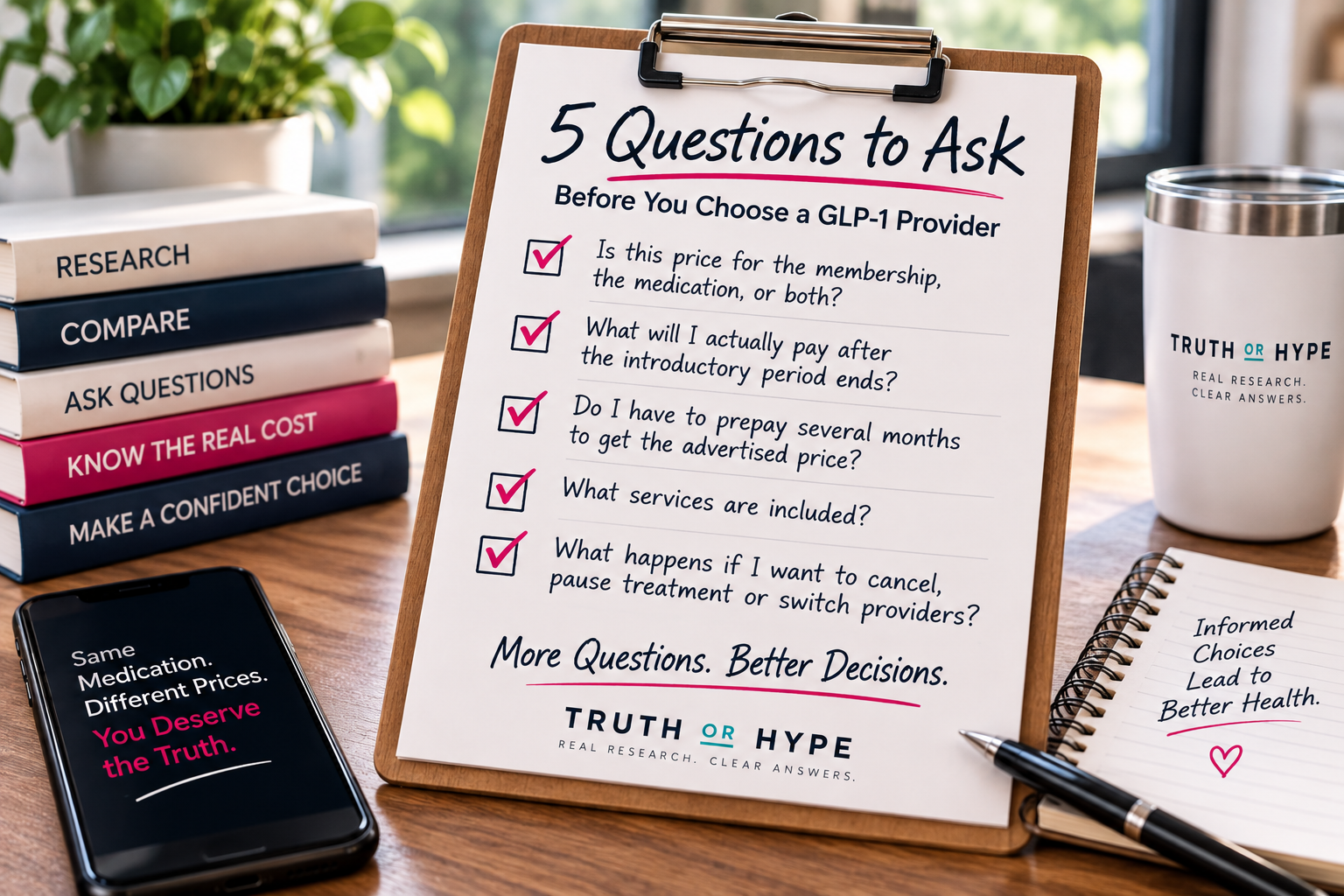
Before signing up, find answers to these:
- Is this price for the membership, the medication, or both?
- What will I actually pay after the introductory period ends?
- Do I have to prepay several months to get the advertised price?
- What services does the membership or program fee actually include?
- What happens if I want to cancel, pause treatment or switch providers?
I’d add one unofficial sixth question:
Can I understand all of this without needing a calculator, three browser tabs and a law degree?
If not, keep reading before entering the credit-card number.
Truth or Hype?
Hype: A provider with no membership fee is automatically cheaper.
Not necessarily.
A provider could charge no membership fee and still have a higher total cost.
Hype: A monthly membership fee means the provider is ripping you off.
Also not necessarily.
That membership might pay for provider access, coaching, insurance assistance, monitoring or services you actually value.
Truth: You need the total ongoing cost to make a fair comparison.
That’s the number that matters.
Membership.
Medication.
Required visits.
Labs, if they’re additional.
Shipping, if it’s additional.
Dose-related price increases.
And any prepayment required to qualify for the advertised rate.
Put those pieces together and then compare providers.
That’s how you get from the advertised price to the price you’re actually likely to pay.
What We’d Check Before Choosing
If we were comparing two GLP-1 providers with similar medications and clinical options, we wouldn’t automatically choose the one without a membership.
We’d ask:
What is our total expected cost?
Then we’d look at what each program provides for that money.
One person might value insurance assistance and frequent provider access enough to pay a membership fee.
Someone else paying cash might care more about having one predictable bill.
Another person may prefer paying per visit because they don’t want a subscription at all.
Those aren’t right or wrong choices.
They’re tradeoffs.
And you can’t evaluate the tradeoffs until you know what you’re actually buying.
The Bottom Line
Don’t choose a GLP-1 provider based on whether the word “membership” appears on the bill.
And don’t assume the provider advertising the lowest number is necessarily the cheapest.
Instead, figure out:
Your ongoing membership cost + your medication cost + any other required charges = your real cost.
Then look at what you’re receiving for that money.
If you want the bigger pricing picture, our GLP-1 Medication Costs 2026 guide breaks down brand-name pricing, self-pay options, insurance and other costs that can affect what you actually spend.
That’s the comparison that matters.
Because when you’re considering a treatment that may continue for months or longer, a small difference in monthly pricing can become a much bigger difference over time.
We don’t care which company you choose. We care that you know what you’re choosing.
Frequently Asked Questions
Do all GLP-1 telehealth providers charge a monthly membership?
No. Some providers charge a recurring membership plus medication, some bundle care and medication into one price, and others use a pay-per-visit model.
The important comparison is total ongoing cost and what’s included.
Is a GLP-1 membership fee a hidden fee?
Not if it’s clearly disclosed. A membership fee becomes a consumer concern when someone could reasonably mistake an advertised medication or introductory price for the complete ongoing cost.
Always check whether medication is included.
What’s the best way to compare GLP-1 provider prices?
Compare the ongoing cost after introductory offers, not just month one. Include membership fees, medication, required visits, shipping or labs when applicable, and determine whether the advertised rate requires several months of prepayment.